

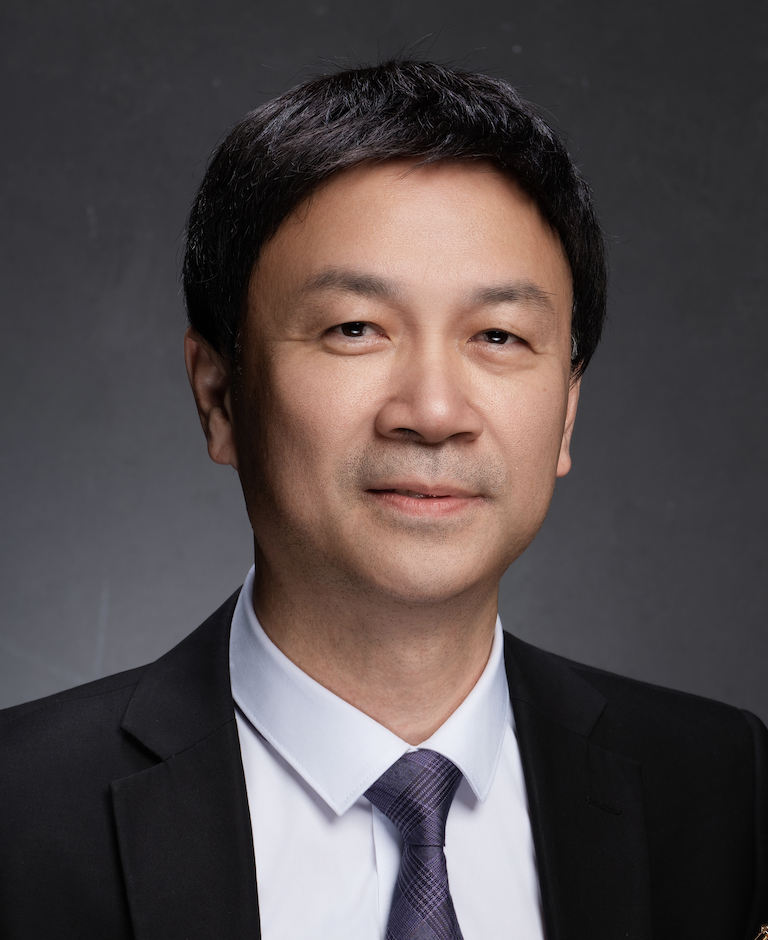
 Bin Xu
· 1 previous affiliation
- Tsinghua UniversityCurrent
- Current
- Full Professor · 2022–2026
- Associate Professor · 2006–2022
- PhD student · 1999–2006
- MS student · 1996–1998
- Undergrad student · 1991–1996
5 other authors named Bin Xu: Bin Xu (Chinese Academy of Sciences · 5 papers), Bin Xu (4 papers), BIN XU (Arizona State University · 2 papers), Bin Xu (1 paper), Bin Xu (Dà-Jiāng Innovations Science and Technology (China) · 1 paper)
Research Overview
Bin Xu focuses on natural language processing, information extraction, and the development of large language model agents. His early research explored web service composition and active learning for networked data before shifting toward event detection and robust knowledge extraction. Currently, his work emphasizes aligning language models for complex instruction following, multi-agent reasoning, and personalized educational applications.
Research Trajectory
Xu's early research investigated the architecture and composition of web services. This included foundational work on A Semantic Matchmaker for Ranking Web Services (2006) and subsequent methodologies for data-driven service composition in Service Data Correlation Modeling and Its Application in Data-Driven Service Composition (2010). Expanding into the area of learning from interconnected and relational data, he introduced MaxCo, an active learning framework detailed in Active learning for networked data based on non-progressive diffusion model (2014). By framing active learning as a minimum source set problem, this approach optimized the selection of samples for labeling across social network datasets.
Moving into natural language processing, Xu focused heavily on event detection and the robustness of information extraction systems. To address the long-tail problem in event detection, he developed an Enrichment Knowledge Distillation model in Improving Event Detection via Open-domain Trigger Knowledge (2020). This work contributed to broader efforts in mitigating lexical memorization for robust generalization and unifying heterogeneous label spaces for universal perception. He further addressed data sparsity in this domain by co-developing a Lattice LSTM-based multi-task learning model in Improving Low-Resource Chinese Event Detection with Multi-task Learning (2021). As principal investigator, he later established a new benchmark for evaluating the real-world reliability of these systems in Preserving Knowledge Invariance: Rethinking Robustness Evaluation of Open Information Extraction (2023), shifting the evaluation focus from simple pairwise matching to syntactic and expressive distribution shifts.
In recent years, Xu's trajectory has aligned with the rapid advancement of large language models (LLMs) and multimodal architectures. He participated in the development of CogVLM: Visual Expert for Pretrained Language Models (2024), a collaborative effort that injected trainable weights into frozen language models. This research touched on several critical areas, including preserving pretrained intelligence during multimodal alignment, overcoming the memory wall in mixture of experts, and connecting frozen backbones via lightweight adapters to bridge the modality gap in contrastive vision-language models. Concurrently, he contributed to a comprehensive theoretical framework for negative sampling across various machine learning domains in Does Negative Sampling Matter? a Review With Insights Into its Theory and Applications (2024).
A major theme in Xu's most recent work is improving how LLMs follow complex instructions and operate as autonomous agents. To advance the area of improving adherence to complex multi-constraint instructions, he co-authored Constraint Back-translation Improves Complex Instruction Following of Large Language Models (2025), introducing a cost-effective dataset generation method. He also helped establish formal evaluation metrics for these capabilities in AGENTIF: Benchmarking Large Language Models Instruction Following Ability in Agentic Scenarios (2025). This focus on agentic behavior extends to specialized generative tasks, such as long-form narrative creation in StoryWriter: A Multi-Agent Framework for Long Story Generation (2025) and the subsequent investigation of verbosity bias in large language model evaluation in StoryAlign: Evaluating and Training Reward Models for Story Generation (2026). Pushing the boundaries of autonomous reasoning, he contributed to WebSeer: Training Deeper Search Agents through Reinforcement Learning with Self-Reflection (2026). This work explored iterative reasoning and retrieval for multi-hop tasks, utilizing reinforcement learning for concise reasoning alignment to enable search agents to autonomously correct their own errors.
Parallel to his core NLP research, Xu has consistently applied AI to educational technology and knowledge augmentation. Building on his earlier work with MOOCCubeX: A Large Knowledge-centered Repository for Adaptive Learning in MOOCs (2021), he recently explored data driven personalization in intelligent education ecosystems. In Learning in Context: Personalizing Educational Content with Large Language Models to Enhance Student Learning (2025), he introduced the PAGE framework, which uses retrieval-augmented generation to tailor lecture materials to individual student interests. This research contributes to scaling personalized instruction with intelligent virtual tutors and sustaining engagement beyond the gamification novelty effect. Additionally, he has investigated how LLMs can serve as context augmenters for specialized tasks, such as disambiguating entities with shared names in retrieval, detailed in LLMAEL: Large Language Models are Good Context Augmenters for Entity Linking (2025).
Current Directions
Based on the most recent papers in the evidence, Xu's current research investigates the alignment and application of large language models in complex, multi-step scenarios. A primary focus is the development of LLM-based agents capable of autonomous web search, self-reflection, and strict adherence to multi-constraint instructions. Additionally, he is actively exploring the use of retrieval-augmented generation to create deeply personalized educational content, alongside ongoing efforts to refine reward models and evaluation frameworks for specialized generative tasks like long-form story writing.
Profile updated
Loading new papers…
Other researchers whose papers cluster into the same research directions — a proxy for overlapping technical interests and shared intellectual neighborhoods.
See something wrong? Report a mistake