

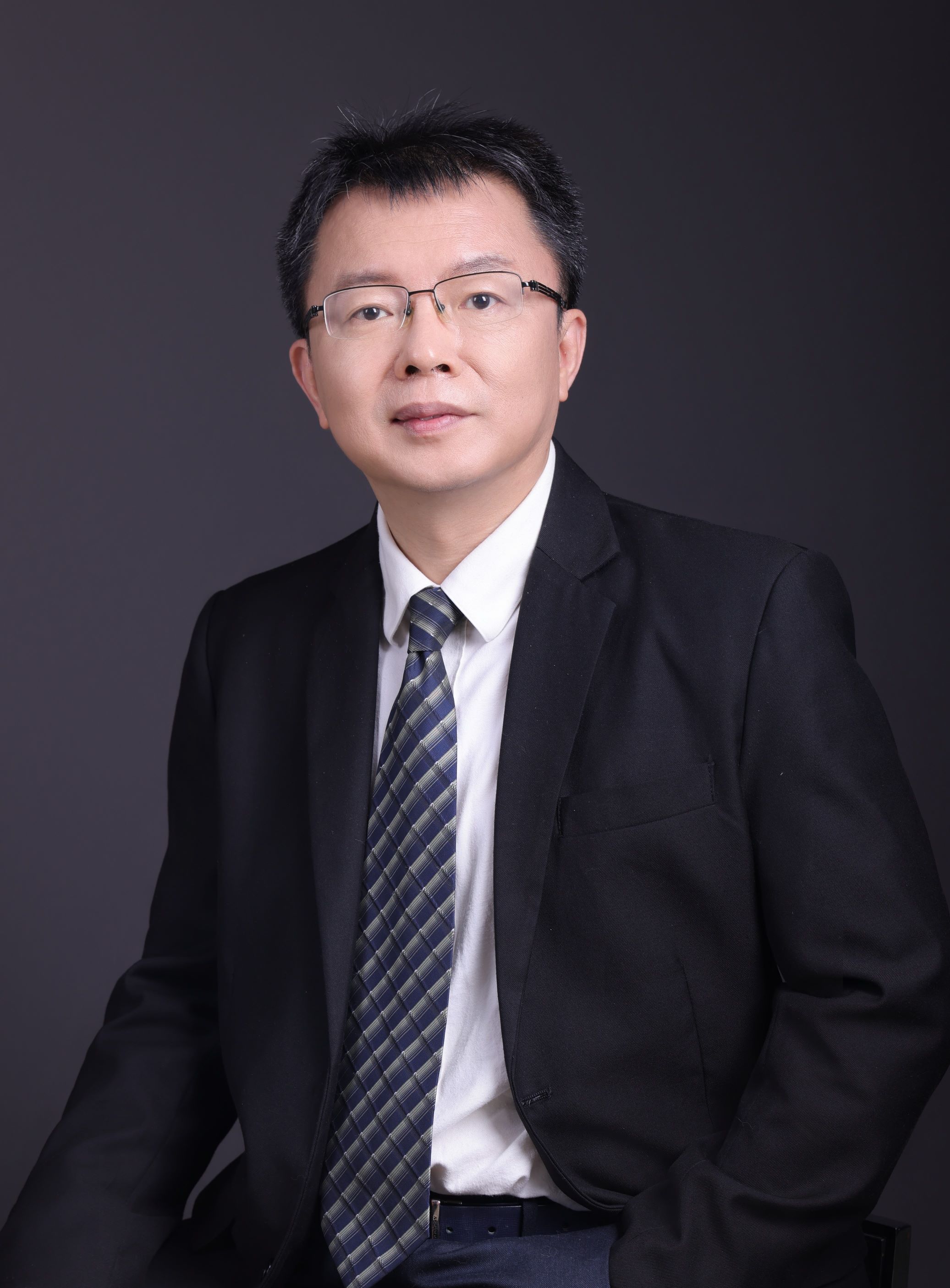
 Bin CUI
· 2 previous affiliations
- Peking UniversitySince 2006
- Full Professor · Since 2006
- National University of Singapore2000–2003
- PhD student · 2000–2003
Research Overview
Bin Cui focuses on database systems, distributed machine learning, and artificial intelligence infrastructure. His trajectory spans from real-time stream processing and big data management to the optimization of large-scale model training frameworks. Currently, his work addresses the efficiency and reasoning capabilities of large language models, exploring advanced parallelism strategies and reinforcement learning techniques for generative AI.
Research Trajectory
The trajectory begins with foundational work in big data management and stream processing. In 2015, he contributed to TencentRec: Real-time Stream Recommendation in Practice, addressing the challenges of deploying real-time recommendation systems. This interest in unbounded data streams continued with POS: A High-Level System to Simplify Real-Time Stream Application Development on Storm (2016), where he participated in developing an abstraction layer to simplify stream processing applications without sacrificing low-latency performance. Expanding into distributed machine learning, he explored communication-efficient training methods in SketchML: Accelerating Distributed Machine Learning with Data Sketches (2018).
As deep learning models scaled, his focus shifted toward the systems and infrastructure required to train massive architectures. He participated in the development of Galvatron: Efficient Transformer Training over Multiple GPUs Using Automatic Parallelism (2022), a framework that automates the search for optimal hybrid parallelism strategies. This work advanced the broader research direction of Overcoming the Hardware Homogeneity Assumption. Continuing to optimize distributed systems, he investigated dynamic resource allocation in Enabling Parallelism Hot Switching for Efficient Training of Large Language Models (2024). Around the same time, his group released OpenBox: A Python Toolkit for Generalized Black-box Optimization (2024), providing a unified platform for complex optimization tasks. He also contributed to security in personalized ranking algorithms, co-authoring Unveiling Vulnerabilities of Contrastive Recommender Systems to Poisoning Attacks (2024), which highlighted spectral vulnerabilities and contributed to the study of The Uniformity Vulnerability in Contrastive Recommenders.
In 2025, his research heavily emphasized the efficiency and capability of large language models (LLMs). To address the computational bottlenecks of heterogeneous sequence training, he explored the area of Flexible Sequence Parallelism for Heterogeneous Training Batches through FlexSP: Accelerating Large Language Model Training via Flexible Sequence Parallelism (2025). This work aligns with broader efforts in Length-Aware Parallelization for Heterogeneous Sequence Training and Layer Specific Heterogeneous Parallelism for Distributed Training. Beyond systems optimization, he led research into model performance and data augmentation. In Enhancing Unsupervised Sentence Embeddings via Knowledge-Driven Data Augmentation and Gaussian-Decayed Contrastive Learning (2025), his team proposed a pipeline to improve data diversity and reduce noise in synthetic samples. Similarly, Improving Low-Resource Sequence Labeling with Knowledge Fusion and Contextual Label Explanations (2025) introduced the KnowFREE framework to boost sequence labeling in domain-specific settings using LLM-generated contextual explanations.
His recent work has also expanded into multimodal understanding and generative AI. He directed the development of HermesFlow: Seamlessly Closing the Gap in Multimodal Understanding and Generation (2025), a self-improvement framework utilizing Direct Preference Optimization to align models' generative capabilities with their visual understanding. In the text-to-image domain, he oversaw IterComp: Iterative Composition-Aware Feedback Learning from Model Gallery for Text-to-Image Generation (2025), which aggregates preferences from diverse expert models to improve spatial and semantic compositionality. Extending these efficiency gains to video generation, his group introduced EchoAttention: Exploiting Token-Pair Redundancy and Frame-Block Similarity for Efficient Video Generation (2026), a sparse attention mechanism that accelerates Video Diffusion Transformers by reusing attention patterns across frames.
Most recently, his focus has centered on accelerating LLM inference and reinforcement learning (RL). To speed up the prefilling stage of long-context models, he led the research on SALE : Low-bit Estimation for Efficient Sparse Attention in Long-context LLM Prefilling (2026), a training-free quantization method that identifies critical attention regions. In the realm of RL, he addressed the rollout bottleneck with DARTS: Distribution-Aware Active Rollout Trajectory Shaping for Accelerating LLM Reinforcement Learning (2026), which reshapes response length distributions to steer models toward conciseness. Finally, Learning What Reinforcement Learning Can't: Interleaved Online Fine-Tuning for Hardest Questions (2026) introduced the ReLIFT framework, dynamically interleaving RL with targeted supervised fine-tuning to teach models entirely new reasoning concepts. This work significantly advances the broader research area of Preventing Entropy Collapse in Reinforcement Learning.
Current Directions
The most recent papers in the evidence address the efficiency and reasoning capabilities of large language models and multimodal generative systems. A major theme is the acceleration of LLM training and inference, utilizing techniques like flexible sequence parallelism, low-bit estimation for sparse attention, and active rollout trajectory shaping during reinforcement learning. Additionally, current work investigates the alignment and compositionality of generative models, employing iterative feedback loops and preference optimization to bridge the gap between multimodal understanding and generation, as well as to improve complex prompt following in text-to-image and video diffusion models.
Profile updated
Loading new papers…
Other researchers whose papers cluster into the same research directions — a proxy for overlapping technical interests and shared intellectual neighborhoods.
See something wrong? Report a mistake