

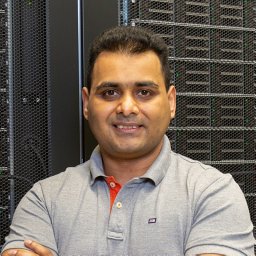
 Ayan Paul
· 7 previous affiliations
- KarmaVSince 2021
- Founder & Chief Scientific Officer · Since 2021
- Harvard Medical SchoolSince 2023
- Staff · Since 2023
- Northeastern UniversitySince 2022
- Research Associate Professor · Since 2025
- Principal Researcher · 2024–2025
- Researcher · 2023–2025
- Postdoc · 2022–2023
- CoVis2020–2022
- Co-founder & Chief Scientific Officer · 2020–2022
- Researcher · 2017–2022
- Postdoc · 2012–2017
- University of Notre Dame2005–2012
- PhD student · 2007–2012
- Master of Science - MS, Physics · 2005–2007
Research Overview
Ayan Paul focuses on theoretical particle physics, precision electroweak measurements, and the application of interpretable machine learning to complex physical and socioeconomic systems. His early work explored flavor dynamics and Higgs physics to constrain models beyond the Standard Model. Recently, his research has expanded into physics-informed neural networks, causal discovery, and generative modeling for high-dimensional data fusion.
Research Trajectory
His early research focused on flavor dynamics, beginning by investigating the area of Rare Meson Decays as Probes of New Physics. In D0 → γγ and D0 → μ+μ− rates on an unlikely impact of the littlest Higgs model with T parity (2010), he and his collaborators explored whether specific extensions of the Standard Model could significantly boost the rates of rare charm meson decays.
By the mid-2010s, his focus expanded to the broader research direction of Disentangling Hadronic Uncertainties from New Physics in Rare Decays. He participated in a critical reassessment of anomalies in B-meson decays with B → K∗ ℓ + ℓ − decays at large recoil in the Standard Model: a theoretical reappraisal (2016), demonstrating that observed tensions could be explained by underestimated non-factorizable power corrections from charm-quark loops rather than new physics. Continuing this thread, he contributed to On flavourful Easter eggs for New Physics hunger and lepton flavour universality violation (2017), which utilized Bayesian global fits to search for subtle signals of new dynamics. This work advanced the field of Testing Lepton Flavor Universality in Meson Decays and utilized statistical methods relevant to the area of Selecting Optimal Models via Information Theoretic Penalties.
Moving toward collider phenomenology and the area of Breaking Parameter Degeneracies in Physical Models, he guided research in On the future of Higgs, electroweak and diboson measurements at lepton colliders (2019). This study showed that future lepton colliders must perform joint analyses of the Higgs and electroweak sectors to ensure robust measurements, noting the distinct operational requirements for circular versus linear colliders. He also investigated the implications of the CDF collaboration's W-boson mass measurement in Violation of custodial symmetry from W-boson mass measurements (2022), framing the statistical anomaly as a potential violation of custodial symmetry pointing toward new physics at the 6 TeV scale. In parallel, he oversaw work on axion couplings in Axion EFTs and Massive Chiral Gauge Fields through the Anomalous Lens (2022), deriving sum rules for axion decay rates to probe heavy chiral matter. This aligns with his broader interest in Model Independent Searches with Standard Model Effective Field Theory.
Recognizing the need for transparency in computational methods, he introduced game-theoretic approaches to the physical sciences in Lessons on interpretable machine learning from particle physics (2022), advocating for the use of SHAP values to understand the underlying dynamics driving a model's decisions. He subsequently applied these causal and interpretable frameworks to epidemiology, leading the analysis in Causal connections between socioeconomic disparities and COVID-19 in the USA (2022). This research merged cooperative game theory with causal inference to identify primary drivers of pandemic spread, a theme he further developed in Crafting Data-Driven Strategies to Disentangle Socioeconomic Disparities from Disease Spread (2023). Concurrently, he maintained his focus on flavor dynamics, participating in Charming penguins and lepton universality violation in b → s ℓ + ℓ − decays (2023) to parameterize charm-loop effects and evaluate the robustness of lepton universality violation signals.
In recent years, his work has increasingly centered on high-performance computational tools and generative artificial intelligence. He developed machine learning surrogates to accelerate particle physics simulations in High-precision regressors for particle physics (2024), achieving significant computational speedups by enforcing physical consistency and novel normalization strategies. Expanding his methodological scope, he analyzed labor market dynamics in The Iceberg Index: Measuring Workforce Exposure Across the AI Economy (2025), simulating millions of workers to quantify hidden technical exposure to artificial intelligence. He also directed research on generative models for remote sensing in Exploring the design space of diffusion and flow models for data fusion (2025), creating frameworks to harmonize historical satellite imagery into a seamless longitudinal record. Returning to fundamental physics with these advanced tools, he oversaw the development of the Four Model Tree Ensemble in Further Exploration of Precise Binding Energies from Physics Informed Machine Learning and the Development of a Practical Ensemble Model (2025), which predicts nuclear binding energies with unprecedented precision by training on theoretical residuals. Most recently, he guided the development of DeepWeightFlow: Re-Basined Flow Matching for Generating Neural Network Weights (2026), proposing a flow-matching approach to sample high-performing neural network weights directly from a distribution, bypassing traditional iterative optimization.
Current Directions
Recent work investigates the intersection of generative artificial intelligence, physics-informed machine learning, and complex systems modeling. The most recent papers in the evidence address the development of flow-matching and diffusion models to solve high-dimensional problems, such as directly generating neural network weights and fusing heterogeneous data sources like historical satellite imagery. Additionally, this research program explores the use of composite machine learning ensembles to predict fundamental physical properties—such as nuclear binding energies—by modeling the residuals of traditional theoretical frameworks. Beyond fundamental physics, current efforts also apply these advanced computational techniques to socioeconomic modeling, utilizing autonomous agent simulations to quantify the hidden impacts of artificial intelligence on the broader labor market.
Profile updated
Loading new papers…
Other researchers whose papers cluster into the same research directions — a proxy for overlapping technical interests and shared intellectual neighborhoods.
See something wrong? Report a mistake