

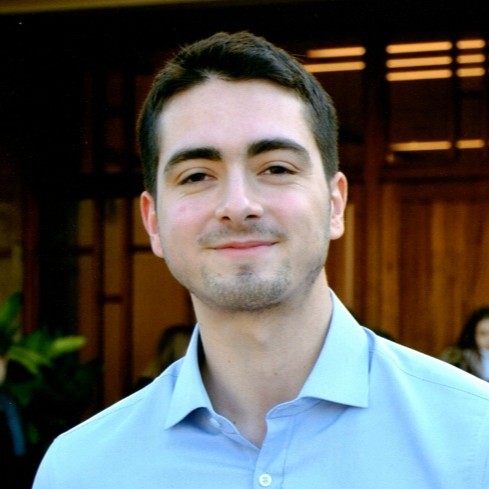
 Augustinos D Saravanos
· 5 previous affiliations
- Massachusetts Institute of TechnologySince 2025
- Postdoctoral Researcher · Since 2025
- Georgia Institute of Technology2020–2025
- Graduate Research Assistant · 2020–2025
- PhD student · 2020–2024
- Machine Learning Research Intern · 2023
- Robotics Club UoP2017–2020
- Automation Control Engineer · 2017–2020
- University of Patras2014–2019
- MS student · 2014–2019
Research Overview
Augustinos D Saravanos focuses on large-scale distributed optimization, stochastic optimal control, and the integration of deep learning with mathematical programming for multi-agent systems. His work addresses the computational challenges of coordinating massive robotic swarms in environments characterized by non-convex constraints and complex uncertainty. By leveraging techniques such as deep unfolding, the Alternating Direction Method of Multipliers (ADMM), and covariance steering, he develops frameworks that enable real-time, safe, and robust decision-making for systems scaling from dozens to millions of agents.
Research Trajectory
The early phase of Saravanos’s research, primarily during his doctoral studies at Georgia Tech, centered on decentralized architectures for stochastic multi-agent systems. This period was defined by a focus on Active Uncertainty Management via Covariance Steering, where the objective was to guide a team of robots toward specific target state distributions rather than just mean trajectories. By utilizing consensus-based ADMM, he developed methods to satisfy inter-agent constraints, such as collision avoidance, in a parallelized manner that significantly improved scalability over centralized approaches.
As his work progressed, the focus shifted toward the challenges of Sequential Convex Programming for Non-Convex Trajectory Optimization. He introduced decentralized frameworks that combined Differential Dynamic Programming (DDP) with ADMM to solve nonlinear control problems for massive swarms. This transition marked a move toward handling more complex dynamics and larger agent counts, eventually leading to the study of Very-Large-Scale Multi-Agent Systems (VLMAS). In this context, he explored hierarchical clustered structures to manage the dimensionality of systems containing up to millions of agents, ensuring probabilistic safety guarantees through distribution control.
In the mid-2020s, Saravanos’s research increasingly integrated Unified Frameworks for Stochastic and Bounded Uncertainty. Recognizing that real-world autonomous systems face both probabilistic noise and worst-case disturbances, he developed methods to approximate robust constraints as Second-Order Cone Programs (SOCPs). This approach allowed for Scaling Robust Control with Second-Order Cone Programs, providing a computationally efficient means of ensuring safety in swarms where traditional robust optimization methods typically fail due to high dimensionality.
His most recent work, following his transition to a postdoctoral position at MIT, explores the intersection of optimization and machine learning through "learning-to-optimize" paradigms. This involves "unfolding" iterative optimization algorithms into neural network architectures to learn optimal tuning policies and accelerate convergence. This trajectory reflects a broader shift in the field toward AI-aided optimization, where the goal is to maintain the rigorous guarantees of classical control while achieving the execution speeds required for high-stakes, real-time robotics.
Current Directions
Saravanos is currently investigating the acceleration of nonlinear and quadratic programming through deep unfolding. By representing optimization iterations as layers in a neural network, he aims to produce solvers that are significantly faster than industry standards while remaining feasible under impossible constraints. This work extends to Safe Optimization and Control in Non-Convex Environments, where the objective is to maintain safety guarantees even when the underlying environment or communication network is unreliable.
Another active area of inquiry involves asynchronous distributed motion planning. In practical deployments, communication between robots is often plagued by latency and packet loss. Saravanos is developing frameworks to handle these imperfections, preventing the oscillations and drifts that typically occur when distributed solvers rely on stale information. Additionally, he is exploring generative modeling for trajectory inference, specifically using multi-marginal Schrödinger bridge matching to derive smooth trajectories from sparse data snapshots.
His participation in broader control and learning research includes work on Robust Adaptive Control for Uncertain Linear Systems and the development of second-order optimizers for Neural ODEs. These efforts contribute to a more robust foundation for safety-critical machine learning, treating model training as a min-max game to enhance resistance to adversarial perturbations.
Representative Work
Distributed Covariance Steering with Consensus ADMM for Stochastic Multi-Agent Systems This work establishes a distributed framework for steering robot teams with stochastic linear dynamics toward target mean and covariance distributions. By employing a consensus-based ADMM, the approach allows agents to satisfy collision avoidance and other inter-agent constraints in parallel, demonstrating superior computational scalability compared to centralized stochastic control methods.
Distributed Differential Dynamic Programming Architectures for Large-Scale Multi-Agent Control This paper introduces two decentralized optimization frameworks, ND-DDP and MD-DDP, designed for massive robot swarms. By integrating the computational efficiency of Differential Dynamic Programming with the distributed structure of ADMM, the research demonstrates optimal coordination for over 4,000 vehicles, pushing the boundaries of what is achievable with nonlinear multi-agent controllers.
Distributed Hierarchical Distribution Control for Very-Large-Scale Clustered Multi-Agent Systems Addressing systems with up to millions of agents, this paper proposes a hierarchical control strategy. It assumes a multi-level clustered structure where the control of agent cliques is managed through state distribution steering. This method ensures probabilistic safety guarantees while managing the extreme dimensionality inherent in very-large-scale multi-agent systems.
Scaling Robust Optimization for Swarms: A Distributed Perspective This research presents a decentralized framework for trajectory optimization that accounts for both deterministic (bounded) and stochastic uncertainties. By reformulating robust constraints into Second-Order Cone Programs and utilizing a distributed ADMM solver, the work enables safe coordination for swarms of hundreds of agents, a scale where centralized robust optimization typically becomes computationally intractable.
Deep Distributed Optimization for Large-Scale Quadratic Programming In this work, Saravanos introduces DeepDistributedQP, a framework that unrolls a distributed optimization algorithm into a deep neural network. By learning optimal tuning policies through this unrolled structure, the system solves large-scale quadratic programs significantly faster than standard solvers while maintaining theoretical performance guarantees.
Learning-to-Optimize via Deep Unfolded Flows This paper introduces FlowOptimizer, a deep unfolded, flow-based framework for iterative optimization. It represents optimization iterations as a velocity field operating on a population of candidate solutions. The model is trained to match displacements from source populations to improved target ones, providing a novel simulation-free approach to learning high-performance optimization policies.
Profile updated
Loading new papers…
Other researchers whose papers cluster into the same research directions — a proxy for overlapping technical interests and shared intellectual neighborhoods.
See something wrong? Report a mistake