

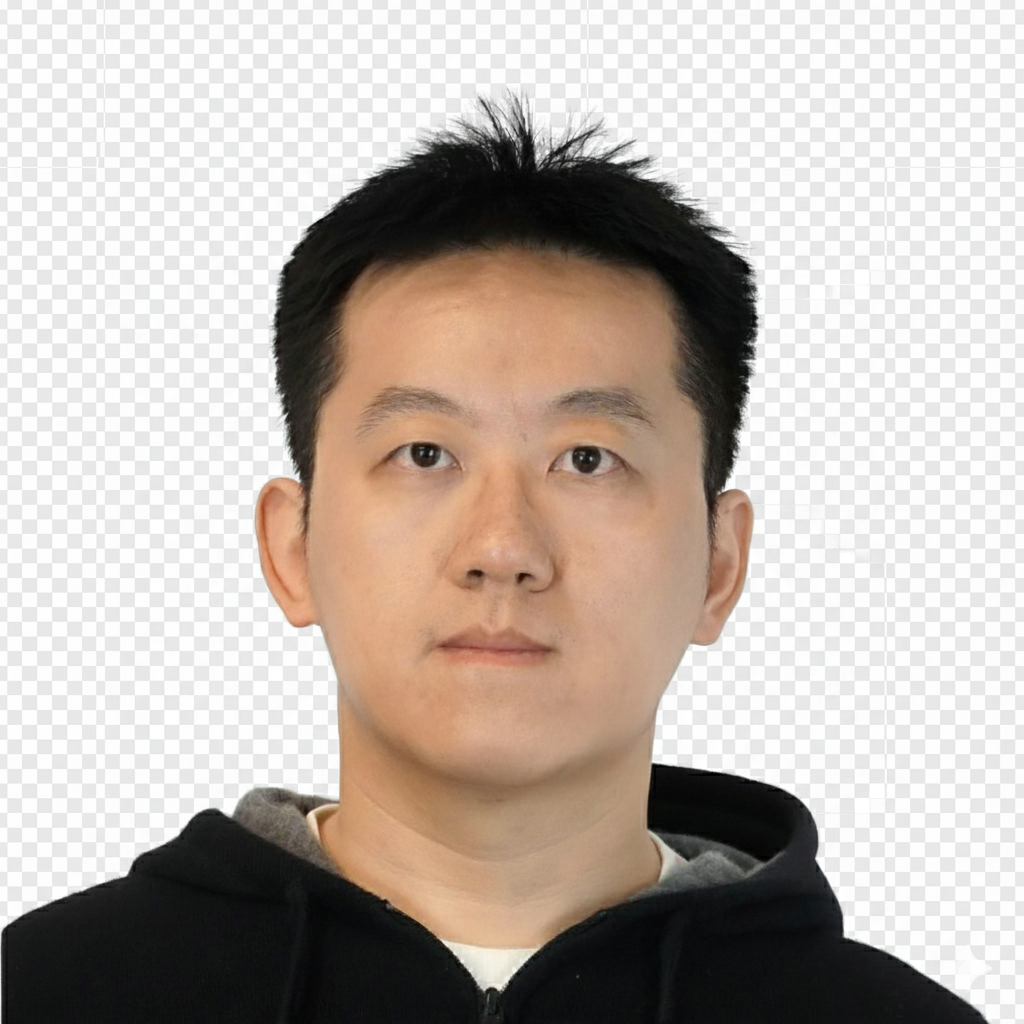
 Aonan Zhang
· 3 previous affiliations
- Apple (United States)Since 2023
- Researcher · Since 2023
- ByteDance (China)2019–2023
- Research Scientist · 2019–2023
- Columbia University2014–2019
- PhD student · 2014–2019
Research Overview
Aonan Zhang focuses on foundation model efficiency, synthetic data generation, and mathematical reasoning in large language models. His trajectory spans early work in nonparametric Bayesian methods and speaker diarization to recent contributions in scaling multimodal architectures and speculative decoding. Currently, he investigates data-efficient pre-training strategies and advanced reasoning capabilities for large-scale models.
Research Trajectory
Zhang’s early research concentrated on probabilistic modeling and Bayesian nonparametrics, with a particular emphasis on discovering latent semantic structures in complex data. As a first author, he developed Sparse online topic models, which addressed the normalization constraints of online latent Dirichlet allocation to better control the sparsity of learned representations in dynamic text streams. He continued to advance sparse representation learning with Markov Latent Feature Models, introducing a sequential construction that interpreted the states of a sequential process as features to model complex dependencies.
Transitioning toward applied sequence modeling during his tenure at Google, Zhang led the development of Fully Supervised Speaker Diarization. This work introduced unbounded interleaved-state recurrent neural networks (UIS-RNN), a system that modeled individual speakers with parameter-sharing RNNs while integrating a distance-dependent Chinese restaurant process to accommodate an unknown number of speakers.
In recent years, Zhang’s focus has shifted to the scale and efficiency of large language models (LLMs), supported by his work on trillion-scale data subsampling at ByteDance and his current role as a Research Scientist at Apple. He has collaborated on evaluating the practical performance of LLM architectures, contributing as a middle author to Revisiting MoE and Dense Speed-Accuracy Comparisons for LLM Training. This research argued that traditional FLOP-based comparisons ignore communication overhead, demonstrating that Mixture-of-Experts models maintain a significant advantage on the speed-accuracy trade-off curve when measured by wall-clock step time.
Concurrently, Zhang has participated in efforts to enhance the multi-step reasoning abilities of LLMs. In Step-by-Step Reasoning for Math Problems via Twisted Sequential Monte Carlo, he was part of a team that applied Twisted Sequential Monte Carlo to sequentially refine sampling efforts, improving the efficiency of verification methods for mathematical problem-solving without relying on extensive process supervision.
Most recently, Zhang has addressed the fundamental data constraints of LLM scaling. As a co-first author, he developed Synthetic Bootstrapped Pretraining, a method designed to overcome the scarcity of high-quality internet text. By training models to map relationships between documents and generate massive synthetic corpora from scratch, this approach significantly improves data efficiency, recovering performance gains that would typically require orders of magnitude more unique data.
Current Directions
Recent work investigates the optimization of foundation models, emphasizing data generation, model efficiency, and mathematical reasoning. The most recent papers in the evidence address the "scaling wall" in LLM training by exploring how synthetic bootstrapped pre-training can reduce reliance on fresh internet data. Additionally, Zhang’s recent collaborative efforts focus on evaluating and improving agentic capabilities across diverse domains, as well as disentangling the core competencies of multimodal large language models. His ongoing research continues to prioritize the practical deployment of large-scale models through fast speculative decoding algorithms and robust reasoning frameworks.
Profile updated
Loading new papers…
Other researchers whose papers cluster into the same research directions — a proxy for overlapping technical interests and shared intellectual neighborhoods.
See something wrong? Report a mistake