

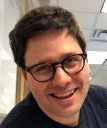
 Andrew Owens
· 4 previous affiliations
- Cornell TechSince 2025
- Associate Professor · Since 2025
- University of Michigan2020–2025
- Assistant Professor · 2020–2025
- Postdoc · 2016–2019
- PhD student · 2010–2016
1 other author named Andrew Owens: Andrew Owens (9 papers)
Research Overview
Andrew Owens focuses on multimodal learning, self-supervised computer vision, and generative modeling. His trajectory spans early work in audio-visual representation learning and image forensics to recent advances in cross-modal correspondence and diffusion-based synthesis. Currently, his research investigates how models can learn physical and spatial structure by integrating vision with sound, touch, and motion.
Research Trajectory
Owens's early research explored how models can learn from the natural synchronization of sensory inputs. This included foundational work on Learning visual models from paired audio-visual examples (2016), which demonstrated that visual representations could be trained using ambient audio as a supervisory signal. Building on self-supervised paradigms, he later co-developed methods for video understanding, such as Space-Time Correspondence as a Contrastive Random Walk (2020). This work cast long-range pixel correspondence as a link prediction problem in a space-time graph, utilizing temporal cycle consistency to optimize transition probabilities without manual labels. During this period, he also participated in evaluating the detectability of synthetic media in CNN-Generated Images Are Surprisingly Easy to Spot... for Now (2020), contributing to the broader research area of Universal Forensic Signatures of Generative Neural Networks by demonstrating that a classifier trained on a single generator could generalize across multiple architectures.
Expanding into 3D synthesis and adversarial techniques, Owens guided research in the area of Implicit Neural Texture Fields for 3D Surface Synthesis. This was exemplified by GANmouflage: 3D Object Nondetection with Texture Fields (2023), which combined neural texture fields with adversarial training to generate high-fidelity textures that conceal complex 3D shapes from detection models. His group subsequently leveraged diffusion models for fine-grained visual control and perceptual manipulation. In Factorized Diffusion: Perceptual Illusions by Noise Decomposition (2024), he introduced a zero-shot method to control individual linear components of an image—such as spatial frequencies or color channels—enabling the generation of hybrid visual illusions. Further exploring non-rigid image editing, he collaborated on Motion Guidance: Diffusion-Based Image Editing with Differentiable Motion Estimators (2024), which used gradients from optical flow networks to steer diffusion sampling for complex structural changes.
Returning to the intersection of modalities, Owens's lab developed unified latent spaces for multimodal generative control. Images that Sound: Composing Images and Sounds on a Single Canvas (2024) demonstrated how pre-trained image and audio diffusion models could be combined zero-shot to create spectrograms that function simultaneously as natural images and coherent audio. He also extended multimodal learning to physical interaction. Tactile-Augmented Radiance Fields (2024) merged 3D vision with touch by registering sparse tactile probes into a Neural Radiance Field, allowing models to hallucinate tactile properties across unseen surfaces. Concurrently, he advanced self-supervised tracking techniques in Self-supervised Any-Point Tracking by Contrastive Random Walks (2024), addressing the challenge of following single physical pixels through occlusions and complex motions without relying on synthetic labeled data.
In 2025, Owens continued to broaden the scope of sensory integration. He oversaw the development of Hearing Hands: Generating Sounds from Physical Interactions in 3D Scenes, which synthesized realistic, synchronized audio for human hand interactions using 3D Gaussian Splatting and rectified flow models. He also contributed to New York Smells: A Large Multimodal Dataset for Olfaction (2025), an in-the-wild dataset pairing visual data with electronic nose signals to align smell and sight. To address hardware discrepancies in robotics, his group advanced the research direction of Generalizing Robotic Touch Across Heterogeneous Tactile Sensors with Cross-Sensor Touch Generation (2025). This work utilized conditional diffusion models to translate tactile signals between different visuo-tactile sensors, enabling zero-shot skill transfer.
His recent work also refines how generative models process visual features and temporal dynamics. Masked Diffusion Captioning for Visual Feature Learning (2025) introduced a framework that trains vision encoders by filling in caption blanks via diffusion, improving compositional reasoning over traditional autoregressive approaches. In Self-Supervised Spatial Correspondence Across Modalities (2025), he extended the contrastive random walk framework to find pixel-level matches between entirely different modalities, such as RGB photos and thermal images. Most recently, Fine-grained Defocus Blur Control for Generative Image Models (2025) decoupled image generation from physical lens modeling to provide precise control over aperture and focus. This trajectory of leveraging generative priors for physical understanding culminates in Point Prompting: Counterfactual Tracking with Video Diffusion Models (2026), which demonstrated that pretrained video diffusion models possess emergent zero-shot tracking capabilities when prompted with simple visual markers.
Current Directions
The most recent papers in the evidence address the intersection of generative modeling, physical interaction, and cross-modal alignment. Current work investigates how diffusion models can be adapted for zero-shot physical tracking and precise optical control, moving beyond pure synthesis to extract structural and temporal priors from video models. Additionally, ongoing research focuses on heterogeneous sensory integration, developing frameworks that align vision with tactile feedback, spatial audio, and olfactory data to build more robust, sensor-invariant representations of the physical world.
Profile updated
Loading new papers…
Other researchers whose papers cluster into the same research directions — a proxy for overlapping technical interests and shared intellectual neighborhoods.
See something wrong? Report a mistake