

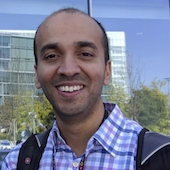
 Aditya Krishna Menon
· 4 previous affiliations
- Google (United States)Since 2018
- Research Scientist · Since 2018
- Australian National University2018–2021
- Fellow · 2018–2021
- Researcher · 2016–2017
- Data612013–2016
- Researcher · 2013–2016
Research Overview
Aditya Krishna Menon focuses on robust machine learning, knowledge distillation, and the optimization of models for long-tailed data distributions. His earlier work addresses worst-case generalization and structural biases in neural ranking and classification. More recently, his research investigates differentially private optimization, dynamic routing for large language models, and trajectory recommendation systems.
Research Trajectory
Beginning in 2021, Menon investigated the generalization properties of overparameterized neural networks, particularly how average-case success can mask poor worst-case performance on under-represented subgroups. In Overparameterisation and worst-case generalisation: friend or foe?, he demonstrated that restricting a model's bias to its classification layers allows for post-hoc processing that improves predictions for rare subgroups. This focus on imbalanced data extended into a statistical framework for long-tail classification. In Long-tail learning via logit adjustment, he introduced techniques based on label frequencies to encourage a larger relative margin between rare positive and dominant negative labels, mitigating the bias toward dominant classes.
In 2022, his attention expanded to information retrieval and the architectural constraints of neural ranking models. Addressing the research direction of Bridging the Bi-Encoder and Cross-Encoder Performance Gap, he authored In defense of dual-encoders for neural ranking. This work analyzed whether the empirical performance gap between cross-attention and dual-encoder models stems from inherent capacity limitations or suboptimal training procedures.
Concurrently, Menon led a series of investigations into knowledge distillation, specifically examining how distillation impacts minority classes. While distillation typically improves average accuracy, it can degrade performance on rare subgroups. In Robust Distillation for Worst-class Performance, and its subsequent expansions including Robust Distillation for Worst-class Performance: On the Interplay Between Teacher and Student Objectives and Robust Distillation for Wost-class Performance, his group explored the application of robust optimization objectives. They demonstrated that jointly modifying teacher and student objectives helps preserve strong performance across classes, contributing to the broader area of Deep Learning for Long-Tailed Distributions.
Between 2023 and 2024, his research group also addressed challenges in privacy-preserving machine learning. They investigated the limitations of Differentially Private Stochastic Gradient Descent (DPSGD) when handling input features with large norms. Across a series of papers, including The importance of feature preprocessing for differentially private linear optimization and its 2024 iterations (The importance of feature preprocessing for differentially private linear optimization and The importance of feature preprocessing for differentially private linear optimization), they established that a private feature preprocessing step—specifically, centering the data—can significantly reduce privacy error bounds, shifting the scaling factor from the maximum feature norm to the dataset's diameter.
By 2026, Menon's collaborative work diversified into large language model inference and spatial recommendation systems. He participated in the development of UniRoute, a framework detailed in Universal Model Routing for Efficient LLM Inference, which dynamically routes queries to unseen LLMs at test time based on error patterns across prompt clusters. In the domain of spatial data, he returned to leading research on trajectory recommendation. In Revisiting Revisits in Trajectory Recommendation, he evaluated graph-based heuristics, integer linear programming, and Viterbi algorithm extensions to generate high-scoring, loop-free travel sequences for tourists. This was complemented by his participation in PathRec: Visual Analysis of Travel Route Recommendations, which introduced an interactive visualization tool to help users analyze geographical features and sequence recommendations.
Current Directions
The most recent papers in the evidence indicate a dual focus on the operational efficiency of large language models and the development of spatial recommendation systems. Recent work investigates dynamic model routing, seeking to optimize inference costs by directing prompts to appropriate models without requiring router retraining. Concurrently, research in trajectory recommendation addresses the algorithmic and user-interface challenges of generating logical, loop-free travel routes, combining machine learning formulations with interactive visual analysis.
Profile updated
Loading new papers…
Other researchers whose papers cluster into the same research directions — a proxy for overlapping technical interests and shared intellectual neighborhoods.
See something wrong? Report a mistake