

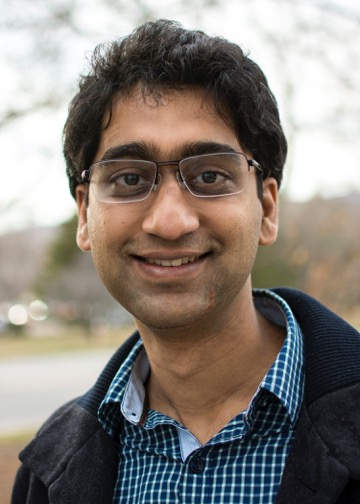
 Aditya Bhaskara
· 3 previous affiliations
- University of UtahSince 2016
- Associate Professor · Since 2016
- Google (United States)2013–2015
- Postdoc · 2013–2015
- Princeton University2007–2012
- PhD student · 2007–2012
Research Overview
Aditya Bhaskara focuses on theoretical computer science, algorithm design, and the foundations of machine learning, with particular emphasis on robustness and efficiency. His trajectory spans early work in approximation algorithms and tensor decompositions to foundational analyses of unsupervised learning and network structures. Recently, his research addresses optimization under hidden convexity, sparse fine-tuning for large language models, and the theoretical properties of graph embeddings.
Research Trajectory
Aditya Bhaskara’s early research addressed fundamental challenges in theoretical computer science and combinatorial optimization. During his doctoral studies, he introduced an improved algorithm for the Densest k-Subgraph problem in Detecting high log-densities: an O(n1/4) approximation for densest k-subgraph, leveraging a novel approach to distinguish random graphs from those with planted dense subgraphs using a caterpillar tree structure.
Moving into his postdoctoral research at EPFL and Google Research, his focus expanded to the theoretical foundations of machine learning, particularly latent variable models. He established a robust version of Kruskal's theorem in Uniqueness of Tensor Decompositions with Applications to Polynomial Identifiability. This work demonstrated that models like Hidden Markov Models are polynomially identifiable, advancing research in the areas of Robustness and Identifiability in Tensor Decompositions, Overcomplete Tensor Decomposition for Latent Variable Discovery, and Efficient Recovery of Overcomplete Latent Variable Models. He further explored these mathematical structures in Smoothed analysis of tensor decompositions. Around the same time, he investigated generative models for neural networks, providing layerwise learning algorithms with polynomial sample complexity in Provable Bounds for Learning Some Deep Representations.
Building on these foundations, he developed new mathematical frameworks for decoupling dependent random variables. This was detailed in Smoothed Analysis in Unsupervised Learning via Decoupling, which provided polynomial-time guarantees for learning overcomplete HMMs and recovering subspaces amidst heavy outliers, contributing significantly to the broader area of Smoothed Analysis for Numerical and Algorithmic Stability.
By 2023, his research spanned several distinct but related domains in optimization, online learning, and graph theory. In the realm of geometric data representation, he established near-optimal bounds for volumetric spanners using local search techniques in Tight Bounds for Volumetric Spanners and Applications. In online learning, he explored how algorithms can leverage predictive information. He demonstrated that active querying is necessary to achieve logarithmic regret with bandit feedback in Bandit Online Linear Optimization with Hints and Queries, and investigated competing against changing strategies in Competing against Adaptive Strategies in Online Learning via Hints. He also examined the economics of machine learning, proposing a balanced marketplace for heterogeneous data sharing in Data Exchange Markets via Utility Balancing. Concurrently, he began analyzing the theoretical properties of graph representations, analytically characterizing optimal low-dimensional embeddings for stochastic block models in Structure of Nonlinear Node Embeddings in Stochastic Block Models.
His work on networks continued into 2024. He formalized the concept of broadcast value to quantify and improve fairness of information access through edge additions in Optimizing Information Access in Networks via Edge Augmentation. He also contributed to the direction of Spectral Analysis of Ultra Sparse Networks by proving that unnormalized Laplacians are surprisingly more robust than normalized variants against adversarial edge additions in semirandom stochastic block models, detailed in On the Robustness of Spectral Algorithms for Semirandom Stochastic Block Models.
Most recently, his trajectory has addressed both fundamental optimization challenges and practical efficiency in modern AI. He provided convergence rates for optimizing convex functions using biased stochastic gradients in Descent with Misaligned Gradients and Applications to Hidden Convexity. Shifting toward large-scale model efficiency, he developed a structured-pruning-based sparse fine-tuning method to reduce the memory footprint of large language models in An Efficient Row-Based Sparse Fine-Tuning. His ongoing work in graph theory includes algorithmic approaches to minimizing the Kirchhoff index via edge additions in Clustering-Based Edge Augmentation for Minimizing the Kirchhoff Index, and providing theoretical analysis of the optimization trajectory of DeepWalk with negative sampling in On the Optimization Trajectory of DeepWalk Embeddings.
Current Directions
Recent work investigates the theoretical underpinnings of optimization and graph learning, alongside practical efficiency improvements for large-scale models. The most recent papers in the evidence address the challenge of optimizing convex functions using misaligned or biased stochastic gradients, particularly in settings with hidden convexity. Concurrently, research explores the optimization trajectories of popular graph embedding techniques like DeepWalk, proving their ability to recover community structures even under stochastic updates. Another active direction involves network augmentation, specifically developing clustering-based algorithms to minimize the Kirchhoff index in undirected graphs. Finally, recent contributions extend into the efficiency of modern AI systems, proposing structured-pruning methods to significantly reduce the memory footprint required for fine-tuning large language models.
Profile updated
Loading new papers…
Other researchers whose papers cluster into the same research directions — a proxy for overlapping technical interests and shared intellectual neighborhoods.
See something wrong? Report a mistake