

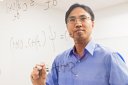
 Sungjin Im
· 7 previous affiliations
- RelationalAISince 2019
- Researcher · Since 2019
- University of California, Santa CruzSince 2025
- Associate Professor · Since 2025
- Current
- University of California, Merced2014–2024
- Associate Professor · 2020–2024
- Assistant Professor · 2014–2020
- Visiting Scholar · 2021
- Duke University2012–2013
- Postdoc · 2012–2013
- PhD student · 2006–2012
- Seoul National University1998–2004
- MS student · 2002–2004
- Undergrad student · 1998–2002
Research Overview
Sungjin Im focuses on the design and analysis of algorithms, with particular emphasis on approximation algorithms, online scheduling, and resource allocation. His trajectory spans foundational work in non-clairvoyant scheduling and massively parallel processing to recent meta-algorithms that incorporate machine learning predictions. Currently, he investigates beyond-worst-case analysis to improve algorithmic performance in practical settings.
Research Trajectory
His early research addressed fundamental challenges in online scheduling and distributed data processing. In An Online Scalable Algorithm for Average Flow Time in Broadcast Scheduling, he explored scalable approaches to minimize average flow time in broadcast environments. Expanding into massively parallel graph processing, he developed methods for distributed big data environments in Fast clustering using MapReduce, bringing robust clustering guarantees to distributed systems.
A significant portion of his subsequent work focused on non-clairvoyant scheduling, where job sizes are unknown upon arrival. In Competitive Flow Time Algorithms for Polyhedral Scheduling, he investigated rate allocation subject to convex packing constraints, establishing positive competitive ratio results for broad sub-classes of scheduling problems that minimize weighted delay. He generalized this approach in Competitive Algorithms from Competitive Equilibria: Non-Clairvoyant Scheduling under Polyhedral Constraints, introducing the General Polytope Scheduling Problem (PSP). This framework yielded novel online algorithms that achieve constant competitive ratios for weighted completion time and scalable ratios for flow time objectives, contributing broadly to the research direction of Provable Guarantees for Algorithmic Performance and multi-dimensional resource allocation for heterogeneous workloads.
More recently, his trajectory has heavily emphasized the integration of machine learning into algorithm design, specifically within the area of Algorithms with Untrusted Machine Learning Predictions. This line of research seeks to improve performance when predictions are accurate while maintaining worst-case guarantees when they fail. In Algorithms with Prediction Portfolios, he addressed the practical challenge of having multiple available predictors with incomparable generalization guarantees, devising strategies to optimally utilize a portfolio of machine learning models. Continuing this theme, he contributed to Parsimonious Learning-Augmented Caching, which demonstrated that near-optimal caching performance can be achieved by querying predictions only during cache misses, drastically reducing the number of required predictions while matching state-of-the-art models.
His work also extends deeply into robust online selection and submodular optimization. In Min-Max Submodular Ranking for Multiple Agents, he introduced a framework to find a single ordering of items that fairly satisfies multiple agents with differing submodular utility functions. By utilizing a "Balanced Adaptive Greedy" algorithm, this work overcomes polynomial bottlenecks, offering applications for designing fair optimal decision trees and web search rankings across diverse demographic groups. He further advanced beyond-worst-case analysis in online ranking systems with Sampling for Beyond-Worst-Case Online Ranking, which bypasses traditional mathematical barriers in ranking items based on pairwise preferences. In the broader context of online resource allocation and the research direction of Resource Augmentation for Online Algorithms, he investigated risk management strategies in Controlling Tail Risk in Online Ski-Rental. Additionally, he addressed the classic theoretical challenge of distributing work across a network of machines under uncertainty in Online Load and Graph Balancing for Random Order Inputs, contributing to the understanding of random order models and online fair division.
His most recent publications continue to refine algorithmic performance across scheduling, clustering, and database theory. In Online Distributed Queue Length Estimation, he explored real-time estimation techniques for distributed queues. Returning to clustering optimization, he provided a rigorous theoretical foundation for widely used practical methods in A Beyond-Worst-Case Analysis of Greedy k-means++. This work proved that for natural data distributions, the greedy approach achieves a superior $O((\ln \ln k)^2)$ approximation compared to the standard $O(\ln k)$ guarantee. He also expanded his focus on database algorithms with Efficient Algorithms for Cardinality Estimation and Conjunctive Query Evaluation With Simple Degree Constraints, and continued his long-standing work in scheduling by developing new optimization techniques in Online Scheduling via Gradient Descent for Weighted Flow Time Minimization.
Current Directions
The most recent papers in the evidence highlight an ongoing focus on beyond-worst-case analysis and the refinement of classical algorithms for practical data distributions. Recent work investigates how greedy initialization strategies, such as those used in $k$-means clustering, can be theoretically validated to match their strong empirical performance on natural datasets. Additionally, current research addresses online scheduling and resource allocation through continuous optimization techniques, such as gradient descent for flow time minimization, and explores efficient query evaluation methods in database theory. Across these domains, the overarching theme remains the development of robust, scalable algorithms that perform reliably under uncertainty and non-clairvoyant conditions.
Profile updated
Loading new papers…
Other researchers whose papers cluster into the same research directions — a proxy for overlapping technical interests and shared intellectual neighborhoods.
See something wrong? Report a mistake