


TL;DR
In self-supervised computer vision, we routinely throw away a neural network's "projection head" right after training, dismissing it as a temporary mathematical crutch. This paper reveals that the projection head is actually doing something profound: just like language models learn from words appearing together, the projection head maps how objects co-occur in the physical world (like forks and food). Even better, learning these contextual relationships is what pushes the main network to master recognizing individual objects—and makes the projection head surprisingly aligned with human semantic intuition.
What Problem Does This Paper Address?
Large language models understand the world because they model word co-occurrences ("peanut" often appears near "butter"). Computer vision’s version of this—Instance-Discrimination Self-Supervised Learning (SSL)—supposedly works differently. Standard SSL takes an image, crops it twice, and forces a network (a visual backbone plus a multi-layer "projection head") to output the same representation for both crops.
The textbook assumption is that both crops show different parts of the same object. Yet, once pre-training finishes, practitioners chop off the projection head because the underlying backbone performs much better on downstream tasks like classifying images. Why is a component that we immediately discard so vital during training?
The authors noticed a flaw in the textbook assumption: on standard ImageNet training, random crops actually land on completely different objects about 15% of the time—pairing a mug with food, or grass with a hedgehog. They set out to discover if SSL models are secretly learning natural object co-occurrence statistics, and where that knowledge lives.
Methods
To test if a network inherently associates "forks" with "food," you can't show it a dining table—the shared background would give it away.
- Context-Free Probing: The authors used segmentation models (Lang-SAM) to slice single objects cleanly out of their backgrounds. By feeding these isolated objects into dozens of standard SSL models (like DINO, SimCLR, MoCoV3, and VICReg), any similarity between a "fork" embedding and a "food" embedding had to come from the model's internal weights, not the image background.
- Measuring Alignment: They used Representational Similarity Analysis (RSA)—essentially correlating a layer's internal similarity map of objects against real-world object co-occurrence counts and against human psychological similarity judgments.
- Causal Pre-training: To prove co-occurrences actually help learning rather than just being a side effect, they ran a clever controlled experiment. They grouped ImageNet categories into arbitrary, artificial "contexts" (e.g., randomly pairing boats with elephants). During SSL training, with probability $p_c$, they swapped one crop of an image for an image of a different object from the same artificial context, stripping away visual shortcuts to isolate pure statistical co-occurrence.
Datasets
- Pre-training & Baselines: ImageNet-1k (used to evaluate pretrained models and run the synthetic context experiments).
- Human Alignment: The THINGS dataset, including ~4 million human "odd-one-out" triplet judgments to measure how humans group concepts.
- Newly Curated Benchmarks: By pairing isolated segmented objects (from THINGS and LVIS) with real-world scene co-occurrence counts (from COCO, ADE20K, and LVIS), the authors introduced three evaluation suites: COCO-THINGS (736 images, 53 categories), ADE20K-THINGS (918 images, 77 categories), and LVIS-LVIS (118,068 images, 1,002 categories).
Key Insights and Ideas
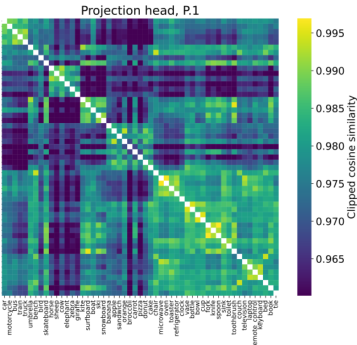
- A Semantic Hierarchy: SSL models naturally divide labor. The visual backbone specializes in sharp categorical discrimination (telling a fork from a spoon), while deeper layers inside the projection head transition to contextual organization (grouping forks, spoons, bowls, and food into a broader dining scene).
- Don't Trash the Head for Cognitive Science: Because humans judge object similarity heavily by context, the normally discarded projection head aligns much better with human similarity judgments than the visual backbone does.
- Context Drives Category Learning: Just as learning to classify whole objects forces early network layers to learn basic edges, forcing the projection head to align co-occurring objects pressures the earlier backbone layers to build cleaner, distinct category representations.
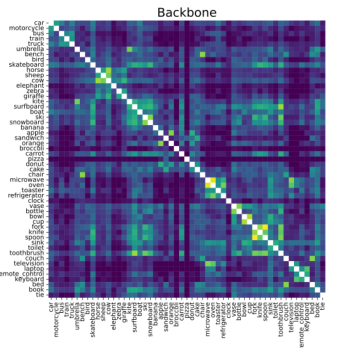 (Note: Compare the tight clusters of the backbone above with the broader contextual blocks emerging in the projection head below).
Key Results
- Projection Heads Capture Co-occurrence: Across nearly all tested architectures (ResNet50, ViT-B) and SSL families, internal layers of the projection head beat the backbone at capturing real-world co-occurrences. On COCO-THINGS, DINO-ViT-B’sRSA Kendall’s tau jumps from 9.0 in the backbone to 33.4 in the projection head. Removing non-linear projection layers during training causes these scores to plummet.
- Better Human Alignment: Across all evaluated models, at least one projection head layer beat the backbone in matching human similarity judgments (e.g., VICReg-R50 rose from 17.7 in the backbone to 23.5 in the head). Across 101 analyzed layers, co-occurrence encoding strongly correlated with human judgment alignment ($r = 0.52$ on COCO-THINGS).
- Causal Boost to Accuracy: In the synthetic context experiments, deliberately pairing different objects from the same context with a $30\%$ probability ($p_c = 0.3$) hit a sweet spot—boosting downstream ImageNet linear classification accuracy by up to +5.52% over standard SSL ($p_c = 0$). Pushing $p_c$ above $0.3$ degraded performance, showing models still need same-image views to anchor their learning.
Limitations and Future Work
The causal pre-training setup relies on simplified, uniform artificial contexts; how this translates to messy, real-world spatial and temporal co-occurrences in massive video datasets (like Ego4D) remains an open question. Additionally, compute limits prevented exhaustive ablations to pinpoint why certain architectures (like DINO) capture co-occurrences better than others. Finally, modern foundation models like DINOv2 don't publicly release their projection head weights—something the authors hope future releases will reconsider so these higher-order semantic spaces can be studied.
Summary updated