


TL;DR
Generative image upscalers are fantastic at inventing crisp textures, yet notoriously prone to hallucinating fake details—like turning legible text on a shirt into alien hieroglyphics. This happens because modern models compress images into a compact "latent space" before processing them, accidentally throwing away vital pixel-level clues right at the starting line. By building a clever bypass that routes raw pixel evidence around this compression bottleneck, Pixel-Grounded Super-Resolution (PGSR) keeps the generative imagination of large transformers anchored to reality.
What Problem Does This Paper Address?
If you have ever used a modern generative AI to upscale a blurry photo—a task known as Super-Resolution (SR)—you have witnessed the classic perception–distortion trade-off. Early neural networks optimized strictly for pixel accuracy, yielding blurry, overly cautious averages. Today's heavyweight champions—Diffusion Transformers (DiTs) and flow-matching models—go the opposite route, synthesizing rich, lifelike textures.
There is just one catch: they don't operate on pixels. To make high-resolution math computationally tractable, they first squeeze the input image through a Variational Autoencoder (VAE) into a compressed latent representation.
That compression is a lossy bottleneck. Subtle edges, color transitions, and tiny characters get wiped out before the generative model even takes its first step. Left to fill in the blanks, the model hallucinates plausible-looking nonsense. Notice how a standard pixel-guided baseline mangles the rodeo shirt logo below compared to the ground truth:
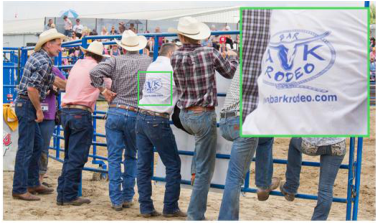
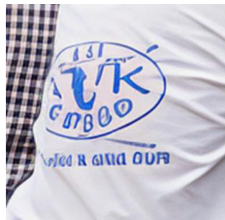
Prior fixes tried feeding pixel hints as external conditions to the latent generator, but two leaks remained: the generative trajectory could still drift away from the original structure, and the frozen VAE decoder at the very end would blur out fine spatial details during final rendering.
Methods
Instead of throwing out pretrained latent models, the authors keep the heavy machinery—specifically FLUX.1-dev and its VAE—completely frozen. Standard adaptation tools like ControlNet and LoRA (low-rank adapters) handle the heavy lifting, while the authors introduce a novel dual-stage bypass called Pixel-Grounded Guidance:
- Pre-VAE Pixel Extraction: Before the low-resolution image ever touches the VAE encoder, a lightweight convolutional extractor grabs raw spatial features (edges, boundaries, local colors) at multiple scales.
- Condition-Side Trajectory Guidance: One stream of this pre-VAE pixel evidence is fused via a learnable gate directly into the compressed latent condition feeding the ControlNet. This acts like a structural tugboat, keeping the flow-matching trajectory from drifting into hallucination territory.
- Decoder-Side Pixel Grounding: A second stream of multi-scale pixel features is injected straight into the frozen VAE decoder via zero-initialized adapters (Decoder-side Feature Modulation, or DFM). When the latent is finally translated back into an image, the decoder has direct access to the original pixel blueprint.
To keep high-resolution compute from exploding, the authors also swap out dense global attention in selected transformer blocks for local-window (sparse) attention, letting tokens focus primarily on their immediate neighbors.
Datasets
No new datasets were introduced; the authors rely on established benchmarks to test both synthetic and real-world grit:
- Training: Stage 1 pretrains on clean bicubic $\times 4$ pairs from DF2K (DIV2K + Flickr2K). Stage 2 fine-tunes on a larger mixed corpus (DF2K, LSDIR, FFHQ, and OST) corrupted online with realistic second-order blur, noise, and compression degradations.
- Evaluation: Tested on DIV2K-Val (synthetic), alongside RealSR and DRealSR (real-world captured low/high-res camera pairs). They also use TextOCR-val to test tiny-text legibility and DIV8K for extreme 8K upscaling demos.
Key Insights and Ideas
- Even a "perfect" latent is already broken: In a clever sanity check, the authors fed pristine, high-resolution ground-truth images directly into standard SD and FLUX VAEs (encode $\rightarrow$ decode, zero diffusion involved). The reconstructions came back with unreadable text and warped fine patterns (~25 dB PSNR). You cannot expect a latent denoiser to faithfully restore details that its own decoder is mathematically incapable of rendering alone.
- Grounding is a two-part job: Ablation studies show that guiding only the latent trajectory or only the VAE decoder leaves performance on the table. You have to constrain both what the model imagines in latent space and how it paints the final pixels.
- Selective image-space supervision: Pixel-level perceptual losses (LPIPS and $L_1$) are gated so they only kick in at low noise levels during training, preventing unstable gradient updates when the latent estimate is still mostly static.
Key Results
Across $\times 4$ upscaling benchmarks, PGSR hits a sweet spot between strict pixel fidelity and visual realism:
- Benchmark Accuracy: Achieves the best fidelity and perceptual scores on DIV2K-Val (25.89 dB PSNR, 0.2104 LPIPS, 24.88 FID) and DRealSR (25.97 dB PSNR, 46.15 FID), while taking top LPIPS (0.2596) and DISTS (0.1365) honors on RealSR.
- Dramatic Text Rescue: On tiny scene text (just 4–8 pixels tall in the input!), PGSR hits 27.48% word recognition accuracy—more than tripling strong diffusion baselines like PASD (8.36%), PiSA-SR (7.32%), and SeeSR (7.17%).
- High-Res Speedup: Switching to sparse local-window attention slashes 20-step inference time by ~37% at $1792^2$ and $1536^2$ resolutions (dropping from 61.8s to 38.9s on DIV2K) with only a ~0.5 dB PSNR dip, and unlocks crisp $2\text{K} \rightarrow 8\text{K}$ upscaling.
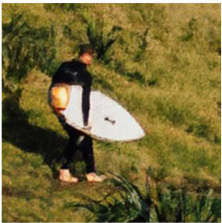
Here is how PGSR restores a blurry surfer crop without inventing weird, over-sharpened artifacts:

Limitations and Future Work
Because PGSR builds on a massive pretrained FLUX backbone and ControlNet, it demands hefty GPU memory during training and runs noticeably slower (~37–62 seconds per high-res image) than lightweight, one-step SR models. Furthermore, because its training objective prioritizes staying faithful to the low-resolution input, its textures can occasionally look slightly smoother than methods that throw caution to the wind for maximum perceptual sharpness. For future work, the authors suggest exploring model distillation to speed up inference and sharpen textures without sacrificing input-output consistency.
Summary updated