


TL;DR
TIBECG introduces a "temporal information bottleneck" to protect demographic privacy in ECG waveforms released for remote diagnostic classification. By architecturally restricting internal time resolution, it successfully suppresses age and sex inference by a median of 22 percentage points over conventional methods while retaining at least 95% of diagnostic utility.
What Problem Does This Paper Address?
Electrocardiogram (ECG) waveforms are rich data sources. While they are primarily used to diagnose heart conditions, they also inadvertently leak sensitive demographic information like age and sex. This creates a privacy risk in modern "cloud-service" deployment models: if a proprietary diagnostic AI lives in the cloud, a consumer device must transmit the raw (or processed) waveform to get a diagnosis.
Existing methods like adding noise or downsampling often destroy the very features needed for accurate diagnosis. The authors tackle the challenge of creating a "protector" that can strip away demographic cues while preserving the specific signal features required by a pre-trained, frozen diagnostic classifier.
Methods
The authors propose TIBECG, an architectural temporal information bottleneck. Unlike standard Variational Autoencoders (VAEs) that might bottleneck the entire representation, TIBECG specifically targets temporal resolution.
The system consists of:
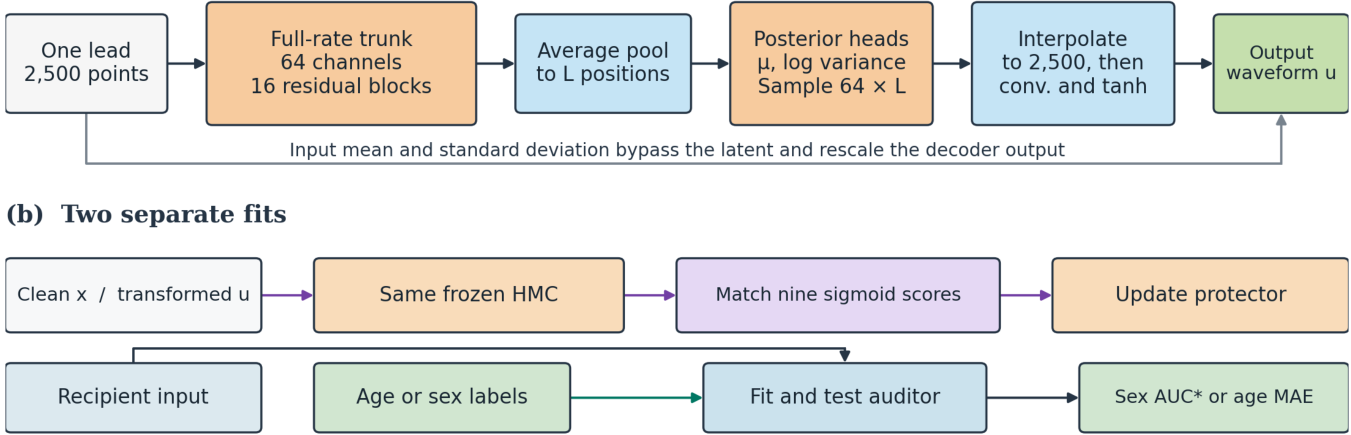
- A "Protector" Processor: A CNN-based encoder that processes a single-lead ECG, an adaptive average pooling layer that reduces the sequence to $L$ latent positions (the bottleneck), and a decoder that reconstructs the waveform to its original length.
- Utility-Only Training: The protector is trained to minimize the difference between the diagnostic scores of a frozen "teacher" classifier (HMC) on the clean waveform versus the protected waveform. Crucially, no age or sex labels are used during training; the model learns to preserve what the classifier needs, not explicitly what the adversary wants.
- Empirical Auditing: To measure privacy, the authors separately train "auditor" models (adversaries) to predict age and sex from the released waveforms.

Datasets
The study uses the CPSC2018 public training set, which contains 6,877 clinical twelve-lead ECGs. After filtering for records with complete demographic data and sufficient length, 6,386 records were used. The data includes various conditions such as atrial fibrillation, bundle branch blocks, and ST-segment changes.
Key Insights and Ideas
- Lead-Specific Privacy: Privacy is not uniform across the heart. Leads V2, V3, and V4 (the anterior leads) naturally leak significantly more sex information than others. This suggests that privacy-preserving measures must be evaluated on a lead-by-lead basis.
- Utility Preservation over Privacy Maximization: Compared to direct downsampling, TIBECG is "gentler." While downsampling can suppress demographics more aggressively, it does so at a catastrophic cost to diagnostic accuracy. TIBECG finds a better "Pareto frontier" for utility.
- KL Divergence is a Poor Proxy: In many information bottleneck studies, Kullback-Leibler (KL) divergence is used to estimate information leakage. This paper finds that at a fixed bottleneck length, lower KL divergence does not reliably correlate with less sex leakage, highlighting the need for direct empirical auditing.
- Architectural vs. Conventional Transforms: TIBECG consistently outperformed eight conventional transformations (like Gaussian/Laplace noise, quantization, and block permutation) in maintaining the utility-privacy balance.
Key Results
The authors evaluated 21 different bottleneck lengths ($L$) across all 12 clinical leads.
- Utility Retention: For every lead, there was a TIBECG setting that retained at least 95% of the clean macro-F1 score.
- Privacy Gain: At this 95% utility floor, TIBECG provided a median 22.08 percentage point advantage in privacy gain over the best eligible conventional transformation.
- Lead V1 and V6: These leads were particularly robust, maintaining high diagnostic utility even at very short bottleneck lengths.
Limitations and Future Work
- Clinical vs. Consumer Data: The study used high-quality hospital recordings. Real-world consumer devices face challenges like motion artifacts, baseline drift, and poor electrode contact, which were not modeled here.
- Human Interpretability: The "protected" waveforms were not evaluated by cardiologists. It is unknown if a human could still accurately interpret a TIBECG-processed trace or if the process introduces "unreadable" artifacts.
- Retrospective Selection: The optimal bottleneck length $L^*$ was selected retrospectively. Future work is needed to determine if these selections generalize to entirely new cohorts or different hardware.
- No Formal Guarantee: The authors emphasize that these are empirical audits, not formal differential privacy guarantees. A stronger adversary or repeated releases might still reveal sensitive data.
Summary updated