


Abstract
New metabolites designated as thiazocins A and B were isolated from the culture broth of Actinosynnema sp. C-304. These compounds exhibit potent inhibitory activities against aldose reductase purified from human placenta, suggesting potential therapeutic applications for diabetic complications.
Introduction
In the management of diabetes, the polyol pathway is a critical target for preventing long-term complications. The enzyme aldose reductase (AR) catalyzes the reduction of glucose into sorbitol. Under hyperglycemic conditions, excessive sorbitol accumulation leads to osmotic stress and cellular damage in tissues such as the eyes and nerves, driving the development of cataracts and neuropathy.
Developing effective Aldose Reductase Inhibitors (ARIs) is a primary pharmacological goal. This study explores naturally occurring ARIs produced by microorganisms, identifying two new sulfur-containing acidic molecules, Thiazocins A and B, from the soil bacterium Actinosynnema sp. C-304.
Isolation and Characterization
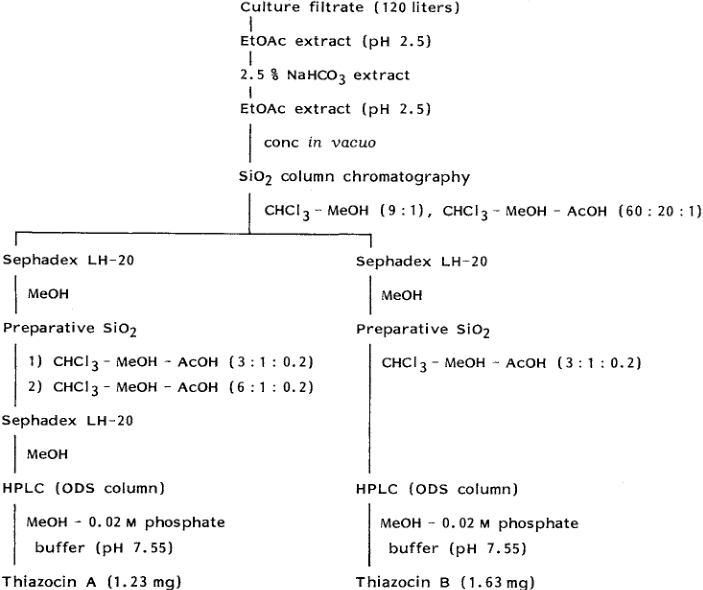
The discovery process utilized a robust natural products pipeline, starting with the fermentation of Actinosynnema sp. C-304 in 120-liter jar fermenters. The active metabolites were recovered from the culture filtrate through a series of solvent extractions and chromatographic steps.
 *[Thiazocins, new aldose reductase inhibitors from Actinosynnema sp.
- Fermentation, isolation and characterization., page 2](/pdf/art_8cf9ef31140e473197081a653a065f39#page=2)*
As detailed in the isolation scheme (Figure 2), the crude ethyl acetate extract was purified using silica gel column chromatography, Sephadex LH-20 size-exclusion chromatography, and finally, preparative High-Performance Liquid Chromatography (HPLC) on an ODS column. This process yielded 1.23 mg of Thiazocin A and 1.63 mg of Thiazocin B.
Chemical characterization was performed using Ultraviolet (UV), Infrared (IR), and Nuclear Magnetic Resonance (NMR) spectroscopy. Thiazocin A ($C_9H_7NO_3S$, MW 209) and Thiazocin B ($C_{18}H_{17}N_3O_6S_2$, MW 435) were both isolated as white powders with distinct physical properties.
 *[Thiazocins, new aldose reductase inhibitors from Actinosynnema sp.
- Fermentation, isolation and characterization., page 4](/pdf/art_8cf9ef31140e473197081a653a065f39#page=4)*
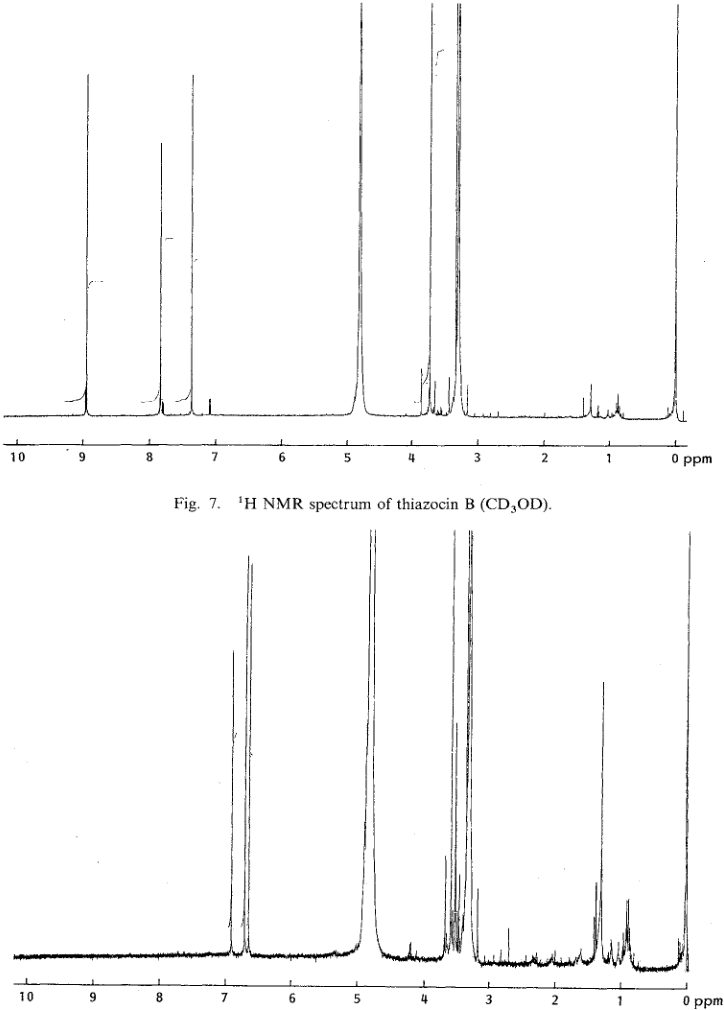
The $^1$H NMR spectra (Figure 6) provide a fingerprint for these novel structures, showing the characteristic proton environments in the sulfur-containing acidic frameworks. Thiazocin B appears to be approximately twice the molecular size of Thiazocin A, suggesting a complex structural relationship between the two.
Biological Activity and Potency
The inhibitory potency of the purified thiazocins was evaluated against human placental aldose reductase. Both compounds demonstrated high activity at sub-micromolar concentrations:
- Thiazocin A: $IC_{50} = 4.55 \times 10^{-7} M$
- Thiazocin B: $IC_{50} = 2.20 \times 10^{-7} M$
Notably, despite their microbial origin, Thiazocins A and B do not possess traditional antibiotic properties. They showed no inhibitory effects against a range of Gram-positive and Gram-negative bacteria or fungi, indicating they are highly specialized enzyme inhibitors.
Conclusion and Future Work
This research identifies Thiazocins A and B as a new class of potent aldose reductase inhibitors. While this initial report focuses on their fermentation, isolation, and basic characterization, subsequent studies are required to fully elucidate their three-dimensional chemical structures. Further investigation into their in vivo stability and therapeutic efficacy in animal models of diabetic complications will be essential to determine their clinical potential.
Summary updated