


TL;DR
Designing 3D drug molecules with generative AI requires moving atoms in continuous 3D space while simultaneously clicking discrete chemical bonds into place. This paper introduces a Reinforcement Learning (RL) framework that steers these hybrid "flow matching" models toward real-world drug discovery goals—like tight protein binding and easy synthesis—without adding unnecessary noise or letting easy-to-solve properties bully the harder ones during training.
What Problem Does This Paper Address?
Generative flow matching models have become exceptional at dreaming up valid 3D molecules from scratch. The best versions are hybrids: they smoothly push atomic coordinates through continuous 3D space using Ordinary Differential Equations (ODEs), while hopping between discrete atom types, charges, and bonds via Continuous-Time Markov Chains (CTMCs).
However, generating chemically valid molecules isn't enough for drug discovery; we need molecules that are drug-like (QED), easy to synthesize in a lab (SAS), and bind tightly to disease-causing proteins. Steering flow matching toward these properties with Reinforcement Learning (RL) runs into three roadblocks:
- The Hybrid Likelihood Gap: RL needs to know the exact probability of every action taken to assign credit. While continuous RL is well-studied, unifying continuous coordinate shifts and discrete CTMC jumps under a single, mathematically consistent transition likelihood has remained an open challenge.
- Noisy Exploration: Standard flow matching uses deterministic ODE paths, giving RL zero wiggle room to explore. The usual workaround converts the entire generation timeline into a noisy Stochastic Differential Equation (SDE). Yet, molecular properties aren't shaped uniformly over time—injecting noise everywhere wastes compute and corrupts steps that have nothing to do with the target property.
- Multi-Objective Dominance: Drug design is a tug-of-war. Easier objectives with steep reward gradients (like basic drug-likeness) quickly hijack the training updates, leaving harder, complex objectives (like 3D pocket binding affinity) behind.
Methods
Starting with a pretrained hybrid flow matching backbone (FlowMol3) and Proximal Policy Optimization (PPO), the authors introduce three key innovations:
(Note: Let's look at the full workflow below in Figure 2)
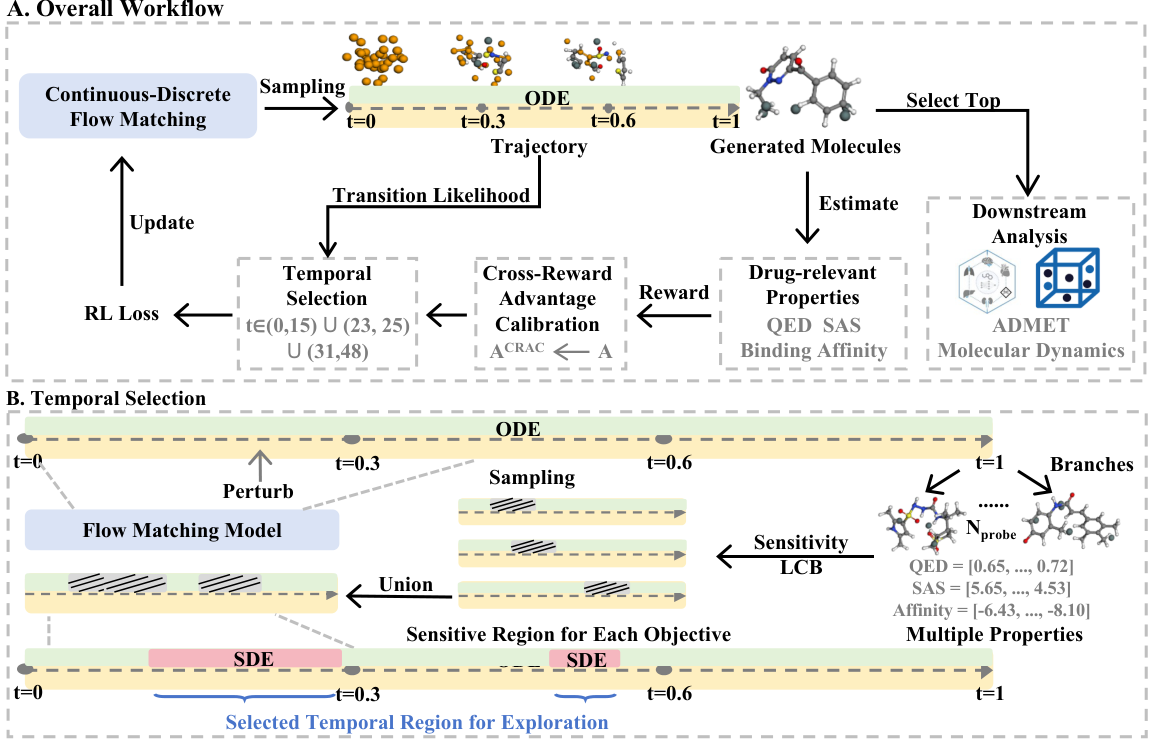
- Unified Continuous-Discrete Likelihoods: For 3D coordinates, the deterministic ODE is converted into a tractable Gaussian SDE step. For discrete elements (atoms, bonds, charges), likelihoods are derived directly over the CTMC stochastic masking and unmasking decisions. Adding their log-probabilities yields a clean, unified joint likelihood for PPO updates.
- Temporal Selective Exploration: Before RL training begins, the model runs "probe" trajectories. At various timesteps, it branches out with random perturbations to see how much the final drug properties actually change. Using a statistical Lower Confidence Bound (LCB) to filter out noise, it identifies the exact time windows where properties are sensitive to change. During RL, stochastic exploration is switched on only inside this union of sensitive windows, leaving the rest of the trajectory clean.
- Cross-Reward Advantage Calibration (CRAC): Instead of endlessly maximizing rewards (which leads to over-optimizing easy metrics), rewards are capped once strict target cutoffs are met. CRAC then dynamically re-weights PPO advantages based on how far each property is from its target across the batch, paired with a joint-success bonus when all criteria are satisfied together.
Datasets
- Molecular Pretraining & Generalization: GEOM-Drugs (a large-scale dataset of drug-like 3D conformers) serves as the primary dataset, with QM9 used in the appendix to test methodological generality. No new benchmarks are introduced.
- Protein Targets: Two cancer-related proteins from the Protein Data Bank—EGFR (PDB:
3W2S), a well-studied receptor, and Pin1 (PDB:3IKD), a notoriously challenging target linked to triple-negative breast cancer.
Key Insights and Ideas
- Timing is everything in molecular generation: Perturbing a trajectory early on (
t < 0.2) dramatically swings final QED, SAS, and binding affinity scores, whereas perturbing pastt = 0.6barely registers. Restricting SDE exploration to just those early, high-leverage moments dramatically outperforms full-trajectory noise.
- Both halves of the hybrid matter: Ablating RL updates on either the discrete chemical identities or the continuous 3D coordinates causes a steep drop in performance—proving that 2D topology and 3D geometry must adapt together to fit a protein pocket.
- Inference-time filtering sacrifices diversity: Pure sampling tricks like Sequential Monte Carlo (SMC) can find decent molecules without training, but they collapse uniqueness (down to ~65–68%), whereas RL optimization shifts the underlying generator while keeping uniqueness above 99.6%.
Key Results
Evaluated on the percentage of generated molecules simultaneously passing Strict drug criteria ($\text{QED} \ge 0.6$, $\text{SAS} \le 4$, and docking affinity $\le -7.5\text{ kcal/mol}$):
- EGFR (
3W2S): The framework hits a 70.77% strict success rate (up from 47.53% in the base model), beating SMC (63.50%), PCGrad (67.37%), and Full-SDE exploration (49.87%), while maintaining 99.77% validity and 100% novelty. - Pin1 (
3IKD): On this much harder pocket, strict success more than doubles from 0.37% (base model) to 0.83% (vs. 0.57% for SMC and 0.40% for Full-SDE), with loose success reaching 7.63%. - In Silico Validation: For Pin1, the top generated candidate beat the known co-crystallized reference ligand across the board—scoring higher in drug-likeness (0.91 vs. 0.85), easier synthesizability (3.75 vs. 4.78), stronger docking affinity (-7.50 vs. -7.10 kcal/mol), cleaner predicted toxicity/ADMET profiles, and lower structural fluctuation (RMSD) in 10 ns Molecular Dynamics simulations.
Limitations and Future Work
While the main text does not include a dedicated limitations section, the authors explicitly frame their results as early-stage molecular discovery backed solely by in silico computational metrics (AutoDock Vina, ADMET predictors, and short MD simulations). As they note regarding their top Pin1 inhibitor candidate, wet-lab experimental synthesis and biological validation remain necessary future steps to confirm real-world therapeutic activity.
Summary updated