


Diffusion models have taken the generative AI world by storm, but their application in wireless communications often hits a snag: the real world isn't always Gaussian. Wireless channels frequently exhibit "heavy-tailed" behavior—think sudden, impulsive interference or fading—and they aren't just random snapshots; they evolve over time.
A new paper from researchers at the American University of Beirut, titled "Temporal Diffusion Models for Joint Signal-Channel Estimation under Gaussian and $\alpha$-Stable MIMO Channels," tackles these challenges head-on. They propose a framework that uses diffusion models to jointly estimate signals and channels while accounting for both temporal dependencies and non-Gaussian statistics.
TL;DR
This paper introduces a diffusion-based framework for joint signal and channel estimation in MIMO systems that leverages temporal correlations and specialized heavy-tailed ($\alpha$-stable) priors. By adapting "canonical" diffusion models to specific channel conditions without retraining, the authors achieve significantly better reconstruction quality and channel estimation accuracy than traditional independent or Gaussian-only methods.
What Problem Does This Paper Address?
In Multiple-Input Multiple-Output (MIMO) systems, the receiver needs to figure out two things: what was sent (the signal) and how the environment distorted it (the channel).
Most existing diffusion-based solutions face two major limitations:
- The Gaussian Assumption: They rely on Gaussian distributions, which fail to capture the "heavy tails" of impulsive noise or fading common in many wireless environments.
- Temporal Blindness: They often treat each time step independently, ignoring the fact that wireless channels usually change gradually. This "memoryless" approach throws away valuable information from previous observations.
The authors aim to bridge this gap by developing diffusion models that are both "tail-aware" and "time-aware."
Methods
The researchers developed a multi-pronged approach to refine diffusion-based inference for communications:
- Heavy-Tailed Diffusion (DLPM & LIM): Instead of standard Gaussian diffusion (DDPM), they utilize Denoising Levy Probabilistic Models (DLPM) and Levy-Ito Models (LIM). These variants replace Gaussian noise with $\alpha$-stable noise in the diffusion process, allowing the model to better represent impulsive data.
- Canonical Adaptation: A major practical contribution is showing how a diffusion model trained on a "standard" distribution (e.g., zero mean, unit scale) can be mathematically transformed to match any specific location, scale, or covariance without retraining. This makes the models highly flexible for changing channel conditions.
- Temporal Predictive Priors: Rather than starting from scratch at each time step, the receiver uses the previous channel estimate to form a predictive prior. This exploits the temporal correlation ($\rho_H$) of the channel, effectively giving the model "memory."
- Joint Likelihood Guidance: For "blind" recovery (where neither the signal nor the channel is known), the authors use separate diffusion models for the source (e.g., an image) and the channel. These are coupled during the reverse diffusion process through a shared observation likelihood gradient.
Datasets
- MNIST: The classic handwritten digit dataset was used as the source signal for joint image-channel recovery experiments.
- Synthetic MIMO Channels: The authors generated synthetic channel data using first-order autoregressive models to simulate both Gaussian and symmetric $\alpha$-stable (S$\alpha$S) fading with varying degrees of temporal correlation.
Key Insights and Ideas
- The "Tail" Matters: If the channel is heavy-tailed, using a standard Gaussian diffusion model leads to significant performance degradation. Matching the diffusion noise family to the underlying data distribution is crucial.
- Time is an Asset: As the channel becomes more correlated over time (higher $\rho_H$), the benefit of temporal priors grows. The model essentially "learns" the channel's evolution, leading to much sharper signal recovery.
- Efficiency through Math: The ability to adapt canonical models to different means and scales without retraining is a "huge win" for real-world deployment, where channel statistics can shift rapidly.
Key Results
The authors evaluated their methods across two main scenarios: pilot-based channel-only estimation and blind joint recovery.
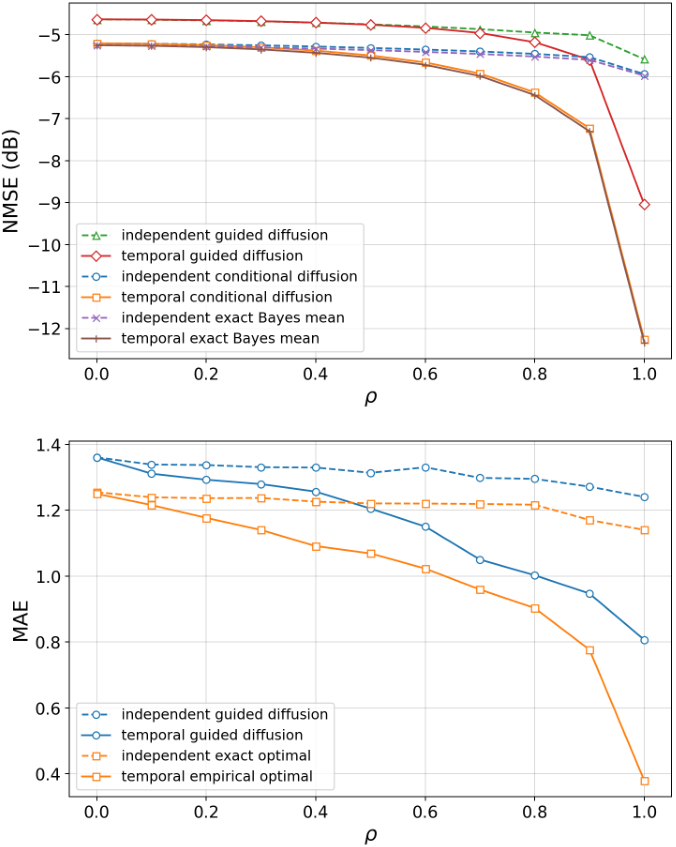
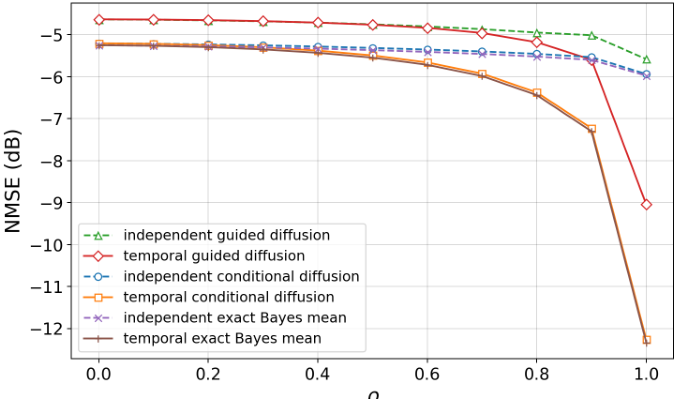
- Temporal Gains: In channel-only estimation, temporal methods significantly outperformed independent ones as correlation increased. For Gaussian channels, the Normalized Mean Squared Error (NMSE) dropped by several decibels when using temporal priors at high correlation ($\rho \approx 1$).
- Heavy-Tailed Robustness: For $\alpha$-stable channels, the temporal DLPM method showed a marked reduction in Mean Absolute Error (MAE) compared to independent processing.
- Joint Recovery Quality: In blind MIMO recovery, temporal awareness improved both the image MS-SSIM (a measure of visual quality) and channel estimation accuracy across all tested Signal-to-Noise Ratios (SNR).
- Visual Impact: The qualitative results are striking. Under heavy-tailed conditions, the matched $\alpha$-stable prior (DLPM) produces recognizable images where a mismatched Gaussian prior (DDPM) yields only noise.
Limitations and Future Work
While promising, the authors acknowledge a few hurdles:
- Initial Knowledge: The blind MIMO setting currently assumes the receiver has a perfect estimate of the initial channel ($H_0$), which might require a long training phase in practice.
- Uncertainty Propagation: The current temporal model treats the previous estimate as "exact" when forming the next prior. A more robust approach would explicitly propagate the estimation uncertainty over time.
- Computational Complexity: Like all diffusion-based methods, the iterative sampling process is computationally intensive, which remains a challenge for real-time, low-latency communication systems.
Summary updated