


TL;DR
This paper investigates the linguistic gap between human and AI-generated language by pitting Large Language Models (LLMs) against humans in the high-stakes arena of improvisational comedy. While GPT-4o can craft coherent scenes, it fails to replicate the messy spontaneity of human dialogue, tending toward overly long, syntactically rigid, and "too-polite" interactions that lack the raw emotional depth of human humor.
What Problem Does This Paper Address?
As LLMs become increasingly integrated into our digital lives, a critical question emerges: How "natural" is the language they produce? While these models excel at formal tasks, the authors argue that humorous improvisational dialogue represents a "final boss" for natural language generation.
Improv requires more than just grammar; it demands real-time semantic, pragmatic, and cultural agility. Participants must follow the "Yes, and..." principle—accepting a partner's premise and building upon it instantly. The authors seek to identify the defining characteristics of "synthetic" language by comparing it to "spontaneous" human speech in a setting where there is no time for premeditation.
Methods
The researchers developed a comparative framework to analyze two distinct corpora:
- Spontaneous (Natural) Corpus: Transcripts from the Spanish-language improvisational TV show ¿Quién dijo yo?, where actors perform scenes based on audience prompts.
- Synthetic Corpus: A multi-agent environment powered by GPT-4o.
To move beyond simple "scriptwriting," the authors designed a novel multi-agent setup. Instead of asking one LLM to write a whole scene, they assigned individual agents specific personas (e.g., "the jealous ex-boyfriend"). These agents interacted in a shared context but with a randomized turn-taking mechanism to better simulate the unpredictability of a live performance.
The analysis utilized a "hybrid" approach:
- Automated Tools: Measuring turn length, lexical richness (MATTR), Part-of-Speech (POS) tags, and Named Entity Recognition (NER).
- Manual Linguistic Annotation: Grounded in Systemic Functional Linguistics (SFL), specifically "Appraisal Theory," which categorizes how speakers express emotions (Affect), social evaluations (Judgment), and aesthetic values (Appreciation).
Datasets
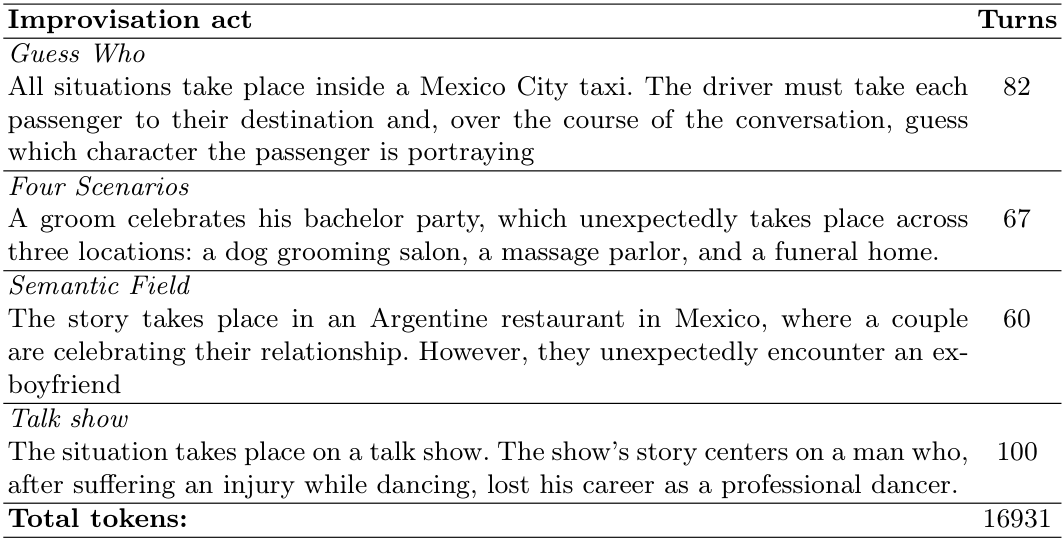
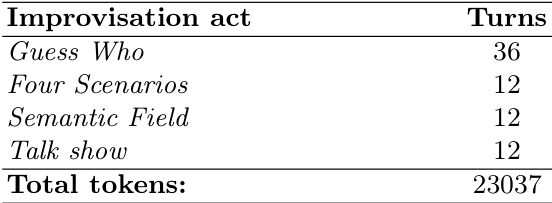
The study focused on four specific improvisation scenarios (e.g., a taxi driver guessing a passenger's identity, a bachelor party in a funeral home).
- Natural Corpus: 309 turns across 4 acts (~17k tokens).
- Synthetic Corpus: Replicated versions of the same 4 acts (~23k tokens), with additional data generated through repeated runs (~155k tokens) to ensure statistical consistency.
Key Insights and Ideas
- The "Scriptwriter" Bias: LLMs behave more like playwrights than actors. Their turns are significantly longer and more self-contained, lacking the rapid-fire interruptions and short interjections (e.g., "Wait, what?") that characterize human improv.
- The Politeness Trap: Due to safety alignment, LLMs exhibit a strong bias toward positive evaluations and "sycophantic" behavior. Human humor, by contrast, frequently relies on confrontation, negative judgments, and "inappropriate" remarks to create comedic tension.
- Lexical Diversity vs. Cognitive Load: Surprisingly, the LLMs showed higher lexical diversity (MATTR) than humans. In linguistics, this is a tell-tale sign of "synthetic" language; humans in real-time settings repeat words and use simpler structures because of the cognitive load of thinking on their feet.
- Affect vs. Appreciation: Humans primarily use "Affect" (expressing internal emotions) to drive humor. LLMs lean heavily on "Appreciation" (evaluating external objects or situations), making their humor feel more detached and descriptive rather than felt.
Key Results
- Turn Length: The average human turn was just 9.42 words, while the LLM average was a whopping 51 words.
- Attitudinal Shift: In the human corpus, 55.6% of evaluative language was categorized as "Affect" (emotion). In the synthetic corpus, this dropped to 32.8%, with "Appreciation" rising to 51.1%.
- Syntactic Complexity: LLMs used more adjectives, determiners, and coordinating conjunctions, resulting in highly structured, "grammatically perfect" sentences that feel unnatural in a spontaneous spoken context. Humans favored parataxis—short, independent clauses that don't rely on complex sub-clauses.
Limitations and Future Work
The authors acknowledge that their corpus is relatively small (4 acts) due to the labor-intensive nature of manual SFL annotation. Furthermore, LLMs currently struggle with "instruction drift," where they begin to lose their assigned persona after about eight turns.
Future work suggests that fine-tuning on specific persona-based datasets—rather than relying on zero-shot prompting—might help LLMs capture the "deeper" traits of human interaction. Additionally, the researchers point out that prosody (tone of voice, timing) remains a major hurdle that text-based models cannot yet address in the context of "spotting the artificial."
Summary updated