


TL;DR
In sign language, how your hands move over time—a quick tap versus a broad sweep—can change "airplane" into "fly." Standard generative flow models struggle to preserve these crisp temporal rhythms when steered by text guidance, often blurring distinct movements into generic averages. By teaching the model’s training algorithm to pay attention to motion frequencies, the authors unlock cleaner, far more semantically accurate sign language generation.
What Problem Does This Paper Address?
Generating sign language from spoken-language text is fundamentally a one-to-many puzzle: a single sentence can be signed in multiple valid ways depending on the signer and context. Flow-matching models paired with Optimal Transport (OT) handle this well by learning straight paths from random noise to 3D body poses. To ensure the generated signs actually match the text's meaning, researchers naturally reach for Classifier-Free Guidance (CFG)—the same steering trick that makes text-to-image models stick closely to prompts.
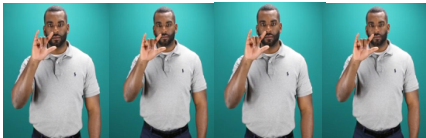
Here lies the catch. In sign languages, meaning lives in temporal dynamics. Consider minimal pairs like airplane (repeated small motions) versus fly (a single large sweep), or chair (repeated movement) versus sit (a single motion). Suppressing those rhythms produces motions that look smooth and human, yet say the wrong thing.

Training a model with CFG requires randomly dropping the text prompt (condition dropout) so a single network learns both conditional and unconditional motion distributions. During training, minibatch OT pairs noise samples with target sign motions using standard Euclidean distance in pose space. Because human motion energy is dominated by slow, gross body trajectories, Euclidean distance is practically blind to fast, subtle oscillations. During unconditional updates, a noise sample can get paired with wildly incompatible motion dynamics across the dataset, muddying the training signal and limiting how well CFG works at inference.
Methods
The authors build on a standard Conditional Flow Matching with Minibatch Optimal Transport (CFM-OT) baseline and standard CFG training, introducing Spectral Optimal Transport (SOT) to fix the pairing step.
Instead of coupling noise and target sequences using only pose-space Euclidean distance, SOT adds a spectral distance to the assignment cost before running the Hungarian matching algorithm:
- Temporal DCT Descriptor: Each pose trajectory is transformed into the frequency domain along the time axis using a Discrete Cosine Transform (DCT-II)—a classic, hyperparameter-free way to summarize periodicity and smoothness.
- Frequency Reweighting: Because low frequencies dominate raw motion energy, the authors apply a linearly increasing gain (from $1$ at the lowest frequency to $\beta=3$ at the highest) to amplify faster-varying components like repetition and articulation speed.
- Ratio-Normalized Cost: To keep the spectral penalty balanced against raw pose distance, the spectral cost matrix is normalized by the minibatch mean ratio of the two costs and scaled by a knob $\rho$ (set to $2 \times 10^{-2}$).
Datasets
No new datasets are introduced. The authors evaluate on two standard, large-scale benchmarks preprocessed into 3D SMPL-X body and hand poses:
- CSL-Daily: Roughly 20,000 samples of Chinese Sign Language covering daily conversations.
- Phoenix-2014T: Roughly 8,000 samples of German Sign Language from weather forecast broadcasts.
Key Insights and Ideas
- Noise acts as a dynamics-neutral probe: Wait—Gaussian prior noise doesn't have meaningful "motion dynamics," so why compare its spectrum to a real sign's spectrum? Because minimum-cost bipartite matching only cares about cross-terms, SOT actually reweights the metric of the space. Isotropic noise under a linear DCT acts as a neutral probe, nudging near-tied assignments to resolve in favor of targets with distinct high-frequency dynamics (changing the dominant matched partner about 7.7% of the time).
- Condition dropout hurts naive OT, and SOT heals it: Sharing network weights between masked (unconditional) and unmasked updates under Euclidean OT actively degrades unguided generation quality. Applying SOT specifically to the masked branch recovers nearly all of that lost performance, proving that unconditional coupling mismatches were the hidden culprit.
- A Goldilocks zone for frequency weighting: Cranking the spectral weight $\rho$ too high ($\ge 10^{-1}$) overwhelms spatial pose matching and tanks quality; keeping it gentle ($2 \times 10^{-2}$) hits a sweet spot where spatial and temporal cues cooperate.
Key Results
SOT combined with CFG beats prior state-of-the-art methods across every pose and semantic metric on both datasets.
(Note: See Table 1 below for exact benchmark figures.)
- Big semantic leaps: Measured via Back-Translation (where a separate sign-to-text model translates generated poses back into words), BLEU-4 jumps from 6.84 to 9.09 (+2.25) on CSL-Daily and from 8.91 to 9.78 (+0.87) on Phoenix-2014T over the SignFlow baseline. On CSL-Daily, 9.09 approaches the ground-truth upper bound of 9.27.
- Preserved pose accuracy: Joint position errors (DTW-aligned PA-JPE and JPE) improve modestly across the board (e.g., CSL-Daily Body JPE drops from 7.45 to 6.87), showing that sharper semantics don't come at the expense of anatomical realism.
- Crisper qualitative motion: Generated avatars exhibit distinct repetitions and spatial placements, avoiding the over-smoothed, generic trajectories of pose-only baselines.
Limitations and Future Work
- No facial expressions: Sign languages rely heavily on non-manual cues—raised eyebrows, mouth shapes, head tilts—to convey grammar and tone. This study focuses strictly on body and hand motion; integrating facial expressions is left for future work.
- Dataset sensitivity without guidance: On Phoenix-2014T, training with condition dropout slightly lowers performance when guidance is turned off at inference, suggesting that the exact interplay between masking and coupling depends on dataset-specific variability.
Summary updated