


TL;DR
This paper provides a quantitative framework to explain why "soft" or compliant robot bodies simplify control. By using information theory and Reproducing Kernel Hilbert Spaces (RKHS), the authors demonstrate that compliance reshapes the probability distribution of a robot's movements, effectively "outsourcing" computational effort to the physical body.
What Problem Does This Paper Address?
A massive gap exists between the adaptivity of biological systems and the rigid, top-down control of modern robots. Traditional robotics often follows a "Cartesian" approach, strictly separating the "mind" (the controller) from the "body" (the mechanics). In contrast, animals and plants leverage morphological computation, where the physical structure itself performs part of the information processing required for movement.
The authors tackle the challenge of quantifying this phenomenon. How exactly does adding "softness" or compliance to a robot's ankle, for example, make it easier to control? They seek a mathematical bridge between mechanical dynamics and informational complexity to provide guidance for designing hybrid hard-and-soft robots.
Methods
The researchers use Passive Dynamic Walkers—mechanical models that can walk down a slope without any motors—as their primary testbed. They progressively add complexity to these models, moving from a rigid "simplest walker" to versions with knee-ankle compliance and rocker feet.
Key technical approaches include:
- Phase-Space Volume ($W$): They calculate the volume of the "viable" state space—the set of positions and velocities from which the walker can successfully complete a step (see Figure 1).
- Information Metrics: They link this volume to Kolmogorov complexity, providing a bound on the "length" of the control program needed.
- Monte-Carlo Estimation: A state-dependent sampling method is used to estimate these viable volumes under various conditions, such as different slope angles.
- RKHS Distributional Complexity: Moving beyond simple volume, they introduce a framework based on Reproducing Kernel Hilbert Spaces (RKHS). This allows them to measure not just the size of the possible state space, but how the robot's dynamics actually populate that space.
Datasets
The paper does not use external datasets. Instead, it generates data through extensive numerical simulations of the walker models. For the Monte-Carlo analysis, they used $10^5$ samples drawn uniformly from energy-bounded regions to estimate phase-space volumes and complexity measures.
Key Insights and Ideas
- Geometry vs. Dynamics: The authors argue that while geometry (the physical shape) determines where locomotion is possible, the dynamics determine how locomotion is distributed across those possibilities.
- Compliance as a Statistical Filter: A major "aha moment" is the finding that compliance doesn't necessarily shrink the set of possible states (the geometric support). Instead, it redistributes the probability mass toward lower-energy states.
- The Mind-Body Nexus: Morphological computation is redefined as the capacity of physical embodiment to reshape the "metric-measure structure" of behavior. By making certain efficient movements more "likely" or "natural" for the body, the informational burden on the controller is reduced.
- Beyond Volume: While phase-space volume is a useful "zeroth-order" descriptor, the RKHS formulation captures the subtle statistical organization that truly defines control complexity.
Key Results
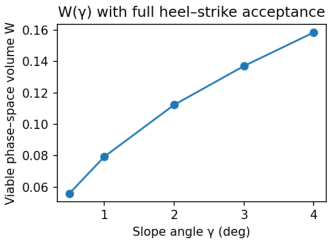
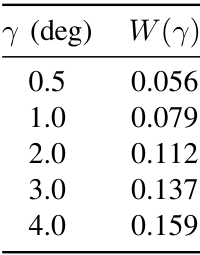
The study quantifies how the viable phase-space volume $W(\gamma)$ changes with the environment, specifically showing it increases as the slope angle $\gamma$ gets steeper.
In a direct comparison between a rigid model and a compliant one with identical geometric support:
- Mean Task Energy: The compliant model naturally gravitated toward lower energy states (0.3328 vs. 0.5004 for the rigid model).
- Distributional Complexity: The RKHS complexity measure was significantly lower for the compliant system (9.865) compared to the rigid one (11.935).
This proves that compliance reduces the "computational effort" needed for control by organizing the system's natural behavior into a simpler, more predictable structure.
Limitations and Future Work
The authors acknowledge several areas for further development:
- Scalability: The current theory needs more efficient numerical approximations to handle high-dimensional and stochastic systems.
- Direct Resource Mapping: While they show that complexity is reduced, they haven't yet established a direct one-to-one mapping between their $C(P)$ metric and specific hardware resources like CPU cycles or memory usage.
- Learning Integration: A promising future direction is integrating these information-geometric metrics into "physics-aware" machine learning algorithms to optimize body and brain simultaneously.
Summary updated