


TL;DR
Current AI coding benchmarks evaluate models in a "single-shot" manner, failing to capture how an agent's early design choices impact future software maintenance. This paper introduces SlopCodeBench (SCBench), a novel benchmark that forces AI agents to iteratively extend their own code across multiple checkpoints. The results reveal a stark reality: agent-generated code rapidly degrades over time, accumulating massive structural complexity and redundant "slop" compared to human-written code.
What Problem Does This Paper Address?
Software engineering is inherently iterative. Developers rarely write a massive codebase perfectly in one go; instead, they build a foundation and continuously modify it to meet changing requirements. A good developer chooses an architecture that remains extensible under future changes.
Existing benchmarks (like SWE-bench) systematically miss this dimension. They either evaluate models once against a complete specification or test them on human-built codebases where the agent never has to live with the consequences of its own poor architectural choices. To bridge this gap, the authors address a critical question: How well do coding agents maintain and extend their own code over long-horizon, evolving tasks?
Methods
The authors developed SlopCodeBench (SCBench), which consists of 36 multi-step programming problems broken down into 196 total checkpoints.
SCBench operates on four core design principles:
- No prescribed internal interfaces: Agents are only given external contracts (e.g., CLI arguments or API inputs/outputs), forcing them to make their own architectural decisions.
- No visible test suite: Agents only see prose specifications and embedded examples, meaning they cannot rely on test-driven trial-and-error to find edge cases.
- Language-agnostic design: Problems constrain only observable behavior, allowing implementations in any language (though this paper focuses on Python).
- Causal continuity: The workspace produced by the agent in checkpoint $i$ is directly carried forward as the starting point for checkpoint $i+1$.
To quantify code degradation, the authors introduced two trajectory-level metrics:
- Structural Erosion: Measures the concentration of control-flow complexity. It calculates the fraction of the codebase's total "complexity mass" (combining cyclomatic complexity and lines of code) that resides in overly complex functions (cyclomatic complexity > 10).
- Verbosity: Measures the fraction of code lines that are redundant, copy-pasted, or flagged by 137 targeted static analysis (
ast-grep) rules designed to catch common LLM anti-patterns.
Datasets
- SlopCodeBench: 36 hand-authored software development problems spanning 196 checkpoints.
- Human Baseline Panel: A calibration dataset consisting of 473 open-source Python repositories (totaling 13,667 commits) ranging from hobby projects to major frameworks (like Flask and Scikit-Learn). This dataset was used to establish how human codebases naturally evolve and degrade over their git histories compared to AI agents.
Key Insights and Ideas
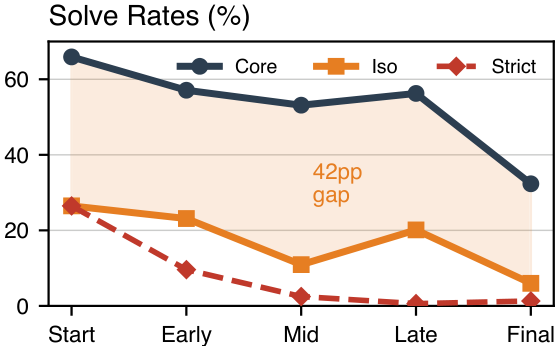
- The "Local Shortcut" Trap: Coding agents frequently pass immediate test checkpoints by patching messy, conditional logic into existing functions rather than refactoring or distributing logic across focused callables. This creates a compounding debt that makes subsequent checkpoints impossible to solve.
- AI Degrades Faster Than Humans: Agent-generated code accumulates verbosity roughly 7x faster and structural erosion 5x faster per checkpoint than human codebases do across git commits.
- Prompting is a Band-Aid, Not a Cure: The authors tested quality-focused prompting strategies, such as
anti-slop(explicitly telling the model to avoid verbose patterns) andplan-first(forcing the model to write a plan before coding). While these prompts significantly improved the initial quality of the code, they did not slow down the rate of degradation in later turns. Furthermore, quality-aware prompts increased financial costs by 12.1% and slightly reduced strict correctness.
Key Results
- Zero Complete Solutions: Not a single evaluated agent was able to fully solve any of the 36 problems end-to-end. The best-performing model, GPT 5.5, achieved a strict pass rate of only 14.8% across all checkpoints.
- Universal Quality Decay: Code quality degraded across almost all agent runs, with structural erosion rising in 77% of trajectories and verbosity increasing in 75.5%.
- The Bloat Gap: Compared to the human repository panel, agent-generated code was 2.3x more verbose and 2.0x more structurally eroded.
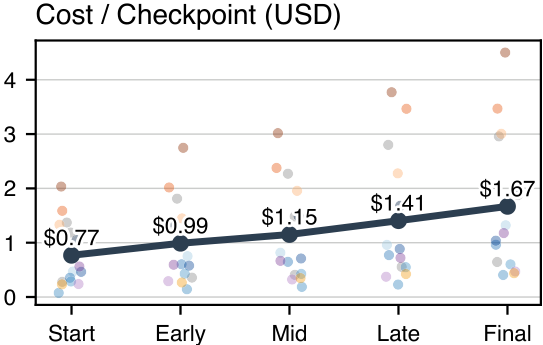
- Compounding Costs: As codebases grew longer and more disorganized, the context window filled up with "slop." Consequently, the mean financial cost per checkpoint grew 2.2x from the start to the final phase of a problem.
Limitations and Future Work
- Language Scope: While SCBench is language-agnostic by design, this study only evaluated the Python track due to the high API costs of running long-horizon evaluations.
- Harness Constraints: The evaluation utilized native model harnesses rather than advanced agentic frameworks (like SWE-agent) that feature multi-turn tool usage or automated refactoring loops. Future work could explore whether specialized agent loops can mitigate this structural decay.
Summary updated