


TL;DR
When you let users fine-tune an AI model on their own data, a handful of snuck-in malicious examples can quietly dissolve its safety guardrails while leaving its day-job skills intact. Instead of applying a clumsy, whole-model patch that makes the AI safe again at the cost of making it dumber, researchers discovered that individual neural network layers act like directional switches—some amplify safety refusals, while others suppress them. By repairing only the two most extreme layers on opposite ends of this spectrum and triggering that repair only when a prompt looks sketchy, we can get near-zero harmful outputs without losing an ounce of task performance.
What Problem Does This Paper Address?
Imagine spending millions of dollars training a Large Language Model (LLM) to be helpful, harmless, and polite. Now, you offer "fine-tuning-as-a-service," letting customers customize your model for medical coding, sentiment analysis, or math. Here’s the catch: if an attacker slips just a tiny fraction of harmful instruction-response pairs into an otherwise benign dataset, the model’s safety alignment unravels. It learns the customer's task, sure, but it also happily answers dangerous queries it used to refuse.
Service providers are stuck in a tug-of-war. Defenses applied during fine-tuning often fail against novel attacks, while post-fine-tuning repairs—like pruning weights or adding noise across the whole model—are blunt instruments. Because safety and task knowledge get tangled up in the weights, fixing the guardrails usually lobotomizes the new skills the user just paid to teach the model. How do you surgically restore refusal behavior without collateral damage?
Methods
Previous research noticed that safety lives in specific layers of a transformer, not uniformly across the whole network. However, those diagnostics only measured magnitude—where safety happens—not direction.
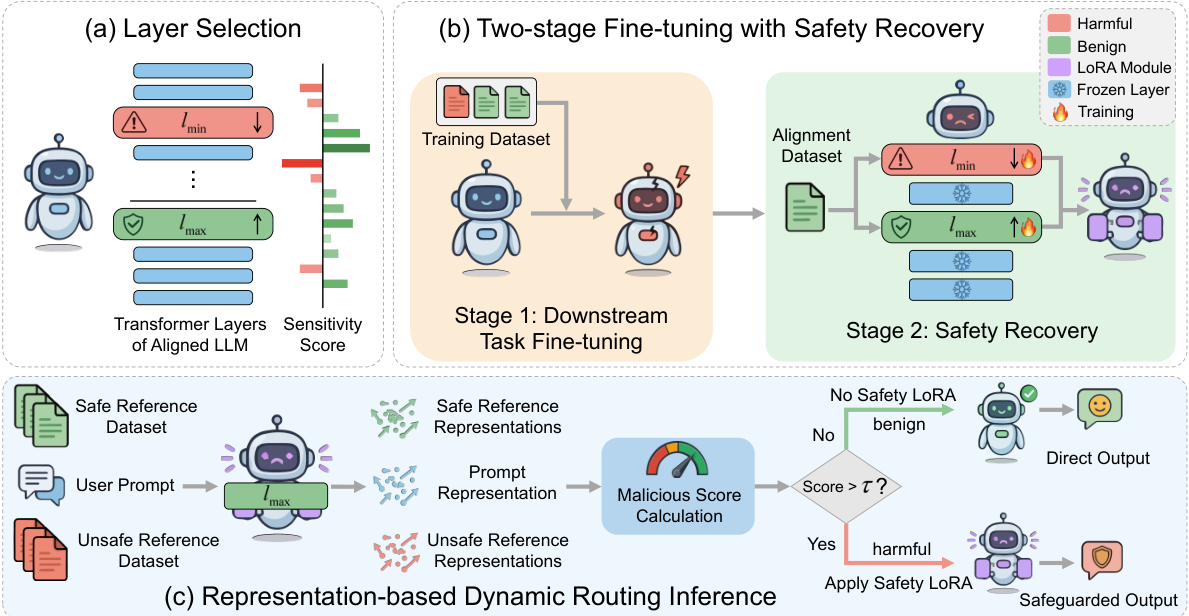
The authors introduce SLDR (Selective Layers Recovery and Dynamic Routing), built around three clever steps:
- Signed Layer-wise Diagnosis (New): Before any fine-tuning happens, the authors probe the base aligned model one layer at a time, scaling its weights slightly up and down by $(1 \pm \alpha)$. They feed it "over-refusal" prompts—innocent sentences containing trigger words like "how to kill time"—and count how often the model refuses. This yields a signed sensitivity score: positive layers increase refusal when strengthened, negative layers suppress refusal when strengthened, and most layers sit near zero.
- Selective Layers Recovery (New): After a user fine-tunes the model (potentially poisoning it) using standard LoRA (Low-Rank Adaptation, a lightweight way to update weights), SLDR freezes the entire model except for just two layers: the single highest-scoring positive layer ($l_{\max}$) and the single lowest-scoring negative layer ($l_{\min}$). It trains a tiny recovery LoRA adapter on just those two layers using 100 safe alignment examples.
- Representation-based Dynamic Routing Inference (New): Even a two-layer patch can slightly nudge benign task outputs if left on all the time. At inference, SLDR extracts the incoming prompt's internal representation at layer $l_{\max}$ and compares its cosine similarity against small anchor sets of known safe and unsafe prompts. If the prompt looks closer to the harmful anchors (score $> 0$), the recovery adapter switches on; otherwise, the query routes straight through the untouched, task-adapted model.
(Note: Let's look at the exact architecture diagram below)
Datasets
The authors do not introduce new benchmarks, instead assembling a comprehensive suite of existing datasets to test tasks, poisoning, and out-of-distribution safety:
- Downstream Tasks: SST2 (sentiment), AGNEWS (news topic classification), GSM8K (math reasoning), AlpacaEval (instruction following), and Magicoder evaluated on HumanEval (code generation).
- Poisoning & Safety Alignment: Non-overlapping subsets of BeaverTails (and an extended version) for injecting poison during fine-tuning and for the 100-sample safety recovery set.
- Safety & Jailbreak Evaluation: BeaverTails test set, DirectHarm4, HarmBench, HEx-PHI, plus jailbreak benchmarks Zulu (low-resource language) and IJP (in-the-wild prompts).
- Diagnostics & Routing Anchors: Over-refusal datasets and benign/harmful reference prompt sets sourced from prior safety literature (LARF and related works).
Key Insights and Ideas
- Safety sensitivity has a sign, and neighbors can be opposites: Look at Llama3.1-8B in Figure 1—Layer 13 has the highest positive score (+200, strongly boosting refusal), while right next door, Layer 12 has the deepest negative score (-185, strongly suppressing refusal). Treating both as generically "safety-sensitive" misses half the story. You have to reinforce the brakes and fix the stuck accelerator.
- Less is genuinely more: Updating all other layers except $l_{\min}$ and $l_{\max}$ actually produces worse safety and no better accuracy than updating those two endpoints alone. Near-zero layers are mostly noise for refusal.
- Extreme poison immunity: Because recovery is quarantined to two specific layers after the fact, it doesn't care how badly poisoned the fine-tuning dataset was—even when 90% to 100% of the user's training data is pure poison, the recovery target stays clean and well-defined.
Key Results
Across four LLM families (Llama3.1, Llama3, Qwen2.5, Mistral-v0.2), SLDR breaks the usual trade-off between safety and utility:
- Near-Zero Harm, Zero Accuracy Loss: On Llama3.1 fine-tuned on SST2 across poison ratios up to 20%, undefended fine-tuning yields an average Harmful Score (HS) of 11.54% (with 92.39% accuracy). SLDR slashes average HS to 0.08%—more than an order of magnitude better than the strongest baseline, BDS (1.68%)—while keeping task accuracy virtually identical at 92.32%.
- Surviving Extreme Poisoning: When poison ratios crank up to 90% (9 harmful examples for every 1 clean example), undefended SFT hits 35.70% HS, while SLDR holds steady at 0.20% HS and 90.14% accuracy.
- Rescuing Vulnerable Architectures: Mistral-v0.2 is notoriously fragile under malicious fine-tuning, shooting up to 49.40% HS. Where prior defenses either leave HS high (Panacea: 37.90%) or tank accuracy (STAR-DSS drops accuracy from 95.18% to 60.78%), SLDR brings HS down to 0.10% while preserving 95.07% accuracy.
- Tiny Data Footprint: SLDR needs only 30 to 100 safe alignment examples to fully restore safety.
Limitations and Future Work
The authors candidly highlight where the armor still has chinks: obfuscated jailbreaks. When tested against Zulu—an attack that translates harmful requests into a low-resource language—every method struggled. While SLDR still achieved the lowest harmful score (61.53% vs. 66.82% for undefended SFT), that is far from safe. Because the dynamic router relies on internal representations anchored by standard harmful prompts, severe distributional shifts (like unfamiliar languages or heavy encoding) can slip past the router or confuse the English-aligned recovery adapter. Hardening the routing mechanism against out-of-distribution, obfuscated attacks is flagged as the key frontier for future work.
Summary updated