


TL;DR
Aligning LLMs using full rankings of candidate responses (listwise preferences) gives much richer training signals than simple A-vs-B pairwise choices, but it also leaks far more sensitive details about a user's beliefs and habits. Trying to protect these rankings with standard local differential privacy injects so much mathematical noise that the ranking becomes useless. The authors solve this by exploiting the full ranking locally on the user's device, then releasing only a coarse "thumbs-up/thumbs-down" partition where privacy noise is strategically concentrated on ambiguous, middle-of-the-pack responses rather than clear winners and losers.
What Problem Does This Paper Address?
Post-training LLMs to align with human preferences usually relies on pairwise comparisons (Response A > Response B). Moving to listwise feedback—where raters rank $m$ different responses at once—captures much richer nuance. However, rankings are a privacy minefield. How you order responses to sensitive prompts can fingerprint your communication style, political leanings, or religious beliefs, which can leak to untrusted model trainers or be extracted later via membership inference attacks.
To protect users without trusting the server, we use Local Differential Privacy (LDP), where data is noisy before it leaves the client's device. In pairwise settings, we just flip binary labels with some probability (Randomized Response, or RR). In listwise settings, however, changing the position of a single item alters the whole list structure. Privatizing raw scores or full rankings requires noise scaling with $O(m^2/\varepsilon)$ or $O(m/\varepsilon)$ (where $\varepsilon$ is the privacy budget). By the time you add enough noise to hide a user's ranking, you've destroyed the signal the LLM needs to learn.
Methods
The authors introduce a clever "bait-and-switch" between local information and server-side supervision, pairing a Rank-Aware Exponential Mechanism (RAEM) on the client with Kahneman–Tversky Optimization (KTO) on the server.
- Item-Level Relocation Adjacency: First, they define privacy over rankings: two rankings are neighbors if you can get one from the other by picking up a single response and slotting it elsewhere in the list.
- Coarse Release Granularity: Instead of sending noisy scores or rankings, the client only sends a fixed-size binary vector marking $B$ responses as "desirable" (1) and the remaining $m-B$ as "undesirable" (0). Because KTO (a standard alignment algorithm) only needs unary desirable/undesirable labels rather than pairs or rankings, this low-sensitivity $O(1/\varepsilon)$ output is all the server needs.
- Rank-Aware Sampling (The Novelty): Instead of throwing away the ranking first and applying uniform RR noise to the binary labels, RAEM uses the clean local ranking inside an exponential mechanism to sample which $B$ items get labeled desirable. They assign each rank a linear score based on its distance from the top-$B$ boundary, which they prove mathematically maximizes the separation between the best and worst items for any given privacy budget.
Datasets
No new benchmarks were created; the authors used established datasets for supervised fine-tuning (SFT), alignment, and evaluation:
- UltraChat-200K: Used for initial SFT of the base models (Qwen2-0.5B and Mistral-7B).
- ListUltraFeedback: An existing offline listwise preference dataset (59.9K training prompts, 1,968 held-out test prompts), where 8 candidate responses per prompt are scored by ArmoRM to establish ground-truth rankings.
- AlpacaEval & MT-Bench: Standard conversational benchmarks (judged by GPT-4 Turbo) used alongside proxy reward models to evaluate the final aligned LLMs.
Key Insights and Ideas
- Where noise lands matters just as much as how much noise you add: Standard Randomized Response flips every binary label with the exact same probability—meaning your absolute favorite response is just as likely to be corrupted into a "dislike" as a mediocre one. RAEM shapes the noise profile like a bell curve: borderline items near the middle cutoff flip frequently, while the #1 best and #8 worst responses remain highly stable.
(Note: See Figure 2 below for the exact noise profile).
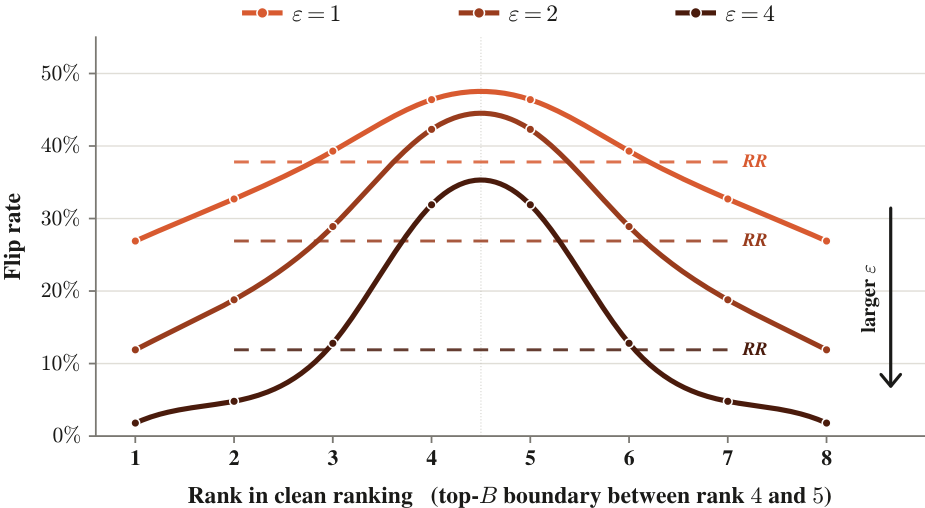
- Match privatization granularity to the loss function: Releasing full rankings privately requires too much noise; collapsing rankings into binary labels too early loses quality information. Using ordinal rankings only to guide private sampling on-device hits a sweet spot.
- Bigger lists actually help under privacy: Intuitively, releasing more items might seem to invite more privacy noise. However, pre-selecting a smaller subset without peeking at the private scores reduces to random guessing, risking dropping the best and worst examples. Keeping the full list ensures strong extremes are present, while RAEM pushes the extra noise onto the middle items.
Key Results
Across both Qwen2-0.5B and Mistral-7B, and across all tested privacy budgets ($\varepsilon \in \{0.5, 1, 3\}$), RAEM+KTO consistently outperforms the RR+KTO baseline on average win rates against the SFT checkpoint ($m=8, B=4$).
- Stronger gains at tighter privacy: On Qwen2-0.5B at strict privacy ($\varepsilon = 0.5$), RAEM+KTO achieves a 51.2% average win rate across four benchmarks, beating RR+KTO (48.0%) by 3.2 percentage points. At $\varepsilon = 3$, RAEM reaches 59.6%, nearly closing the gap with non-private KTO (60.8%).
- Scales to stronger models: On Mistral-7B, RAEM+KTO beats RR+KTO at every budget, reaching 86.7% average win rate at $\varepsilon = 3$ (compared to 85.8% for RR+KTO and 87.1% for non-private KTO).
- Better error correction: When measuring the Error-to-Correct (E2C) flip rate—how often alignment fixes bad pairwise preferences held by the initial SFT model—RAEM consistently corrects more errors than RR across all $\varepsilon$ levels.
Limitations and Future Work
The privacy guarantee in this work is item-level per-list LDP: it prevents an adversary from telling whether any single response was moved to a different rank within one prompt's list. It does not optimize for stricter rank-level privacy (hiding the entire ranking at once) or user-level privacy (protecting a user who submits preferences across many different prompts). Extending to user-level privacy currently requires dividing the privacy budget across all lists a user labels, resulting in severe utility loss—a challenge the authors leave for future work.
Summary updated