


TL;DR
When you train a neural network to predict chaotic systems from incomplete sensor data, standard Mean Squared Error (MSE) hedges its bets—shrinking variance until the system’s rich dynamics collapse into a lifeless fixed point or simple loop. Matching global statistics fixes the shape of the chaos, but loses track of the flow of time. PRIME bridges this gap by borrowing an old trick from Henri Poincaré: instead of matching fragile step-by-step points, it aligns the rhythm and transitions of recurrence events—teaching models both the geometry of chaos and its long-term tempo.
What Problem Does This Paper Address?
Imagine watching the shadow of a 3D butterfly-shaped Lorenz attractor projected onto a 2D wall. Because you are missing a dimension (partial observation), two trajectories might cross the exact same spot on the wall while heading toward completely different futures. The system is no longer Markovian; the present observation doesn't uniquely determine the next step.
If you train an autonomous predictor—one that unrolls predictions purely from a single initial state without a crutch of historical context—using standard pointwise MSE, it learns to output the conditional average of all possible futures. Step after step, this averaging acts like friction, contracting the phase space until your chaotic butterfly spirals into a spurious fixed point or limit cycle.
(Correction: see Figure below for the collapse in action)
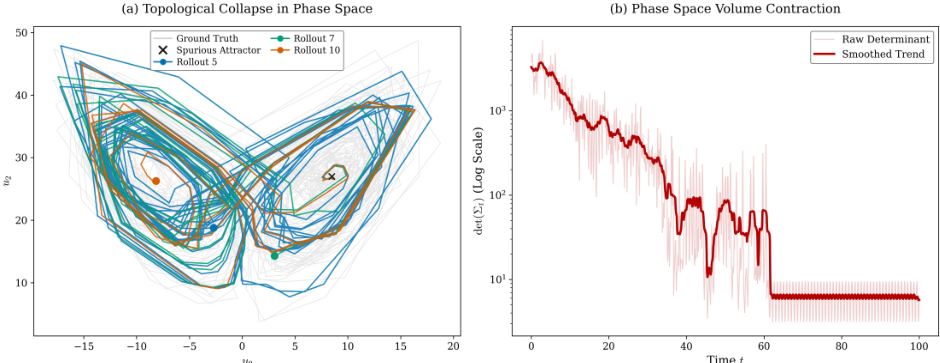
An increasingly popular alternative is invariant-measure matching (specifically Delay Invariant Measure, or DIM), which trains the model so that its long-term cloud of predicted points matches the statistical shape of the true attractor. The catch? Probability distributions don't care about long-term order. You get the right geometric sculpture, but physically invalid, scrambled trajectories. Combining MSE and DIM is the usual patch, but under sparse, noisy, partial observations, MSE still poisons the well. How do you enforce long-term timing without pointwise matching?
Methods
The authors introduce PRIME (Poincaré Return Induced Measure), a two-stage training objective inspired by classical suspension-flow theory.
In physics, a Poincaré section is an imaginary slice through phase space; instead of watching a continuous trajectory, you just record where and when the trajectory punches through that slice. Because building an exact mathematical slice in sparse, noisy data is brittle, PRIME builds a data-driven recurrence section:
- It augments partial observations with time-delay coordinates, filters for high-velocity points (avoiding stagnant regions), and uses farthest-point sampling to pick spatial landmarks. The neighborhoods around these landmarks form the recurrence section.
- Stage 1 (Warm-up): Train the model with standard $\mathcal{L}^{\text{DIM}}$ to capture the global geometry and short-term statistics of the attractor.
- Stage 2 ($\mathcal{L}^{\text{DIM}} + \mathcal{L}^{\text{PRIME}}$): From the training data, PRIME extracts consecutive recurrence events $t_i$ and the exact number of steps between them ($K_i = t_{i+1} - t_i$). During training, the model is unrolled for $K_i$ steps from one recurrence state to predict the next. PRIME then uses Sinkhorn divergence (an optimal-transport distance) to align the joint distribution of consecutive recurrence pairs—the empirical recurrence graph measure—along with their marginals.
Crucially, delay coordinates and empirical $K_i$ schedules are training scaffolding only. At test time, the model runs completely autonomously from a single initial observation.
Datasets
PRIME is evaluated on three classic nonlinear dynamical systems configured as sparse, noisy, partially observed benchmarks (no brand-new underlying PDEs, but tailored partial-observation setups):
- Lorenz63: Atmospheric convection ODE, observing only 2 of 3 coordinates $(u_0, u_2)$ across 500 noisy samples.
- Kuramoto-Sivashinsky (KS): A fiercely chaotic 1D PDE discretized to 200 states (attractor dimension ~27–35), observed through just 5 spatial sensors over 500 steps.
- 2D Flow Past a Cylinder (CFD): Navier-Stokes vortex shedding ($Re = 70$), observed via 9 noisy velocity probes in the Kármán vortex street (200 observations).
Key Insights and Ideas
- Chaos vs. Ambiguity is a Tug-of-War: The authors formalize (Theorem 1) that whether an MSE-trained rollout stays chaotic or collapses depends on a local battle between the system's natural chaotic expansion and the conditional variance lost to unobserved dimensions.
- Low Long-Term MSE Can Be a Lie: On Lorenz63, plain MSE actually achieves the lowest 400-step Normalized MSE (0.28 vs. PRIME's 0.32)—because parking safely near the center of an attractor avoids the massive phase-mismatch penalties of a lively chaotic trajectory!
- Transitions Matter, Not Just Checkpoints: Ablations show that matching only the marginal distributions at recurrence sections still collapses to a point, and shuffling or fixing the step-intervals $K_i$ induces limit cycles or fixed points. Pairing where the system recurs with how long it takes to get there is the secret sauce.
Key Results
Across 5 random seeds and identical 3-layer MLP backbones, PRIME consistently prevents rollout collapse and phase drift:
- Lorenz63: PRIME slashes attractor geometry error (Sinkhorn Divergence) to 8.11 (vs. 53.06 for MSE, 21.37 for DIM, and 31.91 for DIM+MSE) and achieves the best Time Correlation Metric (0.28) and spectral distance (0.74).
- Kuramoto-Sivashinsky: While MSE diverges catastrophically at 400 steps (NMSE of 257) and DIM/DIM+MSE degrade (16.03 / 11.70), PRIME stays rock-solid with an NMSE of 1.47, a Sinkhorn Divergence of 1.99 (orders of magnitude better than baselines), and drops Time Correlation error from >84 down to 10.18.
- Cylinder Flow: Baselines capture oscillation amplitude but suffer progressive phase drift; PRIME cuts Time Correlation error nearly tenfold (0.011 vs. 0.09–0.14) and achieves the lowest 400-step NMSE ($1.69 \times 10^{-4}$).
Limitations and Future Work
- Training Overhead: Computing Sinkhorn divergences over multi-step recurrence blocks isn't cheap—each PRIME training iteration is 10–16× slower than standard DIM (though inference speed is identical).
- Borrowed Clocks During Training: PRIME relies on ground-truth inter-event intervals ($K_i$) as multi-shooting horizons during training rather than learning to generate return times explicitly. Future work points toward a generative suspension model that jointly learns return-map transitions, return-time distributions, and intra-block evolution.
Summary updated