


TL;DR
How does the brain turn a passive mental map of a room into an active, obstacle-avoiding route to the fridge in the dark? This paper proves that a biological neural network doesn’t need a separate search algorithm to plan—if its synapses encode how locations connect, simply "clamping" a goal neuron causes the network’s natural physics to settle directly into the mathematically optimal navigation plan. Planning is the relaxation of the circuit itself.
What Problem Does This Paper Address?
For decades, neuroscientists have marveled at the brain’s GPS: hippocampal "place cells" that fire at specific locations and entorhinal "grid cells" that tile space. Experience wires these cells into a stored cognitive map.
Yet knowing where you are is very different from knowing how to get somewhere else when walls and detours stand in the way. Existing models often propose that the brain stores massive, pre-computed lookup tables of long-term future states, or runs explicit step-by-step mental simulations at decision time. What has remained an open mystery is whether the very neural network that stores the map can, through its own natural settling dynamics, compute a provably optimal route on the fly.
Methods
The authors model a hippocampal region (like CA3) as a continuous-time recurrent neural network where each unit represents a spatial location. The pipeline has three biologically grounded pieces:
- Goal-free map writing: As an animal wanders aimlessly, Behavioral-Timescale Synaptic Plasticity (BTSP)—a known biological learning rule operating over a seconds-long window—wires together neurons that fire in sequence. Synaptic weights come to reflect transition probabilities between adjacent spots. Because you can't walk through walls, barriers naturally get zero synaptic weight.
- Planning as physical relaxation: When a destination is recalled, a top-down signal "clamps" the goal neuron at an elevated firing rate. Activity ripples backward through the recurrent web, decaying slightly at each synaptic hop, until the network settles into a steady-state activity landscape.
- Dendritic readout: A downstream layer of place-tuned cells multiplies this global activity field by a local spatial kernel centered at the animal's current position. Taking the population vector of these cells extracts the local log-gradient of the field—pointing the animal right along the optimal detour.
What’s novel here is the exact mathematical bridge: the authors prove that this steady-state neural activity is identical to the "desirability field" of a Linearly-Solvable Markov Decision Process (LMDP)—a formal optimal control framework developed by Emo Todorov that balances path length against the effort of deviating from spontaneous movement.
Datasets
Rather than external real-world datasets, the authors evaluate their theoretical circuit on a suite of simulated navigation environments:
- Grid mazes: Including a 3,036-state two-room maze with narrow doorways, a deceptive 7,285-state "bug-trap" maze (where heading straight toward the goal traps the agent against a concave wall), a two-door maze for testing dynamic obstacles, and a 425-state maze with one-way gates.
- Continuous arenas & large-scale graphs: Irregular graphs of 1,024 place centers navigating around continuous barriers, scaling up to massive maps with 38,556 states.
Key Insights and Ideas
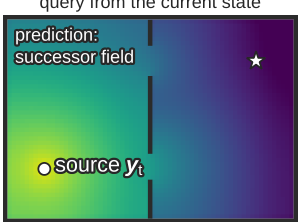
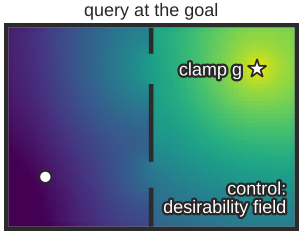
- One circuit, two queries (Prediction vs. Control): The exact same web of synapses answers two fundamental cognitive questions depending on where you inject current. Stimulate the current location, and the network outputs a "successor field" predicting where you'll likely wander next. Clamp the goal, and it outputs the optimal control policy to get there.
- Anytime readiness: You don't have to wait for the entire brain map to reach equilibrium before taking a step. Because your next move only depends on the local slope of the field, the right action direction crystallizes almost immediately, long before distant parts of the network finish settling.
- Scale-free robustness: When recall is super strong, neurons near the goal saturate. Surprisingly, outside a tiny logarithmic "shell" around the goal, this nonlinear saturation merely rescales the entire activity field by a constant—which the log-gradient readout effortlessly cancels out.
- Zero-shot global rerouting: If a familiar door suddenly closes, updating just the handful of synapses crossing that doorway automatically reroutes future plans for every possible goal via a low-rank mathematical update—no retraining required.
Key Results
- Exact optimality: In the linear regime, the network's relaxed state matches the analytical LMDP desirability field to machine precision (error down to $9.5 \times 10^{-16}$), and holds to $10^{-14}$ on 38,556-state maps.
- Extreme resilience: Across a 1,000-fold range of goal-recall amplitudes ($0.1$ to $100$), 100% of 103,190 greedy rollouts reached the goal. Even after randomly or clusteredly deleting 80% of the place cells, 1,080 out of 1,080 routes still succeeded.
- Fast "anytime" decisions: On the bug-trap maze, the first action was ready in just $11\tau$ (11 effective time constants), whereas global field convergence took $331\tau$—a median speedup of 82× across high-horizon conditions.
- Sample & memory efficiency: After goal-free BTSP observed just 3 transitions per state on the bug-trap, routes averaged $1.16\times$ the shortest possible path. With matched experience ($10^3$ to $10^6$ transitions), the recurrent circuit achieved 100% arrival on held-out goals with zero goal supervision, trouncing tabular soft-Q and TD learners (~40% at $10^6$ steps). Furthermore, storing sparse transitions scales linearly ($\mathcal{O}(N)$), saving 252× the memory of a dense all-goal cache at 3,036 states.
Limitations and Future Work
The authors note a few biological idealizations:
- Subfield agnosticism: While inspired by recurrent collaterals in hippocampal area CA3, BTSP signatures appear across multiple subfields; pinpointing where goal-clamped relaxation happens in vivo will require intracellular recordings during decision pauses.
- Idealized transition gating: The model assumes plasticity neatly gates out impossible wall crossings. Identifying how self-motion cues and internal theta/replay sequences enforce this gate biologically is a critical next step.
- Approximated policy readout: While exact optimal transition probabilities live in individual dendritic branch currents, reading them out directly would require action-labeled synapses; the model instead relies on a continuous population-vector approximation.
Looking ahead, because hippocampal maps also chart social hierarchies, sensory continua, and abstract concepts, this principle—where transitions define states and physical relaxation is reasoning—could explain how brains navigate far beyond physical space.
Summary updated