


TL;DR
Foundation models are revolutionizing how we decode the electrical symphony of the human body—from brainwaves (EEG) and heartbeats (ECG) to muscle twitches (EMG). However, these models have a hidden bottleneck: their tokenizers often blur out crucial high-frequency details when chopping continuous signals into discrete pieces. NeuroRVQ solves this with a multi-scale, phase-aware tokenizer that preserves fine-grained physiological dynamics, proving that a smarter "vocabulary" allows even tiny, simple foundation models to outperform massive existing ones.
What Problem Does This Paper Address?
Your body is constantly broadcasting electrical signals across wildly different timescales. An ECG, for instance, contains both slow morphological waves and sudden, subtle high-frequency spikes that hint at cardiac abnormalities. Similarly, EEG and EMG pack critical information across broad frequency bands.
To apply modern self-supervised AI (like masked token prediction) to these biosignals, we first have to translate continuous, noisy waves into discrete "tokens"—essentially building a vocabulary for physiology. Existing biosignal tokenizers use a single scale and a single codebook, and they train with mathematical losses that ignore basic signal processing properties. As a result, they smooth over high-frequency details and fail to faithfully reconstruct the original waveform. If the tokenizer throws away subtle diagnostic clues at step one, no foundation model—no matter how large—can recover them later.
Methods
The authors introduce NeuroRVQ, a modality-adaptive tokenizer family built on two main pillars: a multi-scale architecture and a physics-respecting loss function.
- Multi-Scale Architecture & Hierarchical RVQ: Raw biosignals are sliced into patches and fed through an inception-style encoder using 1D convolutions of varying kernel sizes. This splits the signal into distinct frequency bands (temporal branches). After passing through shared Transformer layers, each branch is discretized using Residual Vector Quantization (RVQ)—a technique that quantizes an embedding iteratively across a cascade of codebooks, where each subsequent codebook captures the fine-grained "leftover" error from the previous one. While Transformers and RVQ are standard, pairing frequency-specific convolutional branches with separate hierarchical RVQ codebooks per scale is a novel way to prevent low-frequency power from drowning out high-frequency details.
- Phase-Aware Fourier Loss: Reconstructing raw, noisy waveforms directly causes unstable training, so NeuroRVQ reconstructs the Fourier spectrum instead. Standard Mean Squared Error (MSE) fails miserably on phase angles because phase is circular ($-\pi$ and $\pi$ are the exact same point, yet MSE penalizes them as maximally distant). The authors introduce a novel phase loss that predicts $(\cos\phi, \sin\phi)$ as a 2D vector and optimizes directional alignment via cosine similarity. They pair this with a log-amplitude loss (compressing dynamic range so quiet, high-frequency components get proper attention) and a time-domain MSE regularizer.
- Modality-Adaptive Tuning & NeuroRVQ-FM: By simply adjusting sampling rate, patch length, kernel sizes, and RVQ depth, the exact same blueprint adapts to EEG, ECG, and EMG. To prove the tokenizer's worth, the authors freeze the trained RVQ codebooks and train a deliberately simple masked-token foundation model (NeuroRVQ-FM) for each modality.
Datasets
Full pre-training corpora are detailed in the paper's appendices (not included in the main text), though no new benchmarks are introduced. In the main paper, the authors highlight:
- Scaling Analysis: PhysioNet MI (EEG), PTB (ECG), and the small split of emg2pose (EMG).
- Downstream Evaluation: Five subject-independent EEG classification tasks from the Lee et al. (2025a) benchmark (Motor, ERP, Memory, Sleep, Eyes); the PTB-XL benchmark for ECG (5-class and 43-class arrhythmia diagnosis); and four EMG gesture/muscle datasets (Discrete Gestures, EPN-612, NinaPro DB5, and UCI-EMG).
Key Insights and Ideas
- Tokenizer fidelity beats model scale: We often assume better AI requires bigger backbones. NeuroRVQ flips this script: fed high-fidelity tokens, a tiny 0.3M-parameter ECG model crushes 30M-parameter baselines. The bottleneck in biosignal AI wasn't the reasoning engine; it was the sensory input.
- Respecting circular geometry matters: Treating Fourier phase as a 2D unit vector rather than a flat number line delivers the single largest jump in signal reconstruction quality.
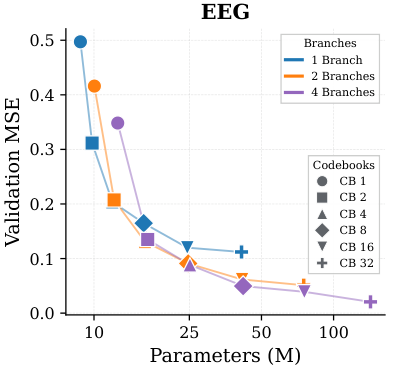
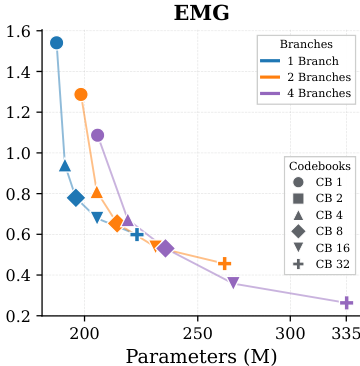
- Signal physics dictates quantization depth: Scaling curves reveal fascinating biological trade-offs. Stereotyped, cleaner ECG signals saturate quickly, whereas broadband EMG signals (sampled at 1000 Hz) and spectrally rich EEG waves keep improving as you add more RVQ codebooks and frequency branches.
Key Results
NeuroRVQ is the first unimodal codebook-based tokenizer to demonstrate high-fidelity reconstruction on ECG and EMG, while outperforming existing codebook tokenizers (LaBraM, BrainOmni) on EEG. Downstream results with the lightweight NeuroRVQ-FM family are striking:
- ECG (PTB-XL): On fine-grained 43-class classification, NeuroRVQ-ECG (0.3M parameters) achieves 58.33% balanced accuracy—more than doubling ECGFounder (28.96%, 30.7M parameters) and HuBERT-ECG (20.71%, 30.2M parameters).
- EEG: NeuroRVQ-EEG (5.9M parameters) claims the best balanced accuracy on 4 out of 5 tasks (e.g., 87.6% on ERP, 72.8% on Sleep), beating models up to 13$\times$ larger like NeuroGPT (79.5M) and REVE (69.2M).
- EMG: NeuroRVQ-EMG (5.9M parameters) sweeps all four benchmarks by wide margins—jumping from 54.70% (PhysioWave) to 70.80% balanced accuracy on Discrete Gestures, and from 25.26% (TinyMyo) to 41.36% accuracy on NinaPro DB5.
Limitations and Future Work
- Separate models per modality: Because EEG, ECG, and EMG have vastly different spectral profiles, the authors trained separate tokenizers and foundation models for each. Exploring whether a single, shared cross-modal tokenizer can match this specialist performance is left for future work.
- Compute-bound scaling: Due to hardware constraints (4$\times$ Tesla V100 GPUs), scaling experiments capped out at 4 temporal branches and 32 codebooks, even though EEG and EMG reconstruction curves hadn't fully plateaued.
- Simple backbones & masking: The foundation models were kept intentionally basic to isolate tokenizer quality. Pairing NeuroRVQ with larger architectures, cross-modal pre-training, and causal/targeted spatial-temporal masking strategies promises even stronger physiological foundation models.
Summary updated