


TL;DR
Steering the behavior of a Large Language Model (LLM)—like nudging it to be more polite or positive—usually requires averaging internal activations across dozens or hundreds of contrasting examples to drown out background noise. MinSteer flips this on its head: by asking an LLM to write something in one style and immediately rewrite that exact content in an opposite style within a single continuous conversation, you can extract a powerful steering vector from just one example. Better yet, these cleanly isolated behavioral directions even generalize across completely different scenarios and languages.
What Problem Does This Paper Address?
Suppose you want to locate the geometric direction for "positivity" inside an LLM’s residual stream—the internal representation highway passing data from layer to layer. Standard methods like Contrastive Activation Addition (CAA) feed the model 100 positive prompts and 100 negative prompts, then subtract their average internal states.
This raises a fundamental question about LLM internals: do we need $n \ge 50$ examples because behavioral traits are diffuse, weak patterns that only emerge in the aggregate? Or are the directions actually crisp and strong, and we’re just averaging away massive amounts of topic, vocabulary, and structural noise caused by comparing unrelated sentences? Finding out requires a way to strip away content variation without relying on massive, human-curated datasets of strictly paired sentences.
Methods
While injecting vectors into the residual stream at inference time is standard practice, the authors’ two-stage cached-continuation extraction method is new. Instead of running two separate prompts from scratch, MinSteer keeps the contrast inside a single, unbroken decoding trajectory using cache inheritance:
- Stage X: Prompt the model to generate a response in Style X (e.g., negative sentiment), recording the hidden states produced only during token generation.
- Style-Flip Suffix: Append an instruction to the conversation asking the model to rewrite what it just said in Style Y (e.g., positive sentiment), feeding this directly into Stage X's saved Key-Value (KV) cache—the model's running memory of past tokens.
- Stage Y: Let the model generate the rewritten continuation from that inherited memory state, again recording only the generation residuals.
(Correction: let's look closely at the diagram)
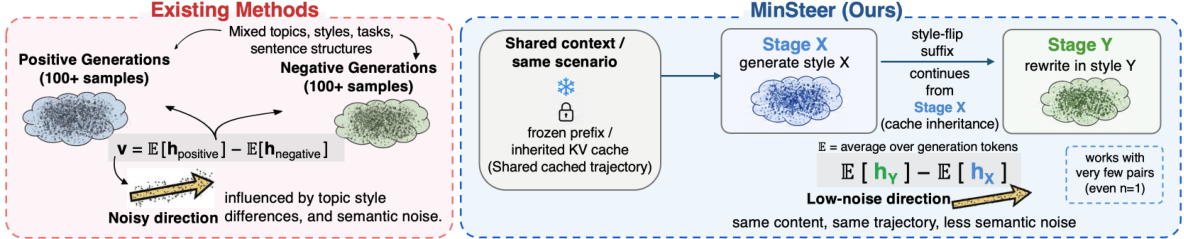
Subtracting the mean generation state of Stage X from Stage Y yields a Contrastive Residual Direction (CRD). Prompt and suffix prefill tokens are excluded so the vector captures generation style rather than instruction-reading artifacts. At test time, adding or subtracting a scaled CRD ($\alpha \cdot v_l$) at specific layers steers new outputs toward Style Y or Style X.
Datasets
Rather than introducing massive training benchmarks, MinSteer extracts vectors from tiny synthetic setups—five everyday scenarios for sentiment, five Japanese workplace emails for honorifics (keigo), and 1 to 10 lines from the ParaDetox training pool for toxicity.
Evaluation relies on established benchmarks:
- TweetEval (500 test tweets) for sentiment transfer.
- Stanford Politeness Corpus (99 prompts) plus a 30-item Chinese politeness set for formality/register transfer.
- ParaDetox (100 held-out toxic sentences) as a bidirectional toxicity stress test.
Key Insights and Ideas
- Large sample sizes were compensating for topic noise, not weak signals: A single self-rewrite trajectory ($n=1$) isolates a cleaner, stronger steering signal than averaging 50 independent pairs. Behavioral directions in LLMs are surprisingly sharp once content differences are held constant.
- Concepts align across languages: A vector representing Japanese keigo (honorifics), extracted on a Japanese-English model, successfully steers English and Chinese outputs toward polite formality in compatible model families. This proves the vector captures an abstract internal register rather than surface-level Japanese vocabulary.
- It’s about the self-rewrite transcript, not cache magic: Ablations replaying the exact text from scratch vs. incrementally inheriting the KV cache produce nearly identical vectors (cosine similarity $> 0.999999$). The secret sauce isn't a quirk of KV-cache mechanics—it's grounding Stage Y in rewriting the concrete content realized in Stage X.
- Layer depth matters: Steering isn't a uniform bias across the network; sentiment control concentrates in middle layers on Llama-3.1 and shows steep layer sensitivity in models like Gemma-2 and Qwen2.5.
Key Results
- Sentiment (Llama-3.1-8B): On TweetEval (with steering strength $\alpha=1.5$), MinSteer with $n=1$ hits 84.6% positive conversion, more than doubling the CAA baseline at $n=50$ (41.2%) and beating a 5-scenario Representation Engineering (RepE) PCA baseline (78.2%). At $\alpha=3.0$, $n=1$ reaches 93.8%.
- Cross-Lingual Politeness: Injecting a Japanese keigo vector into English generation raises formal probability from 0.903 to 0.957 ($\alpha=-1$) and drops it to 0.813 ($\alpha=+1$) ($p < 10^{-4}$). Trajectory-free baselines (
TwoSeq, which run independent prompts without self-rewriting) barely move the needle and produce vectors nearly orthogonal to MinSteer's. - Toxicity Stress Test & Human Eval: On ParaDetox, positive steering lowers Llama-3.1’s Detoxify score from 0.0064 to 0.00040, while reversing the vector spikes toxicity to 0.946, proving bidirectional control. Blinded human ratings across 398 paired comparisons confirm significant style shifts in sentiment and politeness while preserving fluency and meaning in nearly all settings.
Limitations and Future Work
Because Stage Y always follows Stage X, the extracted vector can inadvertently mix style shifts with "rewrite-role" or turn-position artifacts, and aggressive steering trades off against semantic preservation (occasionally causing meaning loss in formal politeness or malformed text under reverse toxicity steering). Furthermore, the authors rely largely on automated classifier proxies and evaluate constrained rewrite setups rather than unconstrained, open-ended generation. Finally, because the mechanism is bidirectional—capable of amplifying toxicity just as easily as suppressing it—they frame the toxicity experiments strictly as diagnostic stress tests rather than a deployable safety filter, pointing toward broader studies of open-ended generation and repeated-sampling analyses of internal vector geometry as natural next steps.
Summary updated