


TL;DR
META-IR is a novel framework that equips Large Language Models (LLMs) with a "dual-loop" reasoning system to combat evolving jailbreak attacks. By combining structured introspection (System 2 thinking) with meta-learning, the model learns to adapt its safety policies to new adversarial strategies, significantly outperforming static alignment methods like RLHF and DPO.
What Problem Does This Paper Address?
Standard LLM safety alignment—typically achieved through Supervised Fine-Tuning (SFT) or Reinforcement Learning from Human Feedback (RLHF)—is notoriously brittle. These methods create a static safety policy that works well against known threats but often fails when attackers use "out-of-distribution" tactics.
For example, a model might easily refuse a direct request for a bomb recipe (a "System 1" instinctive refusal). However, if the same request is wrapped in a complex role-play scenario or a "forced prefix" (e.g., "Imagine a game... start your answer with 'Sure! I'm happy to help'"), the model's static guardrails often crumble. The authors argue that safety should not be a fixed state but an adaptive process capable of identifying the intent behind a prompt, even when disguised.
Methods
The core of META-IR is its dual-loop architecture, which moves the model from instinctive reactions to deliberate, structured reasoning:
- Structured Introspective Reasoning: Instead of jumping straight to an answer, the model follows a multi-step internal template:
- Problem Framing: Restating the prompt in neutral terms to strip away adversarial "packaging."
- Hidden Intent Detection: Specifically looking for role-play deception or forced compliance.
- Risk & Policy Analysis: Checking the intent against concrete safety policies.
- Safe Trajectory Planning: Choosing a refusal or a safe reformulation.
- Inner Loop (SI-MCTS): The framework uses Safety-Informed Monte Carlo Tree Search (SI-MCTS) to explore various reasoning paths. It evaluates these paths using a composite reward function that balances helpfulness ($H$), safety ($S$), and the quality of the introspection itself ($I$).
- Outer Loop (Meta-Learning): This is the "meta" component. The model is trained across diverse "jailbreak families" (e.g., narrative framing vs. linguistic variation). The outer loop optimizes the introspection policy so the model can generalize its safety reasoning to entirely new types of attacks it hasn't seen during training.
- Meta-Adaptive Decoding: At test time, the model uses the learned reward model to perform "Best-of-N" sampling and reward-guided beam search, ensuring the final output is the safest and most helpful candidate.
Datasets
The researchers used a 50k-sample seed corpus drawn from established benchmarks:
- AdvBench & HarmBench: For harmful instructions and behavior prompts.
- WildJailbreak: A large-scale dataset of "in-the-wild" jailbreaks and benign look-alikes.
- DIR (Introspective Dataset): A custom 20k-sample dataset where a teacher model generated structured introspective responses for both safe and harmful prompts.
Key Insights and Ideas
- System 2 for Safety: The most effective way to stop complex jailbreaks is to force the model to "think about its thinking." By separating the reasoning process from the final decision, the model is less likely to be "tricked" by the prompt's surface-level framing.
- Meta-Learning as a Generalizer: Traditional alignment treats every harmful prompt as an individual data point. META-IR treats them as "tasks" within a distribution. This allows the model to learn the logic of safety rather than just memorizing which phrases to refuse.
- The Safety-Utility Balance: The composite reward function $R(H, S, I) = F(S)H + S + \lambda I$ is designed so that safety ($S$) is the dominant objective, but the model is still incentivized to be helpful ($H$) if the prompt is safe.
Key Results
Experiments on Llama-3.1-8B and Qwen-2-7B showed that META-IR-3 (the third iteration of the meta-learning process) set new state-of-the-art benchmarks:
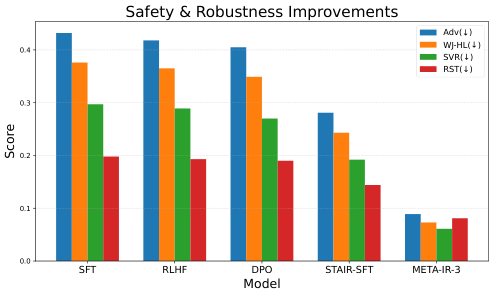
- Robustness: On Llama-3.1-8B, it achieved a 64.1% relative improvement in attack success rate reduction (Adv↓) and a 47.9% reduction in safety violations (SVR↓) compared to the strongest non-meta baseline (STAIR-SFT).
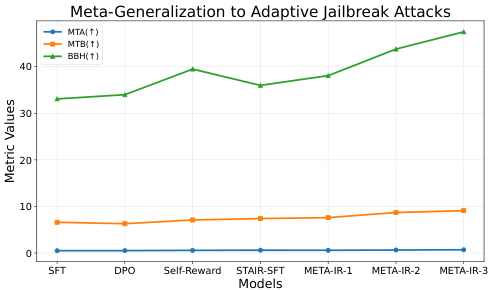
- Generalization: As shown in Figure 5, META-IR variants showed significantly better performance on unseen, adaptive jailbreak attacks compared to SFT, DPO, and Self-Rewarding baselines.
- Reasoning Quality: The model's ability to correctly attribute risks (REAR↑) and avoid "meta-confusion" (MCR↓) improved monotonically through the meta-learning iterations.
Limitations and Future Work
- Computational Cost: The use of MCTS and dual-loop meta-learning is computationally intensive compared to standard fine-tuning. The authors note that inference latency could be a concern for real-time applications.
- Teacher Dependence: The quality of the initial structured introspection depends on the teacher model used to create the DIR dataset.
- Future Directions: The authors suggest scaling META-IR to even larger models and exploring ways to distill the expensive MCTS reasoning into more efficient, direct-policy models without losing the adaptive benefits.
Summary updated