


TL;DR
James Tobin’s seminal 1958 paper reimagines "liquidity preference"—the demand to hold cash instead of interest-bearing bonds—not as a speculative bet on future interest rates, but as a rational response to risk. By applying a mean-variance framework to portfolio selection, Tobin demonstrates that risk-averse investors will diversify their holdings, providing a more robust microeconomic foundation for the inverse relationship between interest rates and money demand.
What Problem Does This Paper Address?
In classical Keynesian economics, the "liquidity preference" curve describes why people hold cash despite it yielding no interest. The traditional explanation relied on "inelastic expectations": investors have a "normal" interest rate in mind. If the current rate is below that normal level, they expect it to rise, which would cause bond prices to fall. To avoid these capital losses, they hold cash.
Tobin identifies a major flaw in this logic: it implies "all-or-nothing" behavior. An individual investor should, theoretically, hold only cash or only bonds depending on their specific expectation. This contradicts the reality of diversified portfolios. Tobin seeks to explain why a rational agent would hold both cash and bonds simultaneously and why the aggregate demand for cash remains sensitive to interest rate changes without relying on the assumption that everyone is trying to time the market.
Methods
Tobin shifts the analysis from certain expectations to portfolio selection under uncertainty. He models an investor choosing between two assets:
- Cash: Zero return, zero risk.
- Consols (Bonds): A perpetual stream of income with a yield ($r$) and a potential capital gain or loss ($g$).
The core of his method involves:
- Risk Measurement: Defining risk as the standard deviation of the portfolio's return ($\sigma_R$).
- The Opportunity Locus: A budget line in risk-return space showing the combinations of expected return and risk available to the investor.
- Indifference Curves: Using utility functions to represent an investor's preference for return versus their distaste for risk. Tobin categorizes investors as "risk-averters" (diversifiers or plungers) or "risk-lovers."
- Optimization: Finding the tangency point between the opportunity locus and the highest possible indifference curve to determine the optimal allocation between cash and bonds.
Datasets
Not discussed in the paper. This is a theoretical work that uses mathematical modeling and deductive reasoning rather than empirical data analysis.
Key Insights and Ideas
- Diversification as Rationality: Unlike the Keynesian model where diversification is an accident of aggregate behavior, Tobin shows it is the optimal strategy for a "risk-averter." By holding some cash, an investor reduces the total volatility of their portfolio at the cost of some expected return.
- The Stickiness of Expectations: Tobin acknowledges the Keynesian view of "sticky" expectations (Figure 1) but argues it is an insufficient foundation for a general theory.
- Individual vs. Aggregate Demand: Tobin illustrates how individual "step functions" (holding all cash or all bonds) aggregate into the familiar smooth, downward-sloping liquidity preference curve when investors have different "critical" interest rates (Figures 2 and 3).
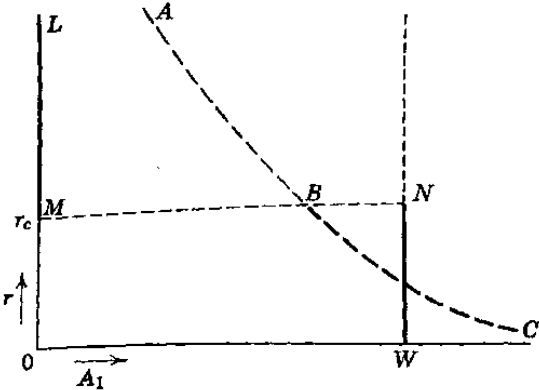
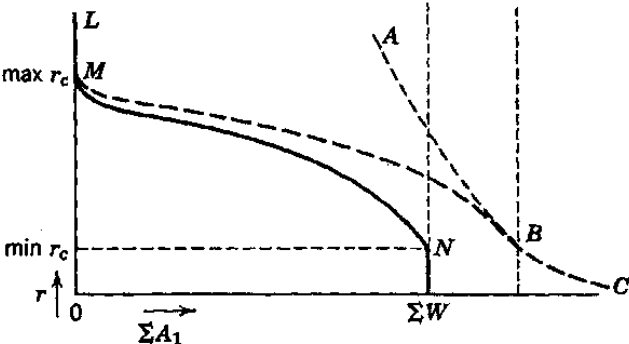
- Income and Substitution Effects: A change in the interest rate has two effects. A higher rate makes bonds more attractive (substitution effect, decreasing cash demand), but it also makes the investor wealthier for a given level of risk (income effect). If the income effect is strong enough, an investor might actually choose to "buy" more safety by increasing cash holdings, though Tobin notes the substitution effect usually dominates.
Key Results
- Derivation of Money Demand: Tobin successfully derives a downward-sloping demand curve for cash based solely on risk-avoiding behavior. As interest rates rise, the "price" of safety (foregone interest) increases, leading investors to take on more risk (more bonds, less cash).
- Mathematical Foundation for Portfolio Theory: The paper provides the early mathematical scaffolding for what would become Modern Portfolio Theory (MPT), specifically the relationship between expected return ($\mu_R$) and risk ($\sigma_R$).
- Taxation Effects: Tobin analyzes how taxes on interest income and capital gains affect liquidity preference. He shows that a tax with full loss-offset provisions actually reduces the private risk of holding bonds, potentially decreasing the demand for cash.
Limitations and Future Work
- Quadratic Utility Assumption: To make the mean-variance analysis work, Tobin often assumes a quadratic utility function. He admits this is problematic because it implies that at very high levels of wealth, marginal utility becomes negative.
- Two-Asset Limitation: While the paper touches on multiple assets at the end, the bulk of the analysis is restricted to a simple cash-vs-bond world.
- Stationary Equilibrium: Tobin notes that his theory struggles to meet the "Leontief challenge"—explaining why liquidity preference exists in a strictly stationary equilibrium where interest rates never change. He suggests that as long as there is a possibility of change, the risk-aversion framework remains valid.
- Future Directions: The paper opens the door for more complex models involving transaction costs, different maturities of bonds, and the integration of these micro-behaviors into macro-level general equilibrium models.
Summary updated