


TL;DR
As Large Language Models (LLMs) generate longer chains of thought before searching for external information, their ability to successfully integrate newly retrieved evidence drops sharply—a phenomenon termed Knowledge Integration Decay (KID). To combat this, the authors introduce Self-Anchored Knowledge Encoding (SAKE), a training-free inference strategy that duplicates retrieved documents at both the front of the context window and inline. This simple dual-placement strategy anchors the model's attention, preventing prior reasoning from distorting new facts and boosting multi-hop reasoning performance by up to 37.6 percentage points.
What Problem Does This Paper Address?
Modern large reasoning models (like OpenAI's o1 or deep research agents) achieve remarkable success by scaling test-time compute, explicitly generating long chains of thought (CoT) interleaved with external tool use like web search. Intuitively, giving a model more time to "think" before it searches should help it formulate better queries and solve harder problems.
However, this paper uncovers a critical and counterintuitive bottleneck: Knowledge Integration Decay (KID). As the length of the reasoning generated before a search ("pre-search reasoning") grows, the model's capacity to integrate newly retrieved information into its subsequent steps degrades sharply.
Through a mechanistic analysis of attention dynamics, the authors show that a massive context of prior reasoning tokens dominates the model's attention weights during knowledge encoding. Instead of treating new search results as objective anchors for new insights, the model's internal representations distort the new facts to fit its pre-existing line of thought, often leading it to ignore or misinterpret the correct answer even when it is explicitly provided in the search results.
Methods
To mitigate KID without requiring expensive retraining or architectural modifications, the authors propose Self-Anchored Knowledge Encoding (SAKE).
Standard search-augmented architectures simply append retrieved documents directly after the reasoning trace that triggered the search. SAKE replaces this with a dual-positioning strategy:
- Cumulative Knowledge Stack (Semantic Anchor): At each step, all previously retrieved documents are placed in reverse chronological order at the very beginning of the input sequence, before any generated reasoning tokens. Because this stack sits at the front of the context, the causal attention mechanism processes the knowledge cleanly, completely insulated from the biasing influence of the model's intermediate thoughts.
- Reasoning-Aligned Contextualization: The same retrieved documents are also kept in their conventional position immediately following the corresponding reasoning trace.
When the model encounters the document the second time (inline), its attention mechanism naturally anchors back to the pristine, un-degraded representation it formed at the beginning of the sequence. This allows the model to leverage the contextual relevance of the search result without allowing prior reasoning biases to overwrite its underlying factual content.
Datasets
The authors evaluated SAKE across several complex, knowledge-intensive benchmarks:
- HotpotQA, 2WikiMultiHopQA, and MuSiQue: Standard multi-hop question-answering datasets where answers are short, span-based text segments.
- FRAMES: A challenging multi-hop reasoning benchmark requiring verification over implicit or multi-step evidence, often involving numerical constraints.
- GAIA: A real-world benchmark for general AI assistants that requires complex, open-ended web search and tool utilization.
Crucially, for the QA and FRAMES datasets, the authors applied a strict filtering procedure to remove "easy" samples that the models could already solve using their internal parametric knowledge. This ensured the evaluation strictly measured the models' ability to integrate external knowledge.
Key Insights and Ideas
- The "Utilization Bottleneck": A common assumption in RAG (Retrieval-Augmented Generation) is that better retrieval tools lead to better answers. This paper proves otherwise: even with "oracle search" (where perfect information is guaranteed to be in the context), standard models still fail if their pre-search reasoning chain is too long. Resolving KID is a prerequisite for successfully scaling search-augmented models.
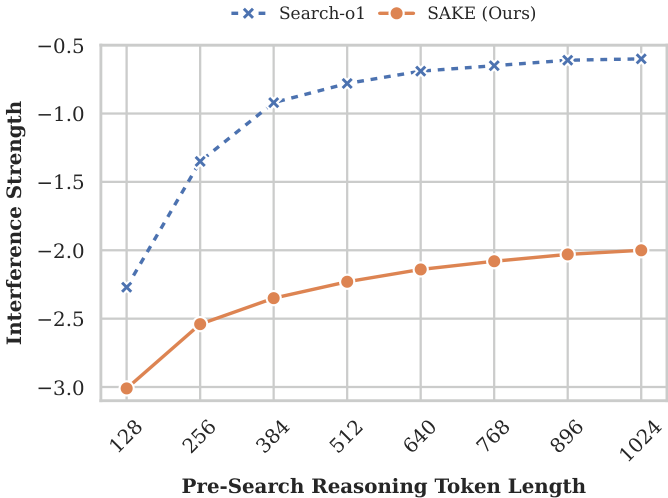
- Quantifying Attention Interference: The authors introduced an "interference strength" metric to measure how much attention a document allocates to prior reasoning vs. itself. In standard setups, this interference spikes drastically as pre-search reasoning length increases, confirming that long thoughts literally crowd out new facts. SAKE successfully flattens this interference curve.
- Layer-Wise Transition: SAKE works by inducing a structured shift in attention across Transformer layers. Early layers partially attend to the reasoning trace to capture context, while deeper layers progressively shift attention back to the pristine knowledge stack at the front, decoupling semantic encoding from reasoning biases.
Key Results
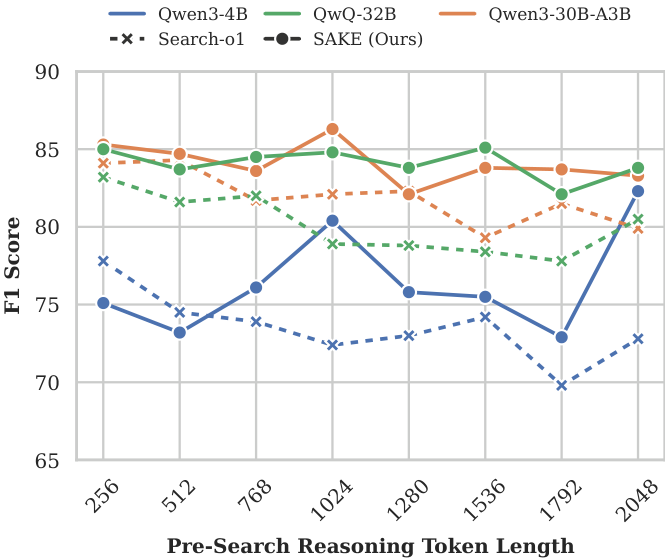
The authors tested SAKE across three representative open-source reasoning models: Qwen3-4B-Thinking, Qwen3-30B-A3B-Thinking, and QwQ-32B.
- Mitigating Decay: While standard baselines (like Search-o1) showed severe performance drops as pre-search reasoning extended up to 2,048 tokens, SAKE maintained remarkable stability.
- Substantial Accuracy Gains: On 2WikiMultiHopQA, SAKE achieved absolute F1 score improvements of up to +37.6%p on bridge-comparison questions over the Search-o1 baseline.
- Complex Benchmarks: SAKE consistently outperformed baselines on FRAMES and GAIA. Notably, on GAIA, the performance gap widened as the task difficulty increased from Level 1 to Level 2, proving SAKE's efficacy near the model's capability boundaries.
Limitations and Future Work
- Context Window Overhead: Because SAKE duplicates retrieved documents (once in the front stack, once inline), it inherently increases the input sequence length. This introduces a practical trade-off, raising inference latency and computational costs.
- Inference-Time Band-Aid: SAKE is an inference-time intervention that fixes the symptoms of KID rather than its root cause.
- Future Work: The authors note that future research should focus on training-centric solutions—such as integrating KID-aware objectives directly into reinforcement learning (RL) frameworks for search policies—and developing more efficient context management techniques.
Summary updated