


TL;DR
Have you ever carried a heavy couch with a friend and accidentally ended up in a silent tug-of-war, pushing against each other instead of moving forward? When two humanoid robots try to move a large object together, they face the exact same physics problem—often destabilizing themselves by generating invisible, opposing forces. IDEAL is the first force-aware imitation learning pipeline deployed on real dual-humanoid hardware that teaches two robots to extract collaborative skills from ordinary 2D videos, coordinate their invisible push-and-pull forces, and smoothly carry bulky objects together in the real world.
What Problem Does This Paper Address?
Teaching a single humanoid robot to move or pick up a box via Reinforcement Learning (RL) is already a major feat. Scaling up to Dual-Humanoid-Object Interaction (DHOI)—two robots manipulating one heavy, shared rigid object—introduces two massive roadblocks:
- Data Scarcity & Bad Depth Perception: Multi-person motion capture studios are expensive and hard to scale. Extracting 3D human motion from cheap, standard 2D videos is much more accessible, but existing computer vision models treat humans in isolation. Because of camera perspective and occlusion, estimated 3D hands either float in mid-air or phase straight through the box, making them terrible physical references for robots.
- Closed-Chain Force Antagonism: A single robot holding an object is an open-chain system. Two robots holding the same rigid object form a closed kinematic chain—every twitch one robot makes transmits physically through the box to the other. Purely mimicking human poses (kinematics) isn't enough; two robots can hit the exact right poses while secretly crushing the box or leaning backward against each other to keep their balance, wasting energy and risking a fall.
Methods
To bridge motion and physics, IDEAL (Interaction Dynamics and ForcE-Aware Learning) breaks the problem into three stages:
- PPIMO (Physical Prior-constrained Interaction Motion Optimization): Takes raw 3D human poses extracted from side-view monocular videos (via standard GVHMR) and cleans them up. Using the object's 3D geometry—represented as a Signed Distance Field (SDF)—it runs an optimization pass that penalizes hands for penetrating the object and snaps them cleanly onto the surface during contact frames, before retargeting the motions to Unitree G1 humanoids.
- DCFA (Dynamics-Constrained Force Allocation): Instead of letting RL guess how hard to push, the authors frame two-robot carrying as a classic rigid-body multi-finger grasping problem. Using Newton-Euler mechanics and Quadratic Programming (QP), DCFA calculates the exact 3D forces needed at the four hands to move the object along its trajectory while minimizing null-space internal forces (useless squeezing/pulling) and respecting friction cones so hands don't slip.
- IDRL (Interaction Dynamics and Force-Aware RL): Uses standard Multi-Agent PPO with a teacher-student setup. What's novel is how force is injected: during simulation training, the robots receive a reward for matching DCFA's optimal forces. Because the real robots don't have force sensors on their hands, a Variational Autoencoder called the Interaction Dynamics Encoder (IDE) learns to infer latent force dynamics purely from a short history of joint states and movement, giving the deployed student policy a "sixth sense" for contact forces.
Datasets
Rather than relying on existing motion-capture benchmarks, the authors construct their own task-specific reference data from custom monocular human demonstration videos processed through their PPIMO pipeline (combining GVHMR pose estimation, annotated object trajectories/contact masks, and GMR robot retargeting). They evaluate the framework across three core collaborative tasks—Box Transport (BT), Cabinet Pushing (CP), and Suitcase Lifting (SL)—plus additional weakly coupled scenarios like Parcel Passing and Cargo Pushing in the appendix.
Key Insights and Ideas
- Kinematics tell you where to be, not how to share the load: Without explicit force guidance, dual robots fall victim to internal force antagonism—literally fighting each other through the box to stay upright. Adding analytical force targets eliminates this invisible tug-of-war.
(Note: See Figure 4 below for force profiles.)
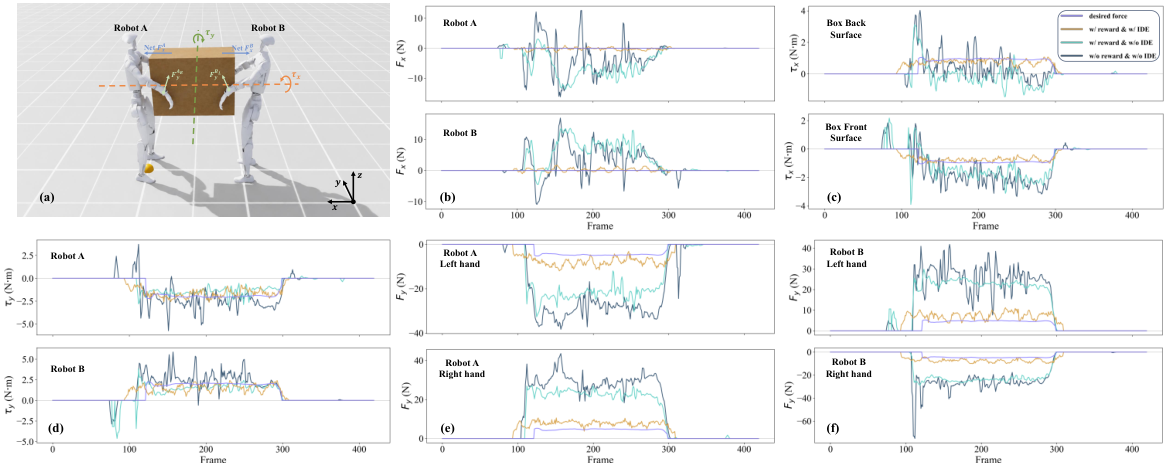
- Robots can "feel" forces without force sensors: By training the IDE module to reconstruct ground-truth simulator forces from proprioceptive history, the student policy implicitly perceives interaction forces during real-world execution without expensive wrist force-torque sensors.
- Soloists make terrible duets: Taking a strong single-robot policy (HDMI) trained to balance and carry a scaled-down object and deploying two of them together yields decent individual posture tracking, but catastrophic failure on the shared object (32%–47% success vs. IDEAL's 100%). Explicit inter-agent coordination during training is non-negotiable.
- Clean geometry speeds up RL: Fixing hand-object penetrations in reference videos (PPIMO) doesn't just make movements look nicer; it allows the simulator to initialize training episodes at random mid-task frames without physics explosions, dramatically boosting sample efficiency.
Key Results
- Simulation Dominance: Across Box Transport, Cabinet Pushing, and Suitcase Lifting in Isaac Sim, IDEAL achieves a 100% success rate, decisively outperforming the multi-agent baseline CooHOI (43%, 58%, and 71% SR) and independently trained HDMI policies (36%, 47%, and 32% SR), while cutting object position and orientation tracking errors substantially.
- PPIMO Boost: Using PPIMO-refined video references boosts simulation success rates from 88%–96% up to 100% across all tasks and slashes joint position errors ($E_{\text{mpjpe}}$) by roughly 33%–34%.
- Real-World Deployment: Deployed zero-shot onto two physical Unitree G1 humanoids (using Ultra-Wideband [UWB] tags for global tracking and ROS over Wi-Fi), IDEAL succeeded in 95% (19/20) of trials on Box Transport, 95% (19/20) on Cabinet Pushing, and 100% (20/20) on Suitcase Lifting—with the only two failures caused by hardware network/UWB dropouts rather than control instability.
Limitations and Future Work
The authors candidly highlight two main bottlenecks:
- Rigid Objects & Privileged Priors: The pipeline relies on known 3D object geometry and rigid-body mechanics, limiting it to non-articulated, solid objects. Extending this to deformable items (like mattresses or bags), articulated objects, or dynamic, shifting grasps is left for future work.
- External Infrastructure: Real-world deployment currently depends on external UWB beacons for global localization and wireless ROS synchronization. Moving toward onboard visual perception and tighter perception-control coupling will be essential for scaling multi-humanoid teams into messy, unstructured environments.
Summary updated