


TL;DR
When we compress giant Vision-Language Models (VLMs) into fast, lightweight hybrid architectures, they keep their broad reasoning skills intact—until you ask them to read the fine print on a receipt. Standard distillation treats blank background patches and crucial text digits as equally important, accidentally washing out local details. HEED fixes this by telling the student model to pay extra attention to visually "dense," distinctive patches during training, recovering lost reading and document skills at zero extra inference cost.
What Problem Does This Paper Address?
Full-attention Transformers are brilliant at multimodal tasks, but their quadratic scaling makes long contexts painfully slow and memory-hungry. A popular solution is a hybrid architecture: swap out most attention layers (say, 75% of them) with linear-time sequence mixers like Mamba-2, while keeping periodic attention layers for heavy lifting. Because training from scratch is expensive, we usually use knowledge distillation (KD) to transfer smarts from a pretrained Transformer "teacher" into this hybrid "student."
Look at aggregate benchmark scores, and this distillation recipe seems to work great. Look closer, and a strange blind spot emerges. While the student stays within ~2 points of the teacher on broad visual reasoning, its performance plummets by over 13 points on optical character recognition (OCR) and document tasks. It can tell you an image is a restaurant receipt, yet completely misread the total bill.
Why the selective amnesia? High-resolution images are mostly smooth, repetitive backgrounds—sky, walls, blank paper margins—with tiny islands of critical information like digits, chart marks, and edges. Standard distillation losses weight every visual token uniformly. Under the limited state capacity of a Mamba-2 block, the student spends most of its alignment budget matching vast expanses of blank paper, leaving sparse, answer-bearing details unprotected.
Methods
The authors introduce HEED (Density-Weighted Residual Alignment), a simple tweak to the distillation loss that adds zero parameters and zero inference overhead.
First, HEED follows a standard three-stage hybrid conversion recipe (initializing Mamba-2 blocks from teacher attention weights, warming up, training full blocks, and finishing with end-to-end logit distillation). However, instead of aligning the isolated outputs of individual layers during Stages 1 and 2, the authors align the residual stream—the actual highway of information passed forward to subsequent layers.
Second—and here is the core innovation—HEED replaces uniform loss weighting with a training-free density weight:
- Measure Local Distinctiveness: Using the model's frozen Vision Transformer (ViT) features, HEED compares each image patch to its $3\times3$ spatial neighbors via cosine similarity. Smooth margins look like their neighbors (low density); text characters and chart lines stand out sharply (high density).
- Reweight the Loss: These self-dissimilarity scores are converted into per-position weights via a temperature-scaled exponential and normalized so the total loss budget stays constant.
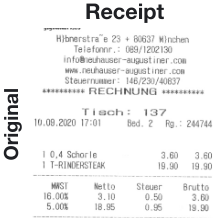
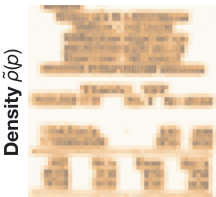
During training, mistakes on high-density patches cost the student much more than mistakes on empty backgrounds. Once training finishes, the density cache is thrown away, leaving a pure, fast hybrid model.
Datasets
- Diagnostic Data: A 1,000-sample validation slice from LLaVA-OneVision-Data was used to diagnose token-level drift.
- Distillation Training: A blend of ~1.34M samples (~2B tokens) following the InternVL data recipe.
- Evaluation Benchmarks: Ten existing benchmarks split into two diagnostic groups (no new benchmarks were introduced):
- Fine-grained perception: OCRBench v2, DocVQA, ChartQA, TextVQA, InfoVQA, and AI2D.
- Broad reasoning: MMMU-Pro, MMStar, MMBench, and MathVista.
Key Insights and Ideas
- It's not "vision vs. text"—it's local distinctiveness: You might guess visual tokens simply degrade faster than text tokens. Yet linear regression diagnostics show local density explains 3$\times$ more unique variance in student-teacher drift than token type, layer depth, or even teacher attention concentration.
- Where the student drifts most, the teacher cares most: Sorting visual patches by density reveals a double whammy: the top 10% highest-density patches drift 3.6$\times$ farther from the teacher than the bottom 10%, and masking them hurts the teacher's accuracy 3.5$\times$ more.
- Cheap input geometry rivals expensive gradients: Calculating patch self-dissimilarity requires no labels and no teacher backward pass, yet captures the exact regions an expensive gradient-based saliency method would target.
Key Results
Distilling Qwen3-VL-8B-Instruct into a 3:1 Mamba-2/attention hybrid:
- Post-Distillation Gains: Compared to standard end-to-end KD, HEED boosts OCRBench v2 by +8.7 points (50.5 $\rightarrow$ 59.2) and the 10-benchmark average by +5.13 points. Against a strict internal control using uniform residual alignment, density weighting alone accounts for +4.7 points on OCRBench v2 without hurting reasoning.
- Reaching Teacher Parity: After applying an identical post-training recipe (SFT + DPO) across all baselines, HEED is the only student to match the teacher's 10-benchmark average (78.79 vs. 78.41), whereas uniform-weight baselines still lag by 1.9 to 5.1 points.
- Speed & Memory: Because the architecture is untouched at deployment, the student retains full hybrid efficiency: 4.12$\times$ higher throughput and 68% less peak VRAM at a 128k context length, plus a 2.8$\times$ faster time-to-first-token at 32k context.
- Generalization: The gains hold across random seeds, transfer to
InternVL-3.5(+3.2 pts on OCRBench v2), and successfully train a 3:1 Gated DeltaNet (GDN) hybrid.
Limitations and Future Work
- Density is a proxy, not true task saliency: Self-dissimilarity naturally favors high-frequency edges and text. On tasks where the decisive clue is smooth, global, or adversarially patterned—or in un-tested domains like medical imaging and remote sensing—local density might misrank importance, requiring a fallback to heavier gradient-based weighting.
- Fixed post-training: Every baseline received the exact same SFT+DPO schedule for fair comparison; custom tuning per baseline might narrow final gaps.
- Combining with token pruning: Inference-time accelerators (like FastV or VisionZip) drop boring tokens during deployment, whereas HEED reweights them during training. Testing both together is a natural, unexplored next step.
Summary updated