


TL;DR
This paper introduces a graph-based recommender system designed specifically for small-scale, sparse datasets where traditional deep learning models often fail. By building a heterogeneous interaction graph and using a Genetic Algorithm (GA) to automatically optimize edge weights, the authors achieve up to a 7% performance boost over state-of-the-art baselines in low-data environments.
What Problem Does This Paper Address?
Most modern recommender system (RS) research focuses on "big data" scenarios—think Netflix or Amazon—where millions of interactions are available. However, Small and Medium Enterprises (SMEs) often operate in "data-poor" environments. They might have a new platform with few users, or operate in domains like insurance where users interact very infrequently.
Traditional collaborative filtering and deep learning models are notoriously "data-hungry." They struggle with sparsity (most users haven't interacted with most items) and the cold-start problem. Furthermore, many models only consider direct user-item interactions (e.g., purchases), ignoring the rich, heterogeneous context of other actions like "liking" a post, "following" a user, or "reading" an information page.
Methods
The authors propose a three-step approach:
-
Heterogeneous Graph Construction: Instead of a simple user-item matrix, they build a directed graph where vertices represent different entities (users, courses, posts, comments, insurance products) and edges represent various interaction types. Importantly, they include interactions with objects that aren't the primary recommendation targets to provide extra context.
Fig. 1: Example of the heterogeneous graph in a social network. -
Personalized PageRank (PPR): To generate recommendations, the model uses a random walk with restart (PPR). Starting from a user node, the algorithm traverses the graph to find the most "reachable" items. The probability of moving across an edge depends on its assigned weight.
- Genetic Algorithm (GA) Optimization: This is the core innovation. Rather than manually setting weights for different actions (e.g., is a "purchase" twice as important as a "click"?), they use a GA to evolve the optimal weights. The GA treats a vector of weights as a "gene," evaluates its performance using Mean Reciprocal Rank (MRR) on a validation set, and uses crossover and mutation to find the best configuration.
Datasets
The authors evaluated their model on two real-world datasets, which they have made public:
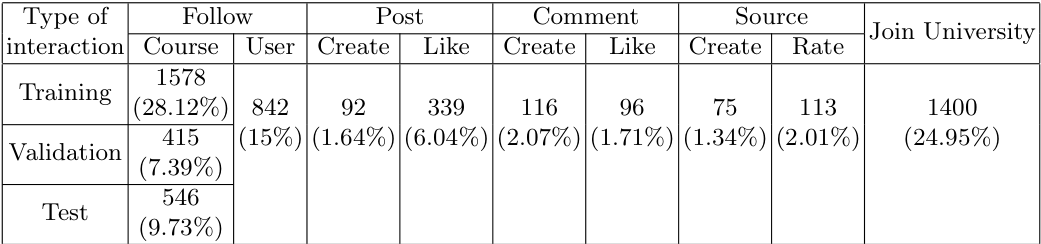
- Educational Social Network: A very sparse dataset from a startup platform. It contains 5,088 interactions among 878 users and 1,605 objects (sparsity of 0.996). Interactions include following courses, creating posts, and liking comments.
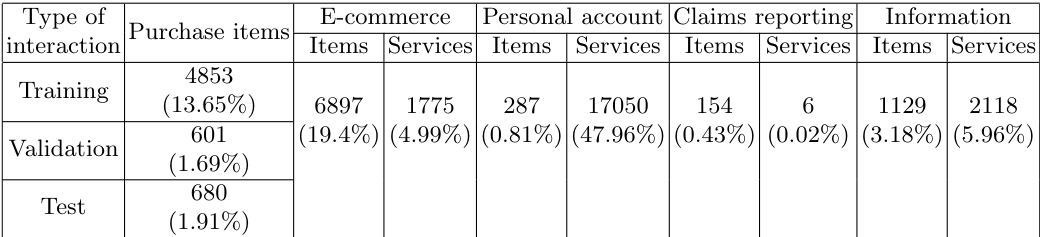
- Insurance E-commerce: A larger dataset (432,249 interactions) but with very few items (only 55). It captures a complex journey of clicking information services, reporting claims, and purchasing products.
The breakdown of these interactions is detailed in the tables below:
Key Insights and Ideas
- Heterogeneity is a Lifeline: In sparse environments, every interaction counts. By including "non-recommendable" items (like comments or info pages) in the graph, the model can find indirect paths between users and items that a standard matrix-based approach would miss.
- Directionality Matters: The authors found that directed graphs outperform undirected ones. For example, in a social network, the weight of "User A follows User B" should not necessarily be the same as the return weight from B to A.
- Heuristics Beat Hand-Tuning: The GA-optimized weights outperformed weights derived from a manual user study. This suggests that the "true" importance of an action for recommendation quality is non-intuitive and best discovered through optimization.
- Robustness to Downsampling: When the insurance dataset was subsampled to just 10% of its original size, the GA-optimized graph model maintained its lead over neural models like NGCF, proving its resilience in extreme low-data scenarios.
Key Results
- Superiority in Sparsity: On the educational dataset, the proposed model outperformed all baselines, including Neural Collaborative Filtering (NeuMF) and Graph Neural Networks (NGCF).
- Significant Gains: The model showed a 7% improvement in MRR compared to the best-performing baselines in low-data environments.
- Stability: Even with the inherent randomness of Genetic Algorithms, the model showed low standard deviation across multiple runs, indicating that it consistently converges to high-quality weight configurations.
Limitations and Future Work
- Temporal Dynamics: The current model treats all interactions as equally recent. The authors suggest that future versions could incorporate a "decay" factor where older interactions have lower weights.
- Scalability of Optimization: While GA works well for these specific datasets, the search space grows with the number of interaction types. The authors propose exploring other metaheuristics like Particle Swarm Optimization or Ant Colony Optimization.
- Explainability: While the graph structure is inherently more interpretable than a "black-box" neural network, more work is needed to provide principled explanations to end-users based on the learned edge weights.
Summary updated