


TL;DR
GeoRA (Geometry-Aware Low-Rank Adaptation) is a novel parameter-efficient fine-tuning framework specifically designed for Reinforcement Learning with Verifiable Rewards (RLVR). By initializing low-rank adapters from a geometry-constrained subspace and anchoring them with a frozen residual matrix, GeoRA aligns training with RL-specific optimization dynamics. This approach delivers superior reasoning performance and training stability while preventing the out-of-domain capability collapse common in standard LoRA variants.
What Problem Does This Paper Address?
Reinforcement Learning with Verifiable Rewards (RLVR) has emerged as a critical paradigm for unlocking advanced reasoning capabilities in large language models (e.g., OpenAI's o1 and DeepSeek-R1). However, RLVR exhibits fundamentally different optimization dynamics compared to Supervised Fine-Tuning (SFT). While SFT primarily injects new knowledge by modifying principal weight directions, RLVR acts as a constrained optimization process that amplifies latent behaviors, favoring low-magnitude directions orthogonal to core pre-trained features.
Existing Parameter-Efficient Fine-Tuning (PEFT) methods suffer from a structural mismatch in this regime:
- SFT-Oriented Low-Rank Methods (like PiSSA or standard LoRA): Force updates onto principal components, which conflicts with RLVR's preferred update subspace and destabilizes core pre-trained representations.
- Sparse Fine-Tuning Methods: Successfully target the correct parameters but introduce unstructured sparsity, which runs poorly on modern GPU hardware and fails to deliver real-world training speedups.
GeoRA addresses this gap by identifying a compressible, geometry-aligned update subspace that allows for stable, hardware-efficient dense matrix computation.
Methods
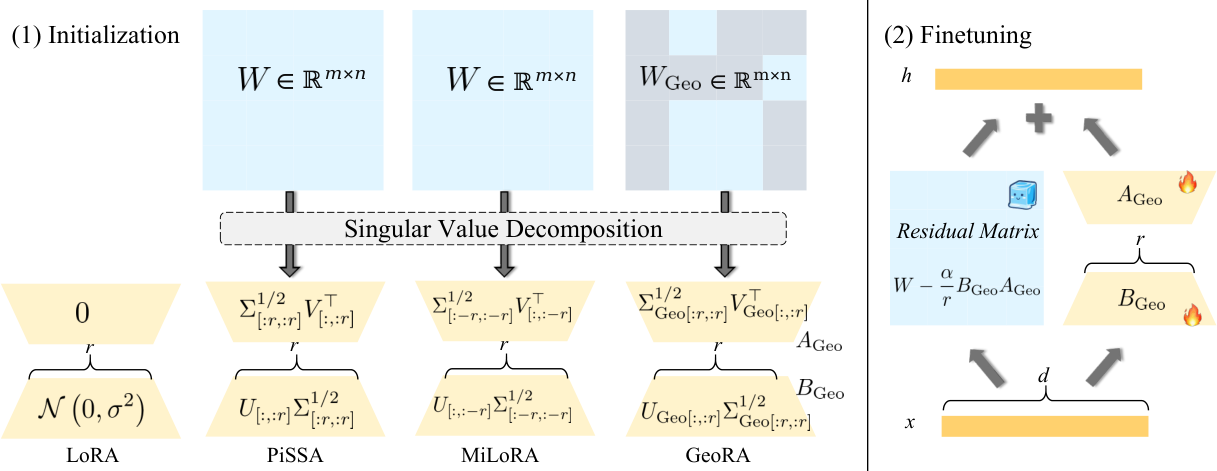
GeoRA introduces a three-phase initialization and forward architecture tailored to the geometry of RLVR:
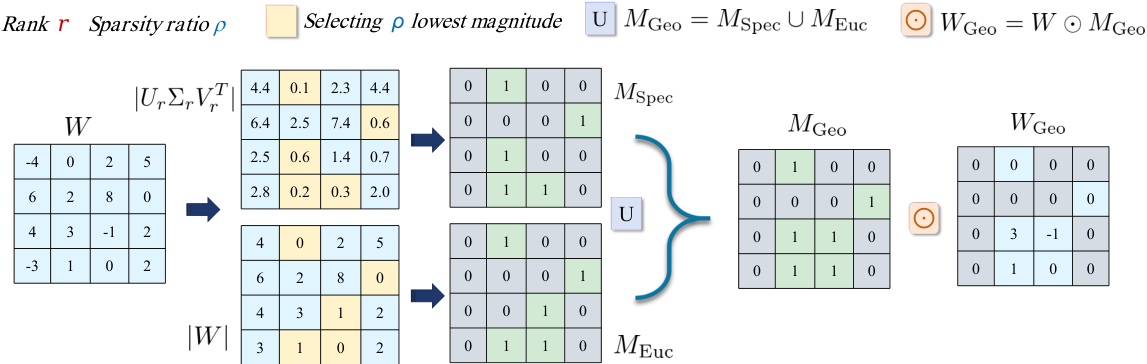
- Geometric Prior Construction: The framework creates a mask ($M_{\text{Geo}}$) by combining a Spectral Prior (which suppresses high-curvature principal components to promote stability) and a Euclidean Prior (which selects low-magnitude weights with high plasticity). This mask isolates a stable, geometry-constrained matrix ($W_{\text{Geo}}$) from the pre-trained weights ($W$).
- Geometry-Aware Decomposition: Truncated Singular Value Decomposition (SVD) is performed on $W_{\text{Geo}}$ to extract its dominant trainable directions, initializing the low-rank adapters ($A_{\text{Geo}}$ and $B_{\text{Geo}}$).
- Residual Leash Instantiation: To ensure the model remains function-preserving at initialization, a parallel Residual Matrix ($W_{\text{res}} = W - \frac{\alpha}{r}B_{\text{Geo}}A_{\text{Geo}}$) is calculated and kept frozen during training. This acts as a structural anchor, preventing aggressive reward maximization from eroding pre-trained capabilities.
Datasets
The authors evaluated GeoRA across several reasoning domains:
- Mathematics: Main experiments used the DeepMath-103K dataset for training, with smaller-scale validation on GSM8K. In-distribution evaluation was conducted on AIME24, AIME25, MATH500, and OlymMATH.
- Medicine: Models were trained on the AlphaMed19K dataset and evaluated on MedQA, MedMCQA, and PubMedQA.
- Coding: Training was performed on Eurus-2-RL-Data, with evaluations on LiveCodeBench, HumanEval, and MBPP.
- Out-of-Distribution (OOD) Generalization: HumanEval, GPQA, MMLU, IFEval, and TruthfulQA were utilized to assess cross-domain capability preservation and robustness against forgetting.
Key Insights and Ideas
- RLVR Updates Favor the Spectral Tail: Mechanistic analysis reveals that effective RLVR updates are anisotropic and highly compressible, concentrating heavily on minor components (the tail) rather than principal components (the head) of the weight matrix.
- Sparsity Does Not Equal Low-Rankness: Unstructured sparse noise remains isotropic in the spectral domain. However, by intersecting spectral and Euclidean priors, GeoRA uncovers a structured, heavy-tailed low-rank form naturally present within the weight sub-regions.
- The Power of the "Residual Leash": Keeping the residual matrix frozen prevents the "Reasoning Boundary Paradox"—where aggressive reward optimization collapses policy exploration diversity—by enforcing proximity to the pre-training manifold.
Key Results
- Performance Breakthroughs: GeoRA consistently outperformed LoRA, PiSSA, MiLoRA, and Sparse Fine-Tuning across Qwen and Llama models ranging from 1.5B to 32B parameters. For instance, on Llama-3.1-8B, GeoRA achieved an 18.54% accuracy on AIME24, noticeably higher than LoRA's 15.42%.
- Exceptional Training Stability: Under aggressive learning rates ($5 \times 10^{-5}$), alternative methods like PiSSA suffered catastrophic reward collapse late in training, whereas GeoRA maintained a high, stable reward trajectory with controlled KL divergence.
- Hardware Efficiency: GeoRA reduced trainable parameters by 99.5% compared to Full Fine-Tuning. It also bypassed the hardware bottlenecks of unstructured sparse methods, lowering VRAM usage and improving per-iteration training speed (185 s/it for GeoRA vs. 256 s/it for SparseFT).
Limitations and Future Work
- Initialization Overhead: GeoRA requires computing a truncated SVD and applying dual masks before training begins. While the authors successfully mitigated this by using randomized SVD (reducing the setup to a sub-minute operation), it remains an extra preprocessing step compared to standard LoRA.
- Domain Constraints: The study focuses heavily on reasoning tasks with deterministic, verifiable rewards (mathematics, coding, medicine). The authors note that GeoRA's generalizability should be further validated across open-ended reinforcement learning scenarios that lack explicit verifiers.
Summary updated