


TL;DR
FedSGN (Federated Sparse Grassmann Newton) is a novel framework for IoT anomaly detection that combines federated learning with sparse Principal Component Analysis (PCA). By imposing an $\ell_{2,0}$-norm constraint and utilizing a second-order semismooth Newton optimization, it achieves state-of-the-art detection accuracy while significantly reducing communication overhead and improving model interpretability.
What Problem Does This Paper Address?
The Internet of Things (IoT) is a massive, distributed ecosystem prone to security vulnerabilities. Detecting anomalies—deviations from "normal" behavior—is crucial, but doing so effectively faces three major hurdles:
- Privacy: Collecting raw IoT data in a central server for analysis raises significant privacy concerns.
- Redundancy: Standard PCA methods often retain redundant features, which can mask anomalies and waste precious bandwidth on resource-constrained devices.
- Efficiency: Deep learning models (like Autoencoders) are powerful but often act as "black boxes" and require substantial computational and communication resources that IoT gateways may not have.
FedSGN addresses these by learning a sparse, shared subspace across distributed clients, ensuring that only the most relevant features are used for detection without ever sharing raw data.
Methods
The core of FedSGN is a federated sparse subspace learning model optimized on the Grassmann manifold (the space of all $p$-dimensional subspaces).
Key technical innovations include:
- Explicit Feature Selection: Unlike methods that merely "shrink" feature weights, FedSGN uses an $\ell_{2,0}$-norm constraint on the global projection matrix. This forces the model to select a specific number of the most important features (row-wise sparsity), making the model highly interpretable.
- Semismooth Newton Optimization: To solve the non-convex optimization problem, the authors developed an augmented Lagrangian solver integrated with a second-order Newton scheme. This allows for faster convergence compared to traditional first-order methods.
- Orthogonality Penalty & Grassmann Projection: Instead of relying on expensive Singular Value Decomposition (SVD) at every step, the model uses an orthogonality penalty during training and a final Grassmann projection to maintain the mathematical integrity of the subspace.
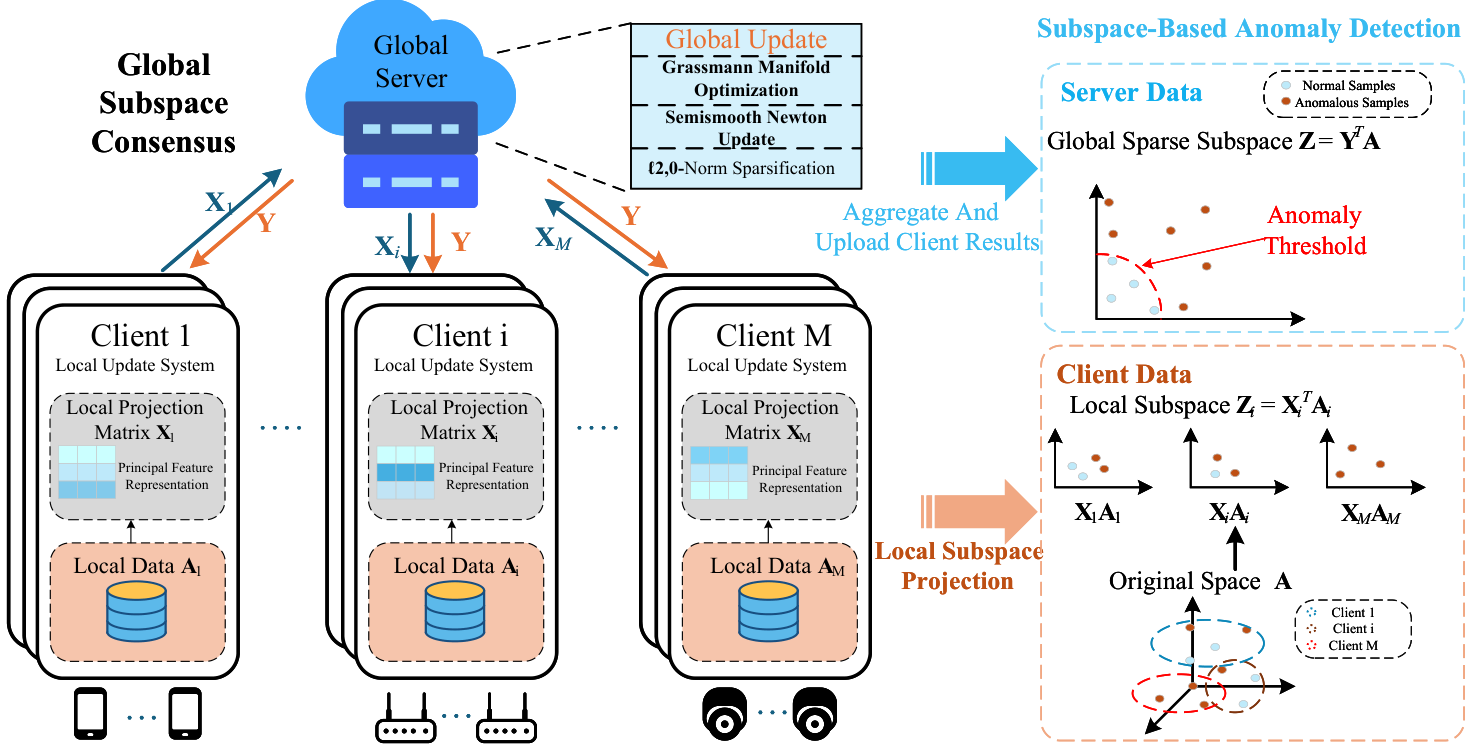 *Fig.
- The FedSGN framework: Clients perform parallel local updates, while the server aggregates results and refines the global sparse subspace using a Newton-based update.*
Datasets
The authors evaluated FedSGN against seven state-of-the-art methods using both synthetic and real-world benchmarks:
- Synthetic Dataset: 50-dimensional data with controlled anomaly intensities to test sensitivity.
- UNSW-NB15: A modern network intrusion dataset with 39 features and 10 classes of attacks.
- NSL-KDD: A refined version of the classic KDD’99 dataset, featuring 34 features.
- TON-IoT: A diverse dataset comprising heterogeneous telemetry and network attacks from various IoT devices, featuring 49 features.
Key Insights and Ideas
- Sparsity is a Feature, Not a Bug: By zeroing out redundant features, FedSGN actually improves detection performance. As shown in Figure 6, FedSGN identifies a clear subset of critical features (like
src_bytesorduration) while ignoring noise, whereas standard federated PCA (FedPG) assigns weights to everything. - Second-Order Info Matters: The introduction of the Newton direction accelerates convergence. The model reaches high performance in fewer communication rounds than first-order alternatives.
- Communication Efficiency: Because the global projection matrix is sparse, the server only needs to transmit non-zero coefficients and their indices. This drastically reduces the "broadcast volume" compared to dense models.
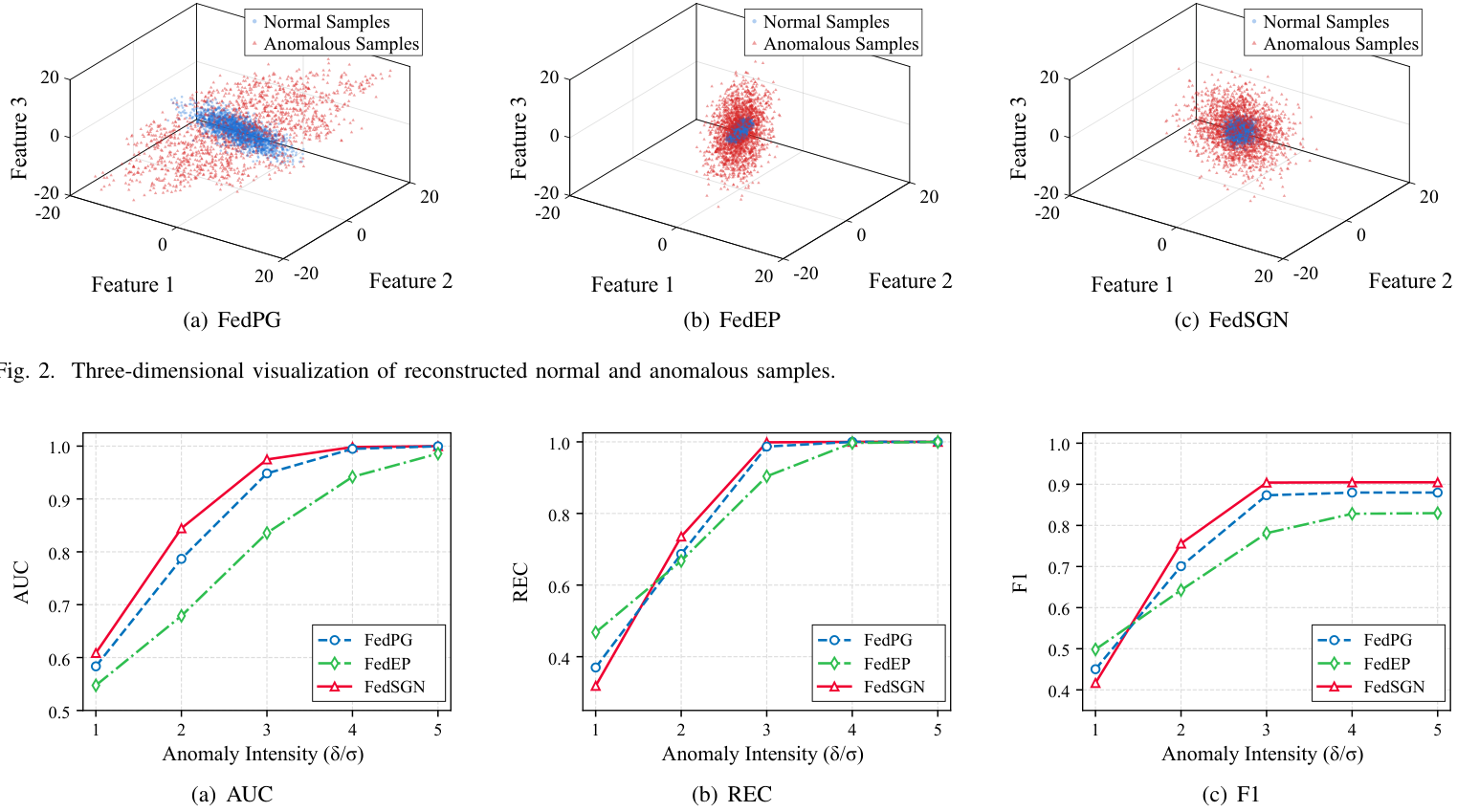 *Fig.
- Visualization of feature selection: FedSGN (red) focuses on a sparse subset of original features, whereas FedPG (blue) retains weights for all features, leading to redundancy.*
Key Results
FedSGN consistently outperformed both deep learning baselines (FedAE, FedBiGAN) and other federated PCA variants (FedPE, FedPG, FedEP):
- Detection Accuracy: On the UNSW-NB15 dataset, FedSGN achieved an Accuracy of 87.92% and an F1-score of 91.70%, surpassing all competitors.
- Robustness: In synthetic tests, FedSGN maintained higher AUC and F1-scores across varying levels of anomaly intensity compared to other subspace methods.
- Resource Efficiency: FedSGN demonstrated a significantly lower model transmission volume (Figure 8) and lower peak tensor memory usage during inference (Figure 9) than neural network-based methods, making it ideal for edge deployment.
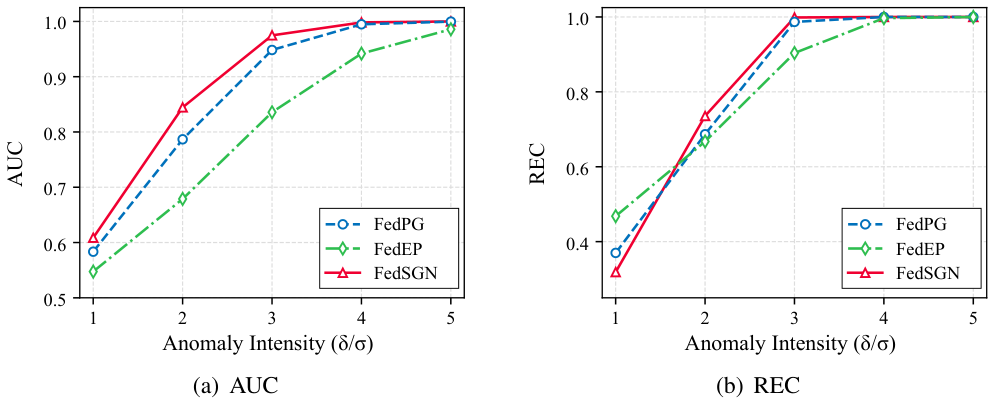 *Fig.
- FedSGN (red line) shows superior AUC and F1-scores across different anomaly intensities compared to FedPG and FedEP.*
Limitations and Future Work
While FedSGN is highly effective, the authors note a few areas for improvement:
- Computational Cost: While communication is reduced, the Newton steps on the server side can be computationally intensive per iteration. Future work will look into even more efficient optimization algorithms.
- Static Sparsity: The current model uses a fixed sparsity level ($s$). Developing adaptive sparsity mechanisms that automatically determine the optimal number of features would improve generalization.
- Neural Integration: The authors suggest extending these sparse subspace ideas to deep neural networks to combine the representational power of deep learning with the efficiency of sparse PCA.
Summary updated