


This paper investigates the feasibility of deploying open-weight Large Language Models (LLMs) locally for scientific literature search. By benchmarking inference latency and retrieval success on a Mac Studio (M3 Ultra) and an NVIDIA A100 server, the authors demonstrate that while dedicated GPUs offer raw speed, the Mac Studio’s unified memory allows it to run massive models that are otherwise inaccessible to mid-tier GPU configurations, making it a potent tool for private, lab-based research assistants.
TL;DR
The study benchmarks local LLM deployment for scientific search, comparing the Mac Studio’s massive unified memory against NVIDIA A100’s speed. It reveals that while A100s are generally faster, the Mac Studio enables running high-parameter models (like Qwen 122B) that exceed standard GPU memory, providing a cost-effective and private alternative for research teams.
What Problem Does This Paper Address?
Modern scientific research often involves sensitive, unpublished data. Sending this material to external LLM providers (like OpenAI or Google) raises significant concerns regarding confidentiality, data governance, and long-term dependency on third-party APIs.
However, running LLMs locally is challenging. Scientific paper retrieval requires processing long contexts and high-dimensional domain knowledge. The "gap" the authors tackle is whether open-weight models, running on practical, locally-owned hardware, can actually perform well enough—both in terms of speed (latency) and accuracy (retrieval success)—to replace hosted solutions.
Methods
The authors developed a custom "harness"—the software layer that manages context and tool calls—to evaluate eight different models from the Qwen, GLM, and Gemma families.
The evaluation was split into two main thrusts:
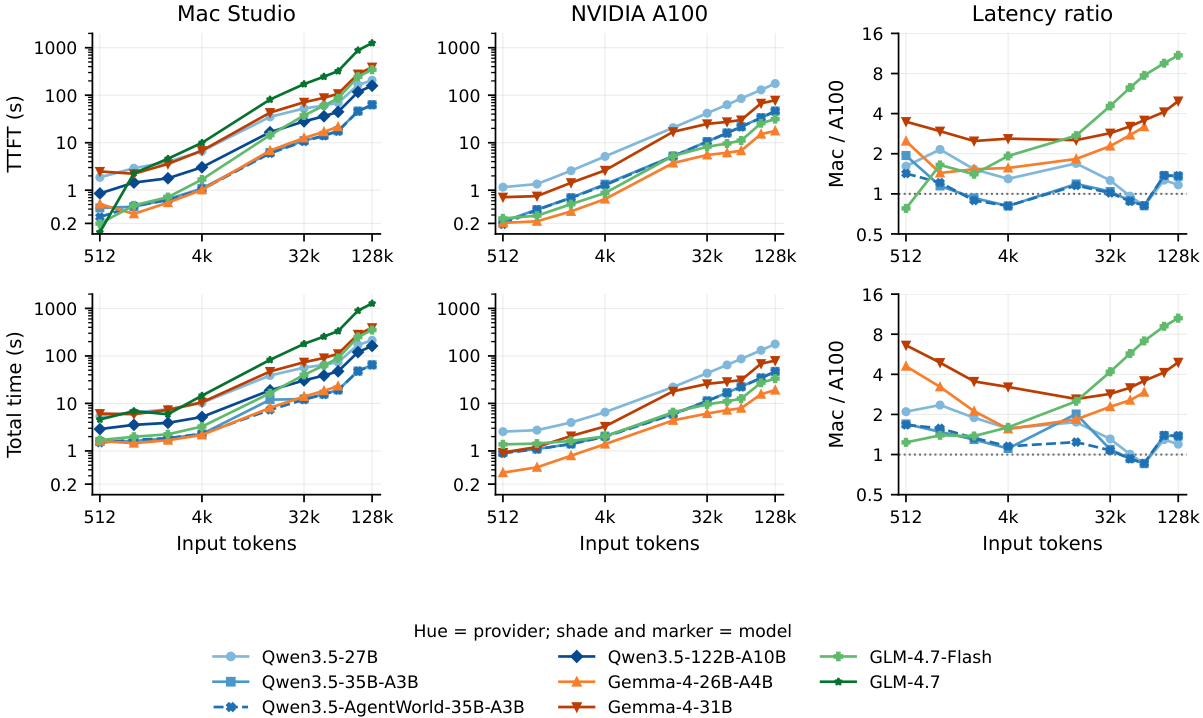
- Inference Latency: They measured Time to First Token (TTFT) and total response time as the input context grew from 512 to 128k tokens.
- Retrieval Success: They tested the models' ability to identify specific papers using a web-search tool.
The hardware comparison is central to the study:
- Mac Studio: M3 Ultra with 512 GB of unified memory (using
llama.cpp). - NVIDIA A100: A server with two 40 GB GPUs (using
vLLM).
Datasets
The authors curated a target corpus of 70 scientific papers, with 10 papers drawn from each of seven repositories: arXiv, bioRxiv, medRxiv, ChemRxiv, SSRN, Research Square, and agriRxiv.
To test retrieval, they used Google Gemini 3.5 Pro to generate 210 queries (3 per paper) representing different levels of domain knowledge:
- Basic: Accessible, layperson terms.
- Intermediate: Discipline-specific concepts.
- Expert: Technical clues and distinctive jargon.
Key Insights and Ideas
- Unified Memory is the "Secret Sauce": The Mac Studio’s 512 GB unified memory pool allows it to load massive models like Qwen3.5-122B and GLM-4.7-355B. These models simply could not fit on the 80 GB total VRAM of the tested A100 configuration.
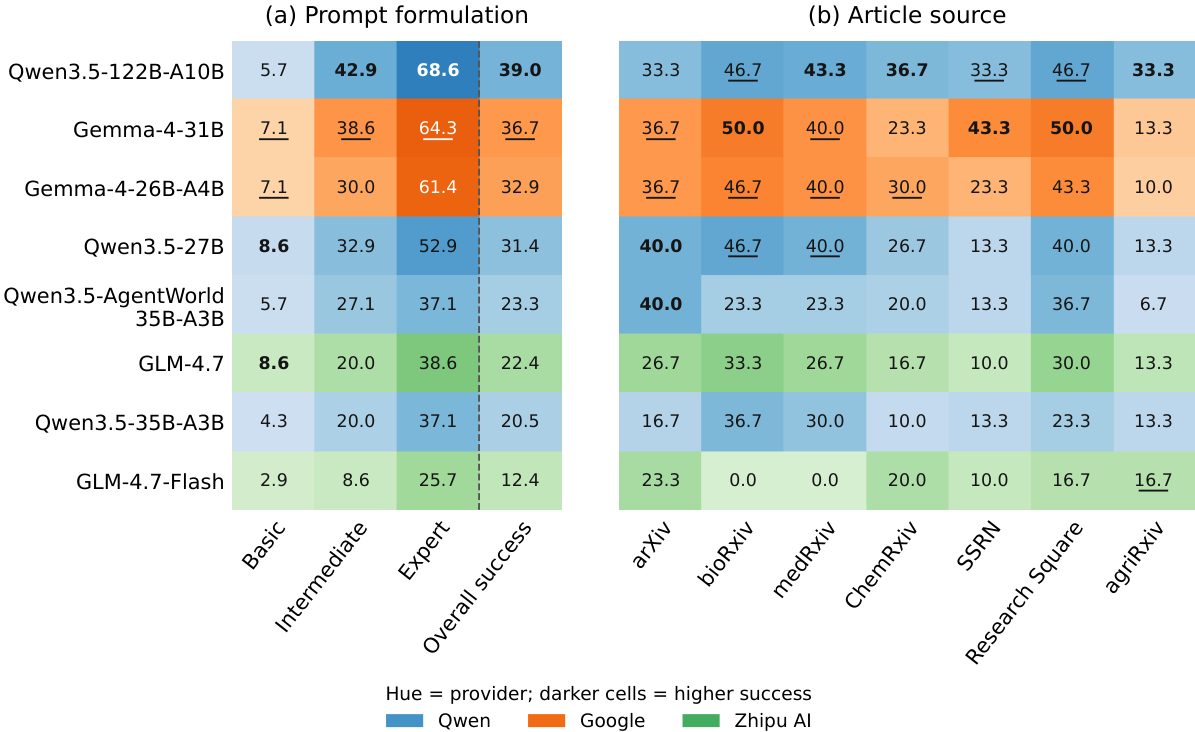
- The "Expertise" Jump: Retrieval success is not just about the model; it’s about the query. There is a massive performance leap when moving from basic to expert queries, suggesting that LLM assistants are currently most effective when used by researchers who already know the technical "keywords" of their field.
- Latency Isn't Linear: On the Mac Studio, latency increases sharply once the context exceeds 64k tokens. At 128k tokens, the time to first token (TTFT) accounts for nearly 99% of the total response time.
- Hardware vs. Model Trade-offs: The fastest model on one platform isn't necessarily the fastest on the other. For instance, Gemma-4-26B-A4B was the speed king on the A100 at long contexts, but Qwen variants performed better on the Mac.
Key Results
- Retrieval Performance: Qwen3.5-122B-A10B was the top performer, achieving a 39% overall success rate and a impressive 68.6% success rate on expert queries.
- Specificity Wins: Across all models, success rates climbed from a meager 6.2% for basic queries to 48.2% for expert queries.
- Speed: The NVIDIA A100 was generally faster, with a "latency ratio" showing it was up to 10x faster than the Mac for certain models (like GLM-4.7-Flash). However, for the fastest Qwen models, the A100 was only about 1.4x faster.
- Cost Efficiency: The authors estimate the Mac Studio setup at €7,000–€8,000, compared to €22,000–€26,000 for just the A100 cards (excluding the rest of the server).
Limitations and Future Work
- Throughput: The study used a sequential protocol. In a real lab setting with multiple users, the A100’s ability to handle concurrent requests via
vLLMwould likely provide a much larger advantage than the single-user benchmarks suggest. - Privacy Leaks: While the model runs locally, "web-assisted" search still sends queries to external search engines, which remains a privacy bottleneck.
- Human in the Loop: No model reached 100% accuracy; the authors emphasize that these systems should be viewed as assistants subject to human verification, not autonomous oracles.
- Quantization Effects: The study compared GGUF (Mac) vs. AWQ (A100) formats. Future work could investigate if these different compression methods significantly alter the "reasoning" quality of the models.
Summary updated