


TL;DR
DIVAL (Diffeomorphic Vector-Field Alignment) is a novel motion planning framework that eliminates the initial heading mismatch for nonholonomic robots by locally "warping" the vector field to match the robot's starting orientation. By using a smooth, invertible transformation (diffeomorphism), DIVAL ensures that robots like cars or fixed-wing UAVs can follow safe, collision-free paths from the very first second without the jerky corrections or trajectory deviations common in traditional planners.
What Problem Does This Paper Address?
Most modern robot motion planners use vector fields: a map of "arrows" that tell a robot which way to go to reach a target while avoiding obstacles. For "holonomic" robots (like a drone that can fly in any direction), this works great.
However, many robots are nonholonomic—think of a car or a plane that must move forward to turn. If a car starts facing North but the vector field says "go East," the car can't just slide sideways. Traditional controllers try to steer the robot toward the field's direction while it moves. This "catch-up" phase causes the robot to deviate from the planned path, which can lead to collisions with nearby obstacles or unstable, jerky movements.
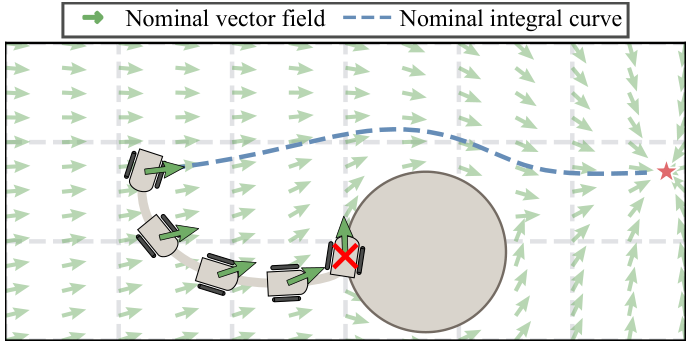
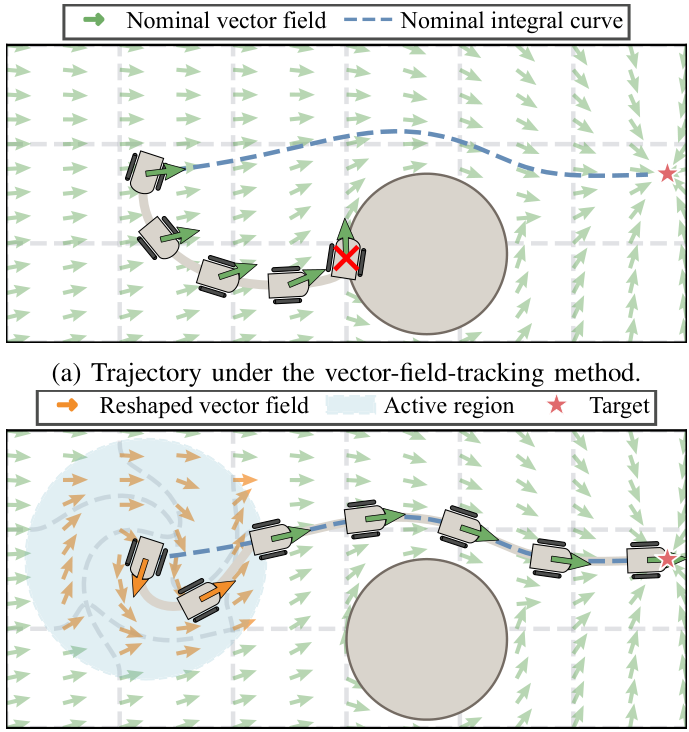
Methods
The authors propose DIVAL, which flips the script: instead of forcing the robot to align with the field, they reshape the field to align with the robot.
- Diffeomorphic Deformation: The core idea is to apply a "diffeomorphism"—a smooth, invertible mathematical warping—to the workspace around the robot's starting position. This warp rotates the local vector field so that at the exact starting point, the "arrow" points exactly where the robot is already facing.
- Local Impact: This deformation is confined to a small "active region." Outside this bubble, the vector field remains completely unchanged, preserving the original global plan.
- Property Preservation: Because the transformation is a diffeomorphism, the authors prove that the "safety" (obstacle avoidance) and "convergence" (reaching the target) properties of the original field are mathematically preserved. The robot is essentially following a "warped" version of a safe path.
- Control Law: The paper derives a specific angular velocity control law that ensures the robot stays perfectly locked onto the reshaped field's integral curves throughout its journey.
Datasets & Benchmarks
The researchers evaluated DIVAL using three well-known nominal vector field baselines:
- ARVF: Attractive and Repulsive Vector Field.
- CAPF-VF: Collision Avoidance and Path Following.
- NVF: Navigation Vector Field.
They performed a Monte Carlo analysis with 1,000 randomly sampled initial configurations for each field to test robustness. Finally, they validated the system on real hardware using an AgileX LIMO UGV in a workspace with six static obstacles.
Key Insights and Ideas
- Eliminating the "Transient": By starting with zero heading error, the robot never has to "hunt" for the path. This eliminates the dangerous transient phase where most collisions occur in vector-field planning.
- Avoiding "Switching Surfaces": Many obstacle-avoidance fields have "seams" (switching surfaces) where the direction jumps abruptly. Traditional controllers often cross these seams during their initial correction, causing jerky control spikes. DIVAL's warping ensures the robot's path naturally avoids these discontinuities.
- Mathematical Elegance: By treating the problem as a deformation of space rather than just a control tweak, the authors can use the tools of differential geometry to guarantee that if the original field was safe, the reshaped one is too.
Key Results
- 100% Success Rate: In Monte Carlo simulations where traditional high-gain controllers still failed in some trials (due to collisions or instability), DIVAL achieved collision-free convergence in every single trial.
- Lower Control Effort: DIVAL required significantly less "steering work" (angular velocity and acceleration). Compared to the best-performing baselines, DIVAL reduced median peak angular velocity by 92% to 98%.
- Hardware Precision: In real-world tests on a ground vehicle, the robot followed the planned curves with an RMS distance error of only 2.75 cm, even in the presence of real-world friction and sensor noise.
Limitations and Future Work
- Curvature Constraints: While DIVAL aligns the direction, it doesn't explicitly account for the robot's minimum turning radius. If the required "warp" creates a path tighter than the robot can physically turn, the robot will still deviate. The authors suggest incorporating curvature bounds into the deformation design as a next step.
- Dynamic Obstacles: The current framework is designed for static environments. Extending this to handle moving obstacles (where the vector field itself changes over time) remains an open challenge.
- 3D Complexity: While the math supports 3D (e.g., for fixed-wing UAVs), the hardware tests were limited to 2D ground vehicles. Testing in 3D environments with complex flight dynamics is a logical future direction.
Summary updated