


- Low-Rank Prior Temporal Data for Specular-Free Video Recovery
Abstract
Specular reflections, or glare, significantly degrade video quality and hinder downstream computer vision tasks such as object tracking and medical image analysis. This paper proposes a novel two-step framework for recovering specular-free video sequences. The approach first employs a spatially adaptive detection algorithm to isolate specular regions. Subsequently, a variational restoration method utilizes a low-rank temporal prior, constructed via a Casorati Matrix and Singular Value Decomposition (SVD), to inpaint the detected regions. This method maintains temporal consistency even under complex camera and object motion. Experimental results across synthetic, medical, and entertainment datasets demonstrate state-of-the-art accuracy and a six-fold increase in restoration speed compared to full-rank alternatives.
Introduction
Specular reflections represent a significant loss of information and create artificial discontinuities in the image domain. These "hot spots" can cause critical failures in tasks like 3D scene reconstruction and endoscopic surgery analysis. While single-image highlight removal is well-studied, video presents unique challenges in maintaining temporal consistency amidst camera and object motion. Existing video inpainting methods often suffer from high computational complexity or produce "ghosting" artifacts because they struggle to align information across frames effectively.
Methodology
The proposed solution consists of two stages: Detection and Restoration.
Spatially Adaptive Detection
Instead of using fixed thresholds, which often lead to over-segmentation, the system calculates color dispersion and maximizes intra-class variance for each frame. This allows the detector to automatically adapt to changing illumination conditions and precisely isolate specular regions.
Low-Rank Temporal Restoration
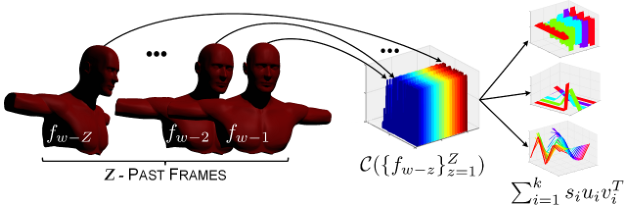
This core innovation involves constructing a Casorati Matrix from a set of past undamaged frames. By applying Singular Value Decomposition (SVD), the model finds a low-rank representation of this data, capturing the essential structure of the scene while filtering out noise and outliers.
 *[Dim the Lights!
- Low-Rank Prior Temporal Data for Specular-Free Video Recovery, page 4](/pdf/art_2df4f9853ae04460b1cb6b4c32249026#page=4)*
To handle motion, past frames are aligned to the current frame using a variational framework. This involves finding "diffeomorphic transformations" (smooth, reversible mappings) that preserve the topology of the objects—a critical feature when dealing with deformable tissues in medical imaging. Finally, the system fills the detected "holes" by iteratively minimizing patch distances between the current frame and the aligned, low-rank search space.
 *[Dim the Lights!
- Low-Rank Prior Temporal Data for Specular-Free Video Recovery, page 6](/pdf/art_2df4f9853ae04460b1cb6b4c32249026#page=6)*
Key Results and Discussion
The authors evaluated their approach across synthetic graphics, in-vivo medical imaging, and entertainment sequences. Key findings include:
- Efficiency: The detection stage is extremely lightweight, taking roughly 3.2ms per frame. Promoting low-rank data representation made the restoration process approximately 6 times faster than using full-rank data.
- Accuracy: The detection stage achieved an accuracy of over 0.99 across all datasets. Qualitatively, the method avoided "over-restoration" artifacts (mistakenly turning regions black/grey) and better preserved fine textures compared to the state-of-the-art NW14 algorithm.
- Robustness: The use of low-rank approximation acts as a powerful prior, making the restoration more robust to noise than raw video data. Furthermore, the topology-preserving regularizer ensures that physical structures remain meaningful during the restoration of deformable objects.
Conclusion
This framework provides a robust and efficient solution for specular-free video recovery. While the restoration process is significantly faster than previous methods, it is not yet real-time for surgical overlays. Future work will explore the impact of temporal window sizes and the handling of complex, long-duration occlusions.
Summary updated