


TL;DR
DeepLévy is a novel neural framework designed to forecast "black swan" events in highly volatile time series by modeling uncertainty with mixtures of Lévy stable distributions. By training in the spectral domain via characteristic function matching, it bypasses the lack of closed-form density functions, providing significantly more accurate tail-risk estimates than standard Gaussian-based models.
What Problem Does This Paper Address?
Most modern probabilistic forecasting models (like DeepAR or ProbTransformer) rely on a fundamental assumption: that the noise in the data follows a Gaussian or "light-tailed" distribution. While this works for routine data, it fails catastrophically during extreme events—market crashes, pandemic surges, or sudden weather spikes. In these "heavy-tailed" regimes, extreme deviations occur far more frequently than a bell curve predicts, and the variance can theoretically be infinite.
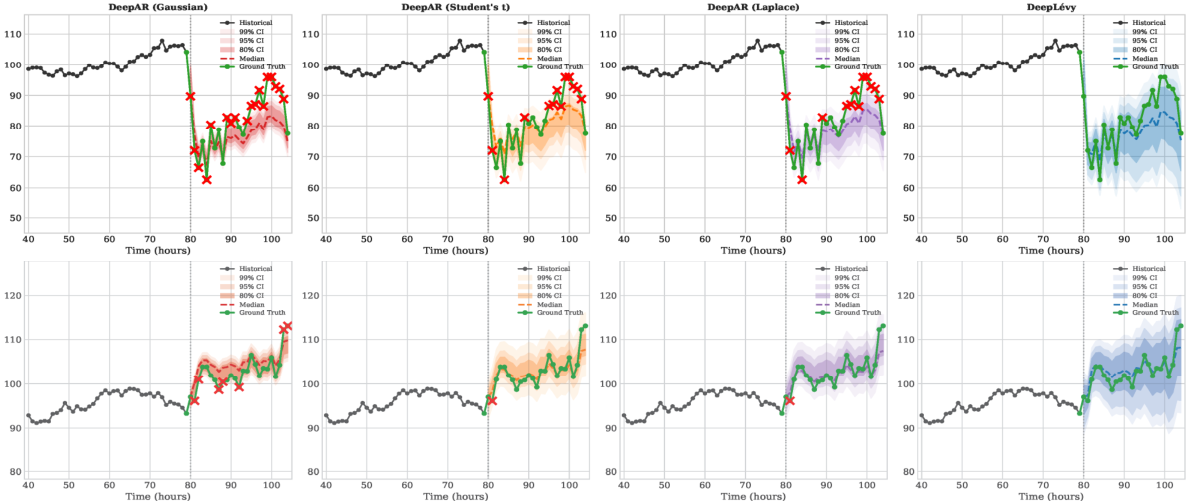
Lévy stable distributions are the mathematically natural way to model such behavior, as they can account for extreme asymmetry and power-law tails. However, they are notoriously difficult to use in deep learning because most lack a closed-form probability density function (PDF). This means you cannot use standard Maximum Likelihood Estimation (MLE) to train a network. As shown in Figure 1, Gaussian models systematically underestimate these sudden shocks, leading to narrow confidence intervals that fail to cover the actual data during crises.
Methods
DeepLévy introduces a modular architecture that combines deep sequence modeling with the full parameter space of Lévy stable distributions ($\alpha, \beta, \gamma, \delta$).
- Architecture: It uses a standard encoder-decoder setup (like an LSTM or Transformer) to generate horizon-specific hidden states.
- Constrained Projection: A specialized layer transforms these hidden states into valid parameters for a mixture of $K$ Lévy components. This includes strict constraints to ensure mathematical validity (e.g., keeping the stability index $\alpha$ within $(0, 2]$).
- Spectral Matching: To overcome the missing PDF, the authors train the model in the spectral domain. They minimize the discrepancy between the Characteristic Function (CF)—essentially the Fourier transform of the distribution—of the predicted mixture and the Empirical CF of the actual target data.
- Numerical Stability: The framework incorporates a scale-adaptive frequency weighting scheme to handle the rapid decay of signal-to-noise ratios at high frequencies and uses the continuous $S_0$-parameterization to prevent gradient explosions near $\alpha=1$.
- Inference: During forecasting, the model uses the Chambers-Mallows-Stuck (CMS) algorithm to generate predictive samples from the learned heavy-tailed distributions.
Datasets
The authors evaluated DeepLévy on three distinct types of data characterized by high volatility:
- Bitcoin Returns: Hourly log-returns from Yahoo Finance, known for extreme price swings.
- COVID-19 Cases: Daily case data from the JHU CSSE repository, representing epidemiological surges.
- Synthetic Lévy: Sequences generated specifically to test the model's ability to recover known heavy-tailed parameters.
Evaluation focused on "volatile segments" pre-selected for high kurtosis to specifically measure performance during non-routine periods.
Key Insights and Ideas
- Ditch the PDF, Use the CF: The most elegant move in this paper is shifting the loss function to the spectral domain. If you can't calculate the density, match the transform. This allows the model to learn tail behavior end-to-end via standard backpropagation.
- The Mixture Advantage: By using a mixture of Lévy components rather than a single distribution, the model can adaptively weight different degrees of tail heaviness and skewness, allowing it to capture complex, multi-modal uncertainty.
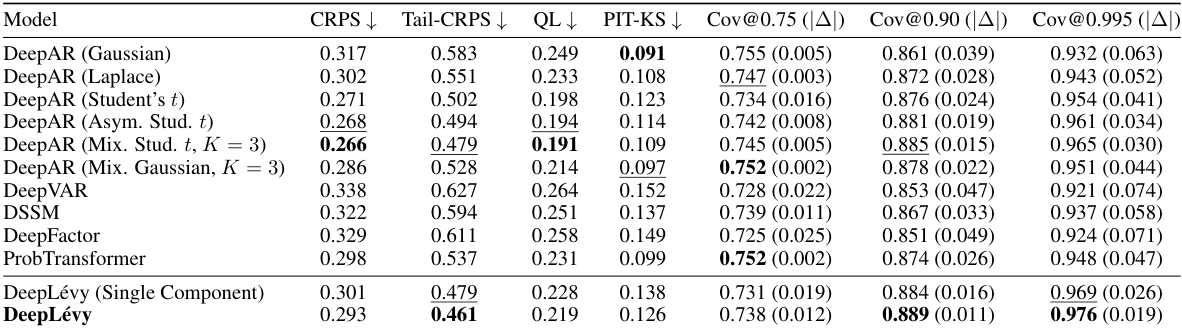
- Center-Tail Trade-off: The results suggest a trade-off: while Student’s $t$ or Gaussian mixtures might be slightly better at predicting the "average" case (global CRPS), DeepLévy is vastly superior at predicting the "worst" case (tail risk).
- Stability is Engineering: Much of the paper's success comes from rigorous numerical engineering—clipping, specific parameterizations, and adaptive weighting—that makes training with these "unruly" distributions possible in a deep learning context.
Key Results
DeepLévy consistently outperformed state-of-the-art baselines in capturing extreme risks.
- Tail Reliability: On the Bitcoin dataset, DeepLévy achieved a [email protected] of 0.976 (meaning only 2.4% of points fell outside the 99.5% confidence interval), whereas the Gaussian DeepAR baseline managed only 0.932, significantly underestimating the risk.
- Tail-CRPS: DeepLévy achieved the lowest (best) Tail-CRPS score of 0.461, compared to 0.583 for Gaussian and 0.479 for the best non-stable baseline (Mixture Student’s $t$).
- Visual Spike Coverage: As seen in Figure 3, DeepLévy's confidence intervals (blue) effectively expand to capture extreme spikes that other models (red crosses) completely miss.
Limitations and Future Work
- Batch Size Requirements: The Empirical CF estimator is noisy; the authors note that stable training requires relatively large batch sizes ($B \ge 128$).
- Univariate Focus: The current work focuses on univariate time series. Extending this to multivariate stable distributions (where tails can be correlated) is a significant mathematical challenge.
- Parametric Assumption: The model still assumes the underlying noise follows a mixture of a specific parametric family (Lévy).
- Future Directions: The authors suggest exploring temporal dependence within the tail parameters themselves and applying the framework to higher-dimensional risk assessment problems.
Summary updated