


TL;DR
This paper introduces a data-driven predictive control framework for multi-agent motion planning that learns system behavior directly from closed-loop input/output data. By avoiding explicit system identification and open-loop data collection, it eliminates dangerous signal spikes during training and cuts control costs by over 50% compared to conventional model-based MPC.
What Problem Does This Paper Address?
Traditional Model Predictive Control (MPC) is a powerful tool for guiding autonomous multi-agent systems, like drone swarms, while respecting safety and hardware constraints. However, MPC relies heavily on having an accurate mathematical model of the system. When system identification is costly, difficult, or inaccurate, MPC's performance plummets.
Recent "data-driven" alternatives (such as Data-Enabled Predictive Control, or DeePC) bypass explicit modeling by using raw input/output data directly. The catch? They typically require open-loop data collection. If a system is inherently unstable without a controller (like many aircraft or quadrotors), injecting random exploratory signals into an open loop can cause dangerously large output spikes. This not only threatens physical hardware but also ruins the numerical stability of the optimization algorithms.
Methods
The authors propose a non-parametric closed-loop behavior learning routine to safely plan trajectories for multiple agents.
Instead of open-loop exploration, data is collected while the system is actively stabilized by a basic, pre-designed controller (such as a simple Linear Quadratic Regulator). A random, exploratory "persistently exciting" signal is injected on top of this control loop.
Using principles from behavioral system theory (specifically Willems' Fundamental Lemma), the collected closed-loop input/output data is organized into a generalized Hankel matrix. This matrix implicitly captures the full dynamic behavior of the system without needing a single physics equation or parameter estimate. This non-parametric model is then embedded directly into a centralized optimization problem solved iteratively via CasADi to handle path tracking and collision avoidance constraints.
Datasets
Not discussed in the paper. No standard external datasets were used. Instead, the authors validated their approach using a simulated multi-agent environment featuring 8 quadrotor UAVs sharing identical, perturbed (imperfectly modeled) dynamics.
Key Insights and Ideas
- Closed-Loop Safety: Learning from closed-loop data ensures the system remains stable and bounded during the data-gathering phase, making it viable for inherently unstable systems.
- Numerical Sanity: Open-loop data collection on unstable systems blows up the condition number of the data matrices, crippling optimization solvers. Closed-loop data collection keeps matrix norms small and numerically well-behaved.
- Optimizing on Reality, Not Approximations: Conventional MPC optimizes trajectories based on an idealized nominal model. Because this paper's framework optimizes directly using real trajectory data, it inherently adapts to system perturbations and uncertainties that a nominal model would miss.
Key Results
- Matrix Norm Reduction: In the 8-UAV simulation, the proposed closed-loop method (Method 1) yielded data matrix norms ($\|W_i\|_2$) that were orders of magnitude smaller than the open-loop alternative (Method 2)—for instance, ~110 versus ~61,539 for the first agent.
- Massive Cost Reduction: When compared to conventional MPC running on an inaccurate nominal model, the proposed data-driven approach reduced the total control cost by 50.67% (a cost score of 48.9363 vs 99.1982).
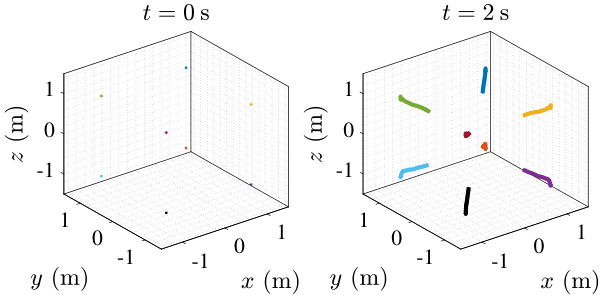
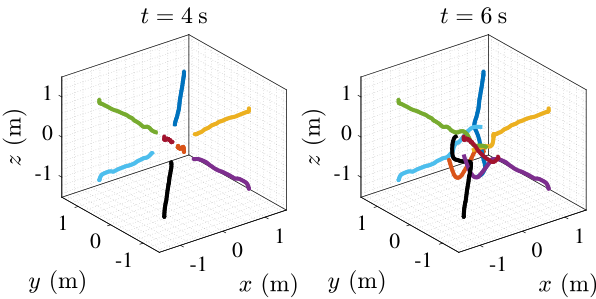
- Flawless Execution: The framework successfully guided all 8 UAVs to their diagonal destinations in a constrained 3D space without a single collision, despite the model perturbations.
Limitations and Future Work
The theoretical proofs establishing the closed-loop input/output relationship assume a noise-free measurement environment. While the simulation demonstrated excellent practical robustness against model perturbations, formally incorporating and bounding measurement noise within the closed-loop behavioral framework remains an open area for future research.
Summary updated