


TL;DR
This paper introduces ReciLoReL and ReciLex, the first benchmark and culinary lexicon designed for culturally adaptive recipe translation into three low-resource Nigerian languages: Hausa, Yorùbá, and Igbo. By augmenting Large Language Models (LLMs) with a targeted culinary lexicon, the researchers demonstrate that models can generate recipes that are not just linguistically accurate, but also culturally authentic and practically feasible for local contexts.
What Problem Does This Paper Address?
Machine translation has made massive strides, but it often fails at cultural adaptation. This is particularly evident in recipes. A literal translation of "sour cream" into Hausa might be linguistically correct but practically useless if the ingredient is unavailable or the concept is foreign.
For low-resource languages (LRLs), this problem is compounded by a lack of large-scale parallel corpora. Most existing work on recipe adaptation focuses on high-resource pairs like Chinese-English. This paper tackles the challenge of how to enable LLMs to perform "culturally grounded" translation—substituting ingredients, tools, and procedures to fit the target culture—without requiring massive amounts of training data.
Methods
The researchers propose a lexicon-augmented prompting strategy. Instead of fine-tuning models on massive datasets, they use a "RAG-lite" approach:
- Entity Identification: They identify key culinary entities (ingredients, tools, actions) in a source English recipe.
- Lexicon Retrieval: They retrieve the corresponding expert-translated and culturally adapted terms from their new ReciLex lexicon.
- Augmented Prompting: These terms are provided to the LLM (e.g., GPT-5.1, Llama-3.3-70B) as contextual guidance within the prompt, instructing the model to use these localized terms where appropriate.
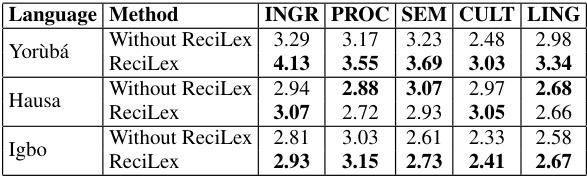
To evaluate success, they moved beyond standard metrics like BLEU and defined five human evaluation criteria for cultural adaptation:
- Ingredient Localisation (INGR): Are ingredients familiar and available?
- Procedural Localisation (PROC): Are cooking methods and tools appropriate?
- Semantic Preservation (SEM): Does it keep the original culinary intent?
- Cultural Authenticity (CULT): Is the resulting recipe plausible in the target culture?
- Linguistic Naturalness (LING): Does it read naturally to a native speaker?
The scope of these adaptations is summarized in the table below:
Datasets
The authors introduced two major resources:
- ReciLoReL: A gold-standard benchmark of 600 recipes (200 each for Hausa, Yorùbá, and Igbo) that were manually translated and culturally adapted by language experts.
- ReciLex: A multilingual culinary lexicon containing ~15,000 translated entities across 10 categories (e.g., chef actions, durations, food states).
These were derived from the RecipeNLG corpus and the ReciFine entity annotations.
Key Insights and Ideas
- Lexicons as a "Low-Resource" Hack: High-quality, domain-specific lexicons can be a powerful, lightweight alternative to large parallel corpora for LRLs. Providing just a few key terms in the prompt significantly improved the model's ability to localize recipes.
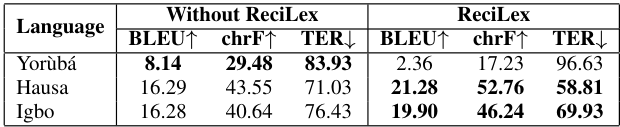
- The "Yorùbá Diacritic Trap": A fascinating finding was that automatic metrics (like BLEU) actually dropped for Yorùbá when using ReciLex. However, human evaluators rated these same translations much higher. The reason? ReciLex used proper, expert-verified diacritics, while the baseline LLMs and reference translations were often inconsistent or lacked them. This highlights how standard NLP metrics can fail to capture quality in LRLs with complex orthography.
- Terminology Realization: As shown in Table 8, incorporating ReciLex increased "terminology agreement"—the frequency with which the model actually used the recommended local terms—by up to 78 percentage points in some settings.
Key Results
- Automatic Metrics: For Hausa and Igbo, ReciLex improved average BLEU from 13.57 to 14.51 and reduced TER (Translation Edit Rate) from 77.14 to 75.12.
- Human Evaluation: Across all three languages, human scores improved significantly. For Yorùbá, Ingredient Localisation scores jumped from 3.29 to 4.13 on a 5-point scale.
- Model Performance: LLMs generally outperformed dedicated machine translation models (like NLLB-200) in cultural adaptation tasks, especially when given few-shot examples.
Limitations and Future Work
The authors acknowledge that ReciLoReL is relatively small (600 recipes), which limits the diversity of culinary practices represented. Furthermore, while the lexicon helps with terminology, models still occasionally struggle with "procedural fidelity"—sometimes changing cooking durations or methods in ways that make the recipe unreliable (e.g., changing 10 minutes to 10 seconds).
Future work aims to expand these resources to more African languages and investigate more robust evaluation methods that can handle linguistic variation better than surface-level metrics like BLEU.
Summary updated