


TL;DR
Chronax is a new JAX-native library that reimagines univariate statistical forecasting and conformal inference from a purely functional perspective. By replacing traditional object-oriented, CPU-bound Python architectures with JAX transformations like jit and vmap, Chronax achieves massive hardware-accelerated parallelization and end-to-end differentiability, delivering dramatic speedups for large-scale time-series pipelines.
What Problem Does This Paper Address?
Modern time-series forecasting increasingly demands processing thousands of heterogeneous series simultaneously, incorporating irregular covariates, and performing frequent model retraining. However, the existing software ecosystem (e.g., libraries like StatsForecast) remains anchored to the traditional Python numerical stack (NumPy, Numba) and object-oriented programming (OOP) paradigms.
This legacy design introduces three major bottlenecks:
- Limited Parallelism: OOP abstractions make it difficult to efficiently parallelize execution across thousands of independent time series without complex, hand-engineered batching logic.
- CPU-Centric Execution: Relying on Python interpreter-driven control flow restricts the use of compiler-guided optimizations and accelerator hardware (GPUs/TPUs).
- Poor Composability: Stateful interfaces hinder seamless integration into modern, differentiable machine learning and scientific computing workflows.
Methods
The authors introduce Chronax, built from first principles around functional purity and JAX program transformations. Key methodological highlights include:
- JAX-Native Abstractions: Preprocessing, model evaluation, and multi-horizon predictions are written as pure functions. This allows the library to leverage
jax.jitfor compilation,lax.scanfor loop fusion, andjax.gradfor automatic differentiation. - Unified Vectorization via
vmap: Instead of relying on multiprocessing or Python loops to handle multiple time series, Chronax uses JAX’s automatic vectorization (vmap). This allows a single-series forecasting routine to scale across thousands of series effortlessly. - Integrated Conformal Inference: Chronax incorporates model-agnostic conformal prediction directly into its functional pipeline. It provides both the conformal distribution method (for symmetric intervals) and the conformal signed method (for asymmetric intervals). By vectorizing the walk-forward cross-validation process with
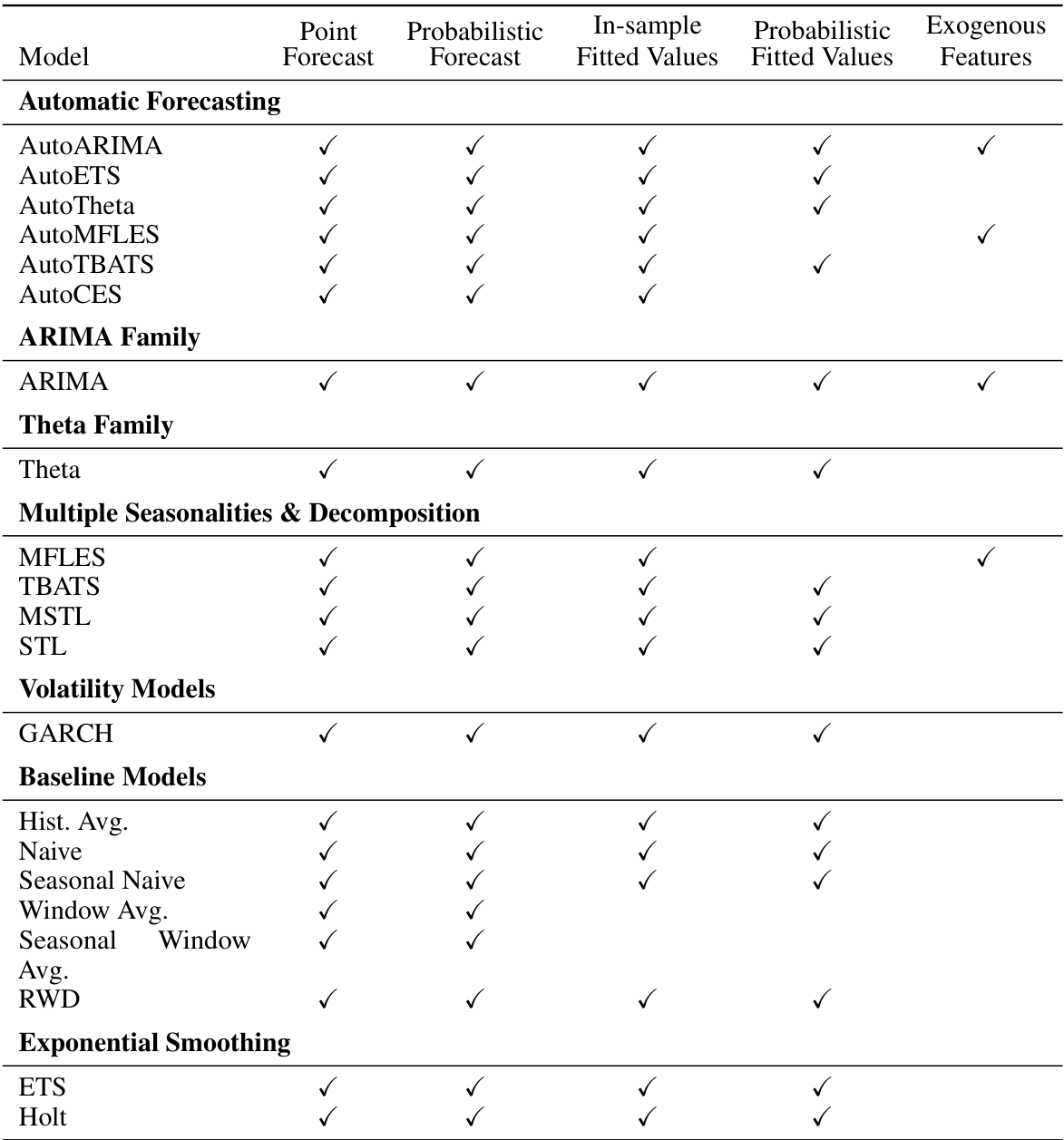
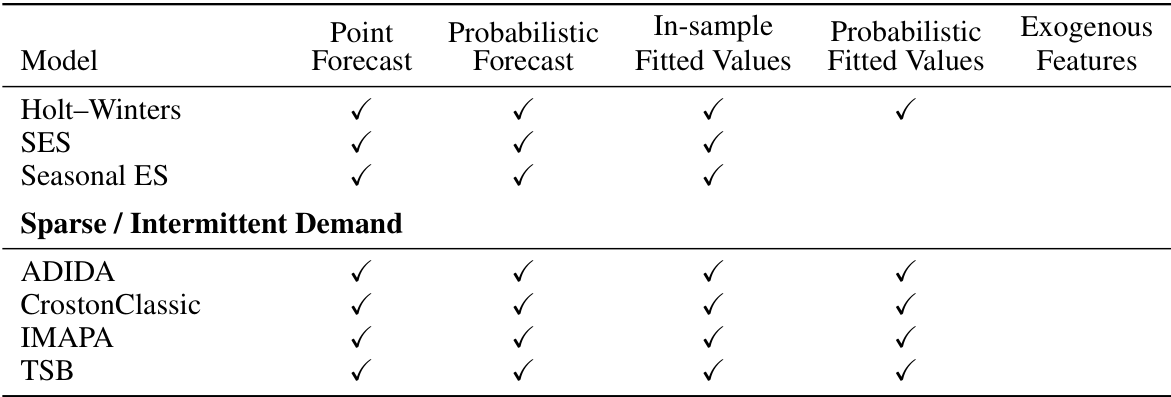
vmap, Chronax avoids the severe latency penalties usually associated with sequential model fitting. - Extensive Model Zoo: Chronax implements 28 public forecasting model classes spanning 8 distinct families, maintaining a scikit-learn-style
fit/predictinterface while remaining entirely stateless under the hood.
Datasets
The library was evaluated against StatsForecast using three real-world datasets representing different scales:
- Airline Passengers Dataset: A small dataset containing 144 monthly observations of US airline passenger totals.
- Daily Female Births Dataset: A mid-sized dataset consisting of 365 daily observations of female births in California.
- Room Temperatures Dataset: A larger dataset featuring 7,056 hourly observations of room air temperatures recorded via an IoT device.
Key Insights and Ideas
- The Functional Programming Payoff: Shifting from stateful objects to pure functions means that complex uncertainty quantification (like conformal validation) can be parallelized across windows and series simultaneously. What used to require nested loops is reduced to a clean, hardware-accelerated tensor operation.
- The Compilation Trade-Off: Chronax trades upfront time for downstream speed. JAX's Just-In-Time (JIT) compilation introduces a heavy "cold start" penalty on the first run. However, for large datasets or repeated operational forecasting ("warm starts"), this investment pays off exponentially.
- Accuracy Scales with Data Size: Interestingly, Chronax doesn't just match classical implementations; its relative predictive accuracy actually improves as the dataset size increases, outperforming the baseline on the largest evaluated dataset.
Key Results
The authors conducted head-to-head performance comparisons measuring both computational efficiency and predictive accuracy (using metrics like MAPE, MAE, RMSE, and MASE):
- Warm Start Speedups: Once compiled, Chronax obliterates the baseline. On the largest dataset (Room Temperatures), Chronax required only 16% of the execution time of StatsForecast on average, with a median warm start execution ratio of just 0.074×.
- Cold Start Penalty: As expected, Chronax's cold start initialization was significantly slower due to compilation overhead—ranging from 5.82× slower on the large dataset to 44.54× slower on the smallest dataset.
- Predictive Accuracy: Chronax maintained strict parity with StatsForecast on smaller datasets (median ratios of 1.00×) but demonstrated an accuracy edge on the largest dataset, reducing error metrics (MAPE, MAE, RMSE, MASE) to roughly 0.94× to 0.95× of the baseline's error.
Limitations and Future Work
Currently, Chronax is strictly focused on univariate, classical statistical models (like ARIMA, ETS, and Exponential Smoothing).
To build on this foundation, the authors propose several future directions:
- Extending the library to support multivariate forecasting and deep learning-based models within the same functional JAX interface.
- Developing the conformal inference layer further to support hierarchical forecasting and improve robustness against distribution shifts.
- Enabling deeper coupling with the broader JAX ecosystem for tasks like differentiable hyperparameter tuning and joint optimization with scientific simulators.
Summary updated