


TL;DR
Imagine teaching an autonomous car to parallel park, only for it to instantly forget how to pull into a regular perpendicular spot. This paper tests which foundational classes of Reinforcement Learning (RL) naturally resist this "catastrophic forgetting" in shifting environments. It turns out that algorithms with a memory bank of past experiences hold onto old skills longer, while sophisticated "world-modeling" agents forget just as quickly as simple ones—and hidden assumptions in how we reward agents can break learning entirely.
What Problem Does This Paper Address?
Reinforcement Learning (RL) is great at mastering static worlds like chess or fixed factory floors. Out in the real world, however, cyber-physical systems like drones and autonomous vehicles face non-stationary environments—conditions that shift over time.
When RL agents adapt to new tasks sequentially—a paradigm called Continual Reinforcement Learning (CRL)—they suffer from catastrophic forgetting: new knowledge overwrites old neural pathways. Researchers usually try to fix this by bolting anti-forgetting mechanisms onto standard RL algorithms. Yet few have stopped to ask a more fundamental question: Are certain underlying classes of RL algorithms naturally better suited for continual learning to begin with?
Methods
Instead of inventing a new algorithm, the authors conduct a head-to-head stress test of three state-of-the-art algorithms representing the major families of RL:
- PPO (Model-free, On-policy): Learns directly by trial-and-error using only fresh data from its current strategy, immediately discarding old experiences.
- SAC (Model-free, Off-policy): Also learns by trial-and-error, but stores past experiences in a replay buffer (a memory queue of 1 million steps) to reuse during training.
- Drama (Model-based): Builds an internal "world model" (powered by a compact Mamba architecture) to simulate the physics of the environment, then trains a PPO agent inside its "imagination."
To simulate a realistic continual learning scenario where future tasks are unknown, hyperparameters and reward functions were tuned only on the first task and frozen for the rest. The authors tested sequential training (forward and reverse order), interleaved multi-task training, and adding Elastic Weight Consolidation (EWC)—a classic regularization method that penalizes changes to important neural weights—to PPO.
Datasets
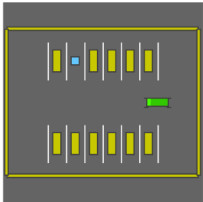
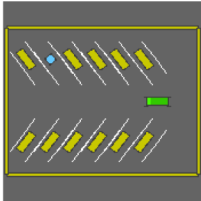
Rather than static datasets, RL relies on interactive simulation environments. Built on the highway-env Python package, the authors created a custom, piecewise non-stationary autonomous parking benchmark consisting of four sequential tasks (trained for 500k steps each) that vary only by parking space angle:
- Perpendicular parking
- $25^\circ$ diagonal parking
- $50^\circ$ diagonal parking
- Parallel parking
Key Insights and Ideas
- World models don't save you from forgetting: Intuitively, learning universal vehicle physics (model-based RL) should help an agent adapt across parking angles. In practice, Drama forgot just as fast as PPO. Even if the world model generalizes, the policy acting inside that imagination is still task-specific and overwrites itself.
- Replay buffers buy time, not permanence: Off-policy SAC resisted forgetting simply because old parking experiences lingered in its FIFO memory buffer, allowing joint optimization. Once new tasks pushed old memories out of the queue, amnesia set in.
- Task order creates toxic biases: Starting with the hardest task (parallel parking) didn't build character—it induced bad parameter biases that degraded the agents' ability to learn easier diagonal and perpendicular parking later on.
- The "hidden trap" of reward abstractions: All agents initially failed at parallel parking. Why? The reward function (designed for perpendicular spots) penalized heading-angle differences, accidentally forcing parallel-parking cars to execute an awkward $180^\circ$ U-turn if facing the "wrong" way in a symmetrical parallel spot! In continual learning, human-designed rewards and hyperparameters can fail silently when the world shifts.
Key Results
- Sequential Forgetting: When switching from perpendicular to $25^\circ$ diagonal parking at step 500k, PPO and Drama saw perpendicular success rates plummet immediately. SAC maintained near-peak performance until ~1.25M steps—shortly after its 1M-step replay buffer flushed out the perpendicular parking data.
- Interleaved Capacity: When tasks were sampled randomly every episode (interleaved training for 2M total steps), all three algorithms converged to single-task baseline success rates, proving the neural networks had plenty of capacity to hold all four skills at once.
- EWC Regularization: Adding online EWC to PPO softened the blow, improving Backward Transfer (BWT) from -0.904 (vanilla PPO) to -0.764 at best ($\lambda=1, \gamma_{EWC}=0.5$). However, BWT remained stubbornly negative across all tested settings, and cranking up regularization ($\lambda=10$) cut Forward Transfer nearly in half (from 0.058 to 0.031), illustrating the classic stability-plasticity trade-off.
- Fixing Parallel Parking: Training PPO longer (1M steps) plateaued at ~60% success on parallel parking. Only after making the reward angle-symmetric ($180^\circ$ invariant) and retuning hyperparameters (learning rates, buffer/minibatch sizes) did PPO reach ~100% success.
Limitations and Future Work
Off-policy replay is the clear winner among base RL classes, but relying on giant memory buffers hits a hard wall on resource-constrained robots and drones—especially as the number of lifetime tasks grows. Even compressing memories into generative models (like GANs) eventually hits capacity limits.
For future work, the authors argue the CRL community must look beyond simple weight-freezing or replay tricks. Real-world deployment will require:
- Runtime autotuning (or hyperparameter-free algorithms) so agents aren't brittle to initial settings.
- Generalizable abstractions and intrinsic rewards so agents can adapt when state spaces, action spaces, or task geometries shift unexpectedly.
- Resource-aware continual learning that balances memory footprint against long-term skill retention.
Summary updated