


TL;DR
This paper introduces a novel tripartite framework designed to generate validating responses in conversational AI, moving beyond generic empathetic platitudes. By combining validation timing detection, emotion classification, and cause extraction using a task-adapted BERT model (JDialogueBERT), the system outperforms ChatGPT in both precision and human preference across text and speech datasets.
What Problem Does This Paper Address?
While current conversational agents can simulate basic empathy, they often rely on generic, repetitive phrases like "I'm so sorry to hear that." For users who suppress their emotions due to stress or adverse life experiences, these canned responses can feel hollow or dismissive.
In psychology and counseling, validation—the explicit recognition, understanding, and acceptance of another person's emotional state—is crucial. This paper tackles the challenge of teaching AI when it is appropriate to validate a user's feelings and how to generate a tailored response that proves the AI truly understands the context of the user's distress.
Methods
The authors propose a modular pipeline consisting of three main components:
- Validation Timing Detection: Determines if the user's utterance warrants a validating response.
- Users' Emotional State Identification: Subdivided into Emotion Classification (mapping the user's state to 8 primary emotions from Plutchik's wheel) and Emotion Cause Extraction (identifying the specific phrase or reason behind the emotion).
- Validating Response Generation: A rule-based template system that synthesizes the identified emotion and cause into a tailored response (e.g., "I understand how you feel. [Reason] sounds [Emotional Word].").
To power this pipeline, the authors modified a pre-trained bert-large-japanese model using Task Adaptive Pre-Training (TAPT) on a daily dialogue dataset. This conversational adaptation, dubbed JDialogueBERT, bridges the gap between standard Wikipedia-trained models and the nuances of human chat.
Datasets
The framework was trained and evaluated on two distinct Japanese datasets:
- Japanese EmpatheticDialogues: A text-based dataset containing 20,000 dialogues (80,000 utterances) aligned with Plutchik's wheel of emotions.
- TUT Emotional Storytelling Corpus (TESC): A speech-based dialogue dataset consisting of 247 conversational sessions (~9.2 hours) between close friends, used to test the model's robustness in longer, spoken-word contexts.
Key Insights and Ideas
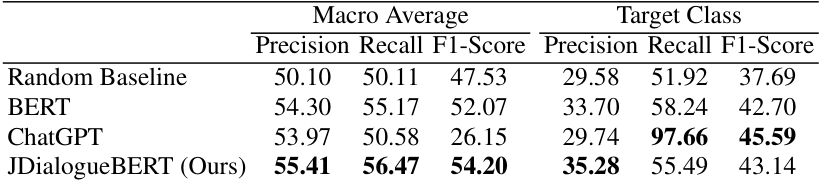
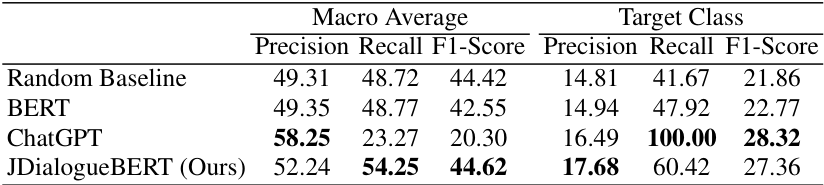
- Precision Over Recall for Empathy: While LLMs like ChatGPT achieved high recall in validation timing (meaning they validated frequently), they suffered from low precision. In a real-world setting, an AI that constantly says "I understand" to trivial statements feels robotic and insincere.
JDialogueBERTprioritizes precision, validating only when genuinely appropriate. - Gradient-Based Cause Extraction: Instead of training a heavy, data-hungry end-to-end model to extract the cause of an emotion, the authors calculated token importance scores by backpropagating gradients from the emotion classification neuron. This pinpoints the exact words causing the user's distress without requiring extra training data.
- The Domain Gap in LLM Classification: ChatGPT struggled significantly with emotional ambiguity, failing to correctly classify approximately 33% of the text-based empathetic samples because it frequently defaulted to a "neutral" category when the emotional cues were subtle.
Key Results
- Timing Detection: On the text dataset,
JDialogueBERTachieved a macro-average F1-score of 54.20%, outperforming standard BERT (52.07%) and ChatGPT (26.15%). On the speech dataset (TESC), it maintained its lead with a macro F1-score of 44.62% compared to ChatGPT's 20.30%. - Emotion Classification:
JDialogueBERThit a macro F1-score of 76.88% on text and 57.99% on speech, consistently outperforming ChatGPT's scores of 62.40% and 52.59% respectively. - Human Evaluation: In rigorous A/B testing, human annotators significantly preferred
JDialogueBERT's responses over ChatGPT's, yielding a win rate of 40.0% (vs 37.8% loss) on text, and 48.9% (vs 38.9% loss) on speech data.
Limitations and Future Work
The model's performance on emotion cause extraction dropped significantly when applied to the speech-based TESC dataset (33.33% accuracy, falling behind ChatGPT's 54.91%). The authors note that the dialogue-centric pre-training might have caused the model to over-focus on text-based dialogue structures, obscuring broader contextual cues necessary for spoken language.
As a next step, the authors plan to transition this framework from offline datasets to real-time, complex conversational settings using the physical android robot ERICA.
Summary updated