


In 1964, at the dawn of artificial intelligence, Thomas G. Evans presented a landmark paper at the Spring Joint Computer Conference. He introduced ANALOGY, a program that didn't just process data—it "reasoned." By tackling geometric analogy problems typically found on human IQ tests, Evans demonstrated how symbolic representation and heuristic search could mimic high-level human cognition.
TL;DR
This paper introduces ANALOGY, one of the first AI programs capable of solving complex geometric analogy problems (e.g., "Figure A is to B as Figure C is to ?"). By combining symbolic figure decomposition with a rule-generalization engine, it showed that "reasoning by analogy" could be mechanized through abstract internal descriptions.
What Problem Does This Paper Address?
The author tackles the challenge of "reasoning by analogy" in a visual domain. While early computers were adept at arithmetic, they struggled with the "fuzzy" logic required to solve intelligence test problems.
A typical geometric analogy problem consists of a set of line drawings. To solve it, a system must:
- Analyze the individual parts of a drawing.
- Identify spatial relationships (e.g., "inside," "above").
- Discover a transformation rule that turns Figure A into Figure B.
- Generalize that rule so it can be applied to Figure C to find the correct answer among several choices.
The gap Evans addressed was the lack of a unified framework that could move from raw geometric input to high-level logical inference.
Methods
ANALOGY is divided into two distinct parts, reflecting a split between "vision" and "logic":
- Part I: Picture Processing: This stage takes raw line descriptions and decomposes them into "objects" or subfigures. It uses a list-processing approach (implemented in LISP) to represent figures as coordinates and curvatures. Crucially, it calculates properties and spatial relations, such as
(INSIDE P2 P3)or(ABOVE P1 P3). It also performs "similarity" calculations to see if one object is a rotated, scaled, or reflected version of another. - Part II: Rule Finding and Generalization: This is the "brain." It generates potential rules for the transformation $A \rightarrow B$ (e.g., "remove the inner dot, rotate the triangle 180 degrees"). It then attempts to find a "common generalization" between the $A \rightarrow B$ rule and a potential $C \rightarrow \text{Answer}$ rule. The program selects the answer figure that yields the "strongest" (most specific) generalized rule.
The program was notably one of the largest LISP programs of its time, so large that Part I and Part II had to occupy computer memory separately.
Datasets
The program was evaluated using problems taken from the 1942 edition of the Psychological Test for College Freshmen of the American Council on Education (ACE). These were real-world benchmarks used to measure human intelligence, rather than toy problems designed specifically for the computer.
Key Insights and Ideas
- Symbolic Abstraction is Key: Evans argued that for a machine to be "intelligent," it cannot look at pixels or raw lines. It must convert them into a "verbal" or symbolic description language. Reasoning happens on the description, not the image.
- Analogy as Rule Generalization: The core "aha moment" is that solving an analogy is essentially finding the most restrictive rule that covers two different instances of change.
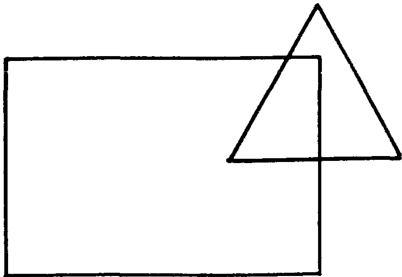
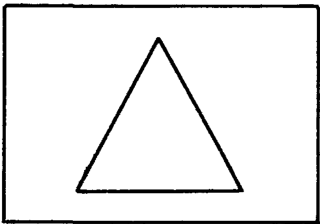
- Decomposition Heuristics: The paper introduces "environmental" decomposition—the idea that a complex figure (like Figure 3a) can be broken down based on how its parts appear in other figures (like Figure 3b).
Key Results
- Human-Level Performance: Evans estimated that ANALOGY could solve between 15 and 20 problems on a standard 30-question ACE test. For context, the median score for 9th graders was 17, and for 12th graders, it was 20.
- Robustness: The program could handle additions, removals, and complex spatial shifts of objects.
- Qualitative Success: In many cases, the "reasoning" produced by the program (the generated rules) corresponded closely to how a human would explain their own answer.
Limitations and Future Work
- Intrinsic Decomposition: The program struggled when a figure needed to be broken down based on internal symmetry or "Gestalt" principles rather than external cues.
- Fixed Vocabulary: The system relied on a predefined set of relations (above, left, inside). It could not "learn" new types of relationships on its own.
- Memory Constraints: The one-way communication between Part I and Part II prevented the "logic" side from asking the "vision" side for more detail if a rule was ambiguous.
- Future Direction: Evans suggested that the next step for AI was autonomous improvement—machines that could not only use a description language but also modify and expand that language as they gained experience.
Summary updated