

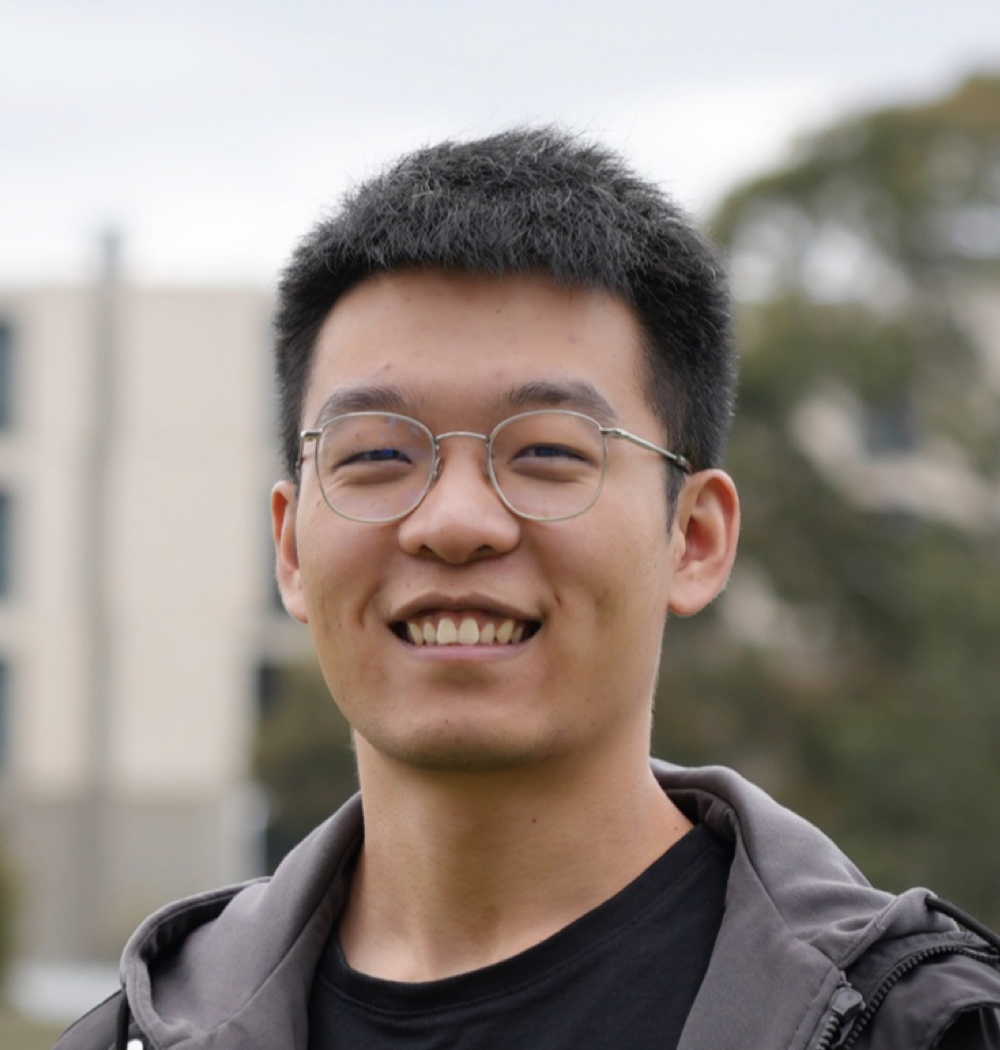
 Zizheng Pan
· 5 previous affiliations
- DeepSeek (China)Since 2024
- Researcher · Since 2024
- Monash University2021–2024
- PhD student · 2021–2024
- Research Internship · 2023
- Adelaide University2018–2020
- MS student · 2018–2020
- Harbin Institute of Technology2015–2019
- Undergrad student · 2015–2019
Research Overview
Zizheng Pan focuses on improving the efficiency of deep neural networks across training, inference, and deployment. His trajectory spans foundational optimizations for Vision Transformers and video recognition models to flexible, stitchable architectures that dynamically adapt to hardware constraints. Most recently, his work addresses memory and sampling bottlenecks in large language models and generative diffusion frameworks.
Research Trajectory
Zizheng Pan’s early research concentrated on mitigating the high computational and memory costs associated with Transformer architectures in computer vision. In 2021, he introduced Scalable Vision Transformers with Hierarchical Pooling, a method that progressively reduces sequence length in deeper network layers. By pooling visual tokens similarly to downsampling in convolutional networks, this work improved scalability and contributed to the research direction of Token Reduction for Efficient Vision Transformers. That same year, he developed Mesa: A Memory-saving Training Framework for Transformers, which halves the memory footprint of model training by storing low-precision activations for backpropagation. This approach allowed for larger batch sizes on standard hardware, advancing the broader area of Activation-Aware Memory Optimization for Large Model Training.
Building on these foundational efficiency improvements, his subsequent work explored novel attention mechanisms to balance local details with global context. He proposed Fast Vision Transformers with HiLo Attention, which splits attention heads to process high-frequency and low-frequency information separately, optimizing for direct hardware throughput rather than theoretical operations alone. He also presented EcoFormer: Energy-Saving Attention with Linear Complexity, which introduced a binarization paradigm to compress models and reduce the energy consumption of pairwise similarity modeling.
Expanding these spatial optimizations into the temporal domain, he designed An Efficient Spatio-Temporal Pyramid Transformer for Action Detection. By utilizing local window attention in early layers and global attention later in the network, this architecture reduced the quadratic cost of self-attention in untrimmed videos. This work bridged the areas of Spatiotemporal Window Attention for Efficient Video Transformers and Jointly Optimizing Spatial and Temporal Representations in Video. Concurrently, he collaborated on Dynamic Focus-aware Positional Queries for Semantic Segmentation, replacing static positional priors with dynamic ones generated from previous attention maps, a contribution to the field of Dynamic Query Generation for Transformer Decoders.
A major theme in his later research is the concept of "stitchable" architectures—frameworks that allow a single model to dynamically adjust its size and computational cost at runtime. He introduced Stitchable Neural Networks, which created a spectrum of scalable models by inserting simple convolution layers between pretrained anchor models of different sizes. He extended this paradigm with Efficient Stitchable Task Adaptation, enabling the fine-tuning of a diverse palette of models for various resource constraints in a single training pass. He further advanced this framework in Stitched ViTs are Flexible Vision Backbones, utilizing bidirectional stitching paths and low-rank adaptation to allow a single network to instantly switch between hundreds of performance-efficiency trade-offs for dense prediction tasks.
Following his doctoral studies, he joined DeepSeek as a researcher, while his academic output expanded into the optimization of large language models (LLMs) and generative diffusion frameworks. He contributed to MiniCache: KV Cache Compression in Depth Dimension for Large Language Models, a training-free method that exploits the similarity between adjacent layers to compress the Key-Value cache, significantly reducing memory usage during inference. In the generative space, his recent work includes Hierarchical Prompt-Enhanced Image Generation Using Hyperbolic Space and he co-developed PaRa: Personalizing Text-to-Image Diffusion via Parameter Rank Reduction, which explicitly reduces the rank of model parameters to align generative spaces with specific concepts using minimal learnable parameters. Most recently, he created T-Stitch: Accelerating Sampling in Pre-Trained Diffusion Models with Trajectory Stitching. This drop-in technique accelerates image generation by using a smaller model for initial sampling stages before switching to a larger model for final details, contributing to research in Draft-and-Verify Mechanisms for Accelerated Autoregressive Inference.
Current Directions
The most recent papers in the evidence address the computational bottlenecks of generative AI, specifically focusing on large language models and diffusion frameworks. Recent work investigates training-free techniques to accelerate sampling and compress memory footprints, such as exploiting depth-wise similarities in key-value caches to improve LLM throughput. Additionally, ongoing research explores parameter-efficient personalization for text-to-image synthesis, seeking to align generative spaces with specific visual concepts by strategically reducing parameter rank rather than relying on additive fine-tuning modules. Across these domains, the unifying focus remains on achieving dynamic, hardware-aware efficiency without sacrificing the representational quality of large-scale foundation models.
Profile updated
Loading new papers…
Other researchers whose papers cluster into the same research directions — a proxy for overlapping technical interests and shared intellectual neighborhoods.
See something wrong? Report a mistake