

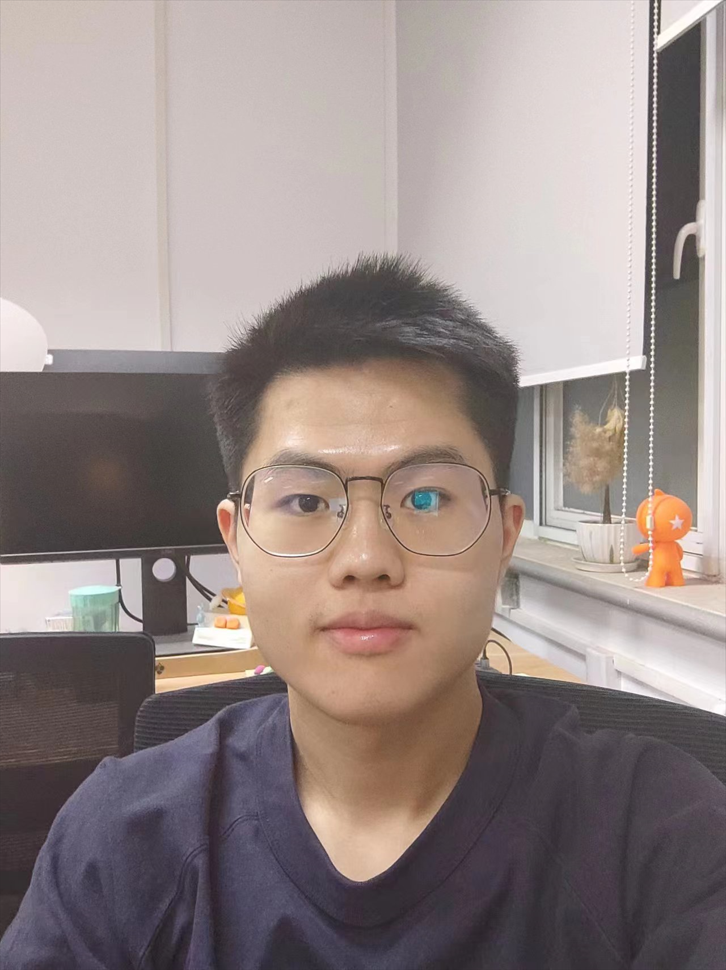
 Zirui Yuan
· 4 previous affiliations
- Current
- PhD student · 2024–2028
- Tianjin University2021–2024
- MS student · 2021–2024
- Dalian Maritime University2017–2021
- Undergrad student · 2017–2021
Research Overview
Zirui Yuan focuses on large language models, AI agents, and urban computing, with an emphasis on reasoning and decision-making in complex urban systems. His early work explored dynamic graph analysis and influence maximization before shifting toward the integration of foundation models into intelligent transportation. Currently, he investigates how cooperative LLM agents can manage spatiotemporal reasoning and network-wide traffic control.
Research Trajectory
His initial research investigated structural patterns and information propagation in complex networks. In 2023, he introduced a framework for Motif-Level Anomaly Detection in Dynamic Graphs, which identifies anomalous subgraph structures in evolving networks by leveraging temporal information to learn discriminative motif-level representations. Building on this network analysis foundation, he subsequently addressed the challenge of interactive information dissemination. With Graph Bayesian Optimization for Multiplex Influence Maximization, he modeled how multiple related information items—such as associated products or recommended content—propagate simultaneously through social networks, moving beyond traditional single-item influence maximization.
Following these contributions to graph theory and network dynamics, his focus transitioned toward the application of foundation models in urban computing and intelligent transportation. He participated in formalizing this emerging intersection in Large Language Model Powered Intelligent Urban Agents: Concepts, Capabilities, and Applications. This survey conceptualizes systems that leverage the linguistic and reasoning capabilities of LLMs to manage the cyber-physical-social complexity of modern cities, touching upon the broader research direction of Responsibility Attribution in Distributed and Autonomous AI Systems.
To rigorously evaluate these systems, he collaborated on USTBench: Benchmarking and Dissecting Spatiotemporal Reasoning Capabilities of LLMs as Urban Agents. This benchmark dissects how models process urban environments across stages of understanding, forecasting, planning, and reflection. The evaluation revealed that while current LLMs excel at interpreting urban data, they face significant challenges with long-term planning and incorporating environmental feedback.
Addressing these operational limitations, he developed CoLLMLight: Cooperative Large Language Model Agents for Network-Wide Traffic Signal Control. This framework introduces an asynchronous architecture that decouples deep cooperative reasoning from real-time decision-making, achieving high traffic efficiency and generalization across diverse urban environments without sacrificing responsiveness. This work advances several key research areas, including the direction of Dual Process Architectures for Real Time Reasoning Agents, the study of Coordinating Independent Agents to Prevent Urban Resource Herding, and the broader field of Adaptive Reasoning via Efficiency Aware Reinforcement Learning.
Current Directions
The most recent papers in the evidence indicate a strong focus on deploying large language models as autonomous agents within complex urban and transportation systems. Current work investigates how to bridge the gap between the high-level reasoning capabilities of LLMs and the strict latency requirements of real-time urban infrastructure. This involves designing dual-process architectures that separate slow, deliberative planning from fast, reactive execution. Additionally, ongoing research explores cooperative multi-agent frameworks, aiming to coordinate independent LLM agents to optimize city-wide resources—such as traffic signal networks—while mitigating issues related to spatiotemporal reasoning and long-term planning in dynamic environments.
Profile updated
Loading new papers…
Other researchers whose papers cluster into the same research directions — a proxy for overlapping technical interests and shared intellectual neighborhoods.
See something wrong? Report a mistake