

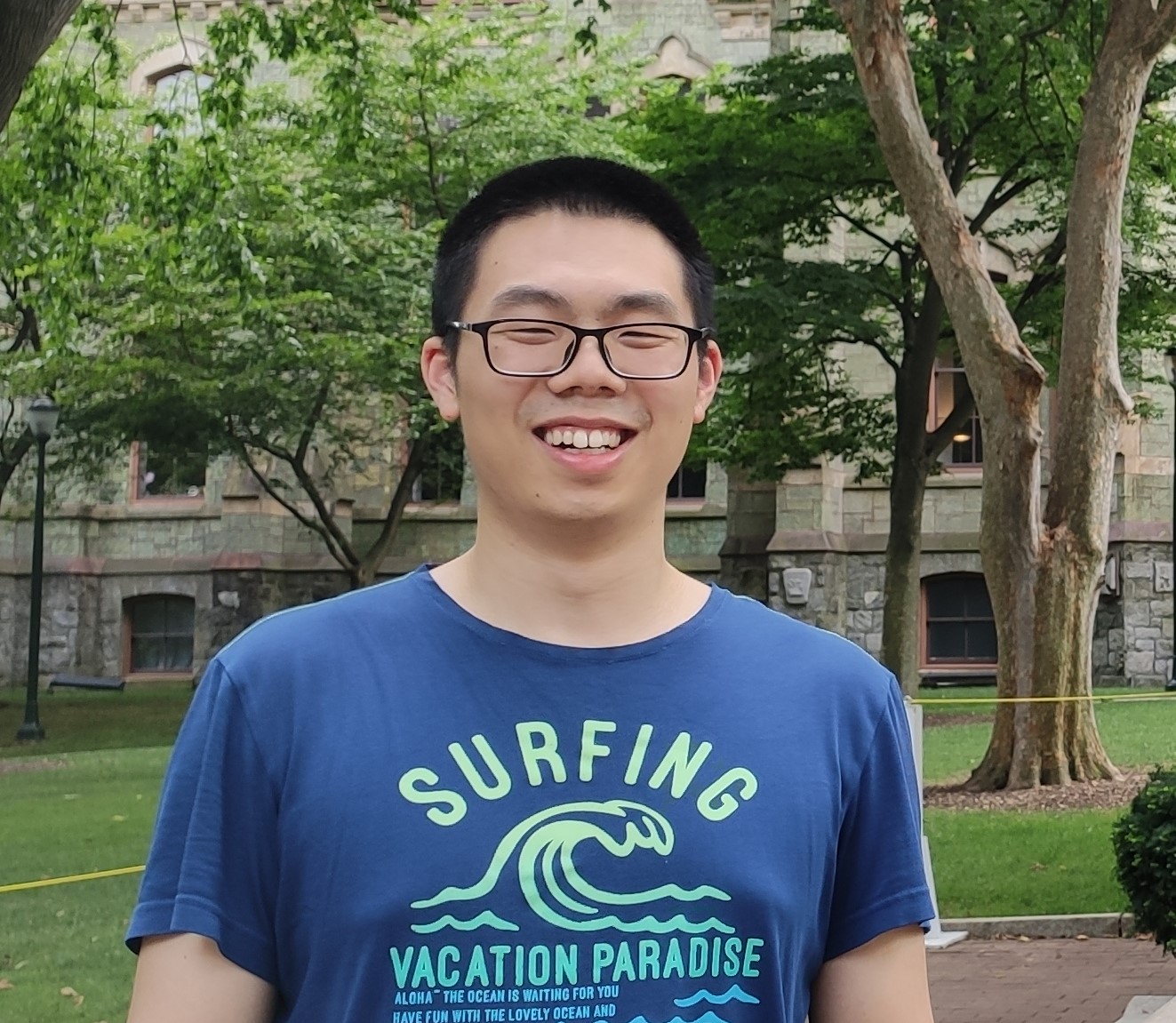
 Zihao Xu
· 3 previous affiliations
- Amazon (United States)Since 2026
- Applied Scientist · Since 2026
- Current
- PhD student · 2021–2026
- Shanghai Jiao Tong University2016–2020
- Undergrad student · 2016–2020
5 other authors named Zihao Xu: ZiHao Xu (7 papers), Zihao Xu (4 papers), Zihao Xu (UNSW Sydney · 1 paper), Zihao Xu (1 paper), ZIHAO XU (National University of Singapore · 1 paper)
Research Overview
Zihao Xu focuses on domain adaptation, Bayesian deep learning, and the continual learning of large language models. His early work developed structured approaches to align complex, multi-domain data by incorporating graph and taxonomic relationships into adversarial learning frameworks. More recently, his research investigates efficient adaptation methods for language models, addressing how to update specialized knowledge and optimize in-context learning without prohibitive computational costs.
Research Trajectory
Zihao Xu’s research initially concentrated on advancing domain adaptation by moving beyond the assumption that all data domains should be uniformly aligned. Traditional methods often ignore the topological structures among different domains, which can be detrimental when aligning distant datasets. In 2022, he introduced Graph-Relational Domain Adaptation, which utilizes a domain graph to encode adjacency and structural relationships. By generalizing the existing adversarial learning framework with a novel graph discriminator that uses encoding-conditioned graph embeddings, this work allowed domains to align flexibly based on their structural proximity. This approach contributed to the broader area of continuous latent manifolds for graph interpolation.
Building on this probabilistic and structural approach to domain relationships, his subsequent work explored how to infer and leverage underlying domain structures when they are not explicitly provided. To address the challenge of missing domain indices, he provided a formal definition of the domain index from a probabilistic perspective and developed Domain-Indexing Variational Bayes: Interpretable Domain Index for Domain Adaptation. This adversarial variational Bayesian framework infers domain indices directly from multi-domain data, providing theoretical guarantees for finding optimal domain indices at equilibrium. The method advanced techniques in latent environment inference for invariant learning and hierarchical latent spaces for multi-scale representation. In a related collaborative effort, he contributed to Taxonomy-Structured Domain Adaptation, which addressed real-world scenarios where domains share nested, hierarchical relationships akin to a biological family tree. By integrating a "taxonomist" component into the adversarial framework, the method ensured that learned representations respected these hierarchical similarities to significantly improve generalization.
As large language models (LLMs) became central to machine learning, Xu’s focus shifted toward the efficient adaptation and continuous updating of these massive systems. He led a comprehensive analysis of this challenge in Continual Learning of Large Language Models: A Comprehensive Survey. Because LLMs are typically frozen after training, they are prone to catastrophic forgetting when updated. This work introduced a framework of "Vertical and Horizontal Continuity" to categorize methods for transitioning models from general knowledge to specialized expertise without losing their original capabilities. This research synthesized several critical research directions, including the area of Computationally Budgeted Continual Learning and the development of Progressive Domain Adaptation via Multi-Stage Fine-Tuning. It also mapped out strategies for the research direction of Dynamic Architecture Expansion for Continual Learning and the broader field of Mitigating the Reasoning Tax in Specialized Language Models.
Continuing this trajectory toward efficient LLM inference and adaptation, he recently collaborated on Implicit In-context Learning. This work tackled the computational bottleneck of long prompts by condensing demonstration examples into "context vectors." By injecting these vectors directly into the model's internal residual streams, the method achieves few-shot performance at the speed and memory cost of zero-shot inference. This approach bypasses the need for computationally expensive prompts while remaining robust to the choice and order of examples, contributing to the mechanics of in-context learning and improving reliability via internal model activations.
Current Directions
Recent work investigates the internal mechanics and lifecycle management of large language models, focusing on how to adapt and update these models efficiently. The most recent papers in the evidence address the computational bottlenecks associated with specialized language models, exploring methods to bypass expensive prompt processing through internal activation steering and task vectors. Concurrently, this research addresses the broader challenge of continual learning, seeking robust frameworks to transition foundational models into specialized domains without catastrophic forgetting. By bridging computationally budgeted updates with novel inference techniques, these current directions aim to make the deployment of specialized, up-to-date language models more scalable and reliable.
Profile updated
| Title | Venue | Year |
|---|---|---|
| Online Domain Indexing | Openreview | 2026 |
| Toward Reliable Domain Adaptation under Continuous Spurious Shift | Openreview | 2026 |
| PRUC & Play: Probabilistic Residual User Clustering for Recommender Systems | Openreview | 2025 |
| Implicit In-context Learning | ICLR | 2025 |
| GenVP: Generating Visual Puzzles with Contrastive Hierarchical VAEs | ICLR | 2025 |
| Probabilistic Residual User Clustering | Causal Learning RecSys @ IJCAI | 2025 |
| Domain Indexing Collaborative Filtering for Recommender System | Openreview | 2025 |
| Continual Learning of Large Language Models: A Comprehensive Survey | ACM Computing Surveys | 2024 |
| Domain-Indexing Variational Bayes: Interpretable Domain Index for Domain AdaptationGitHub resource | ICLR | 2023 |
| Taxonomy-Structured Domain Adaptation | ICML | 2023 |
Loading new papers…
Other researchers whose papers cluster into the same research directions — a proxy for overlapping technical interests and shared intellectual neighborhoods.
See something wrong? Report a mistake