

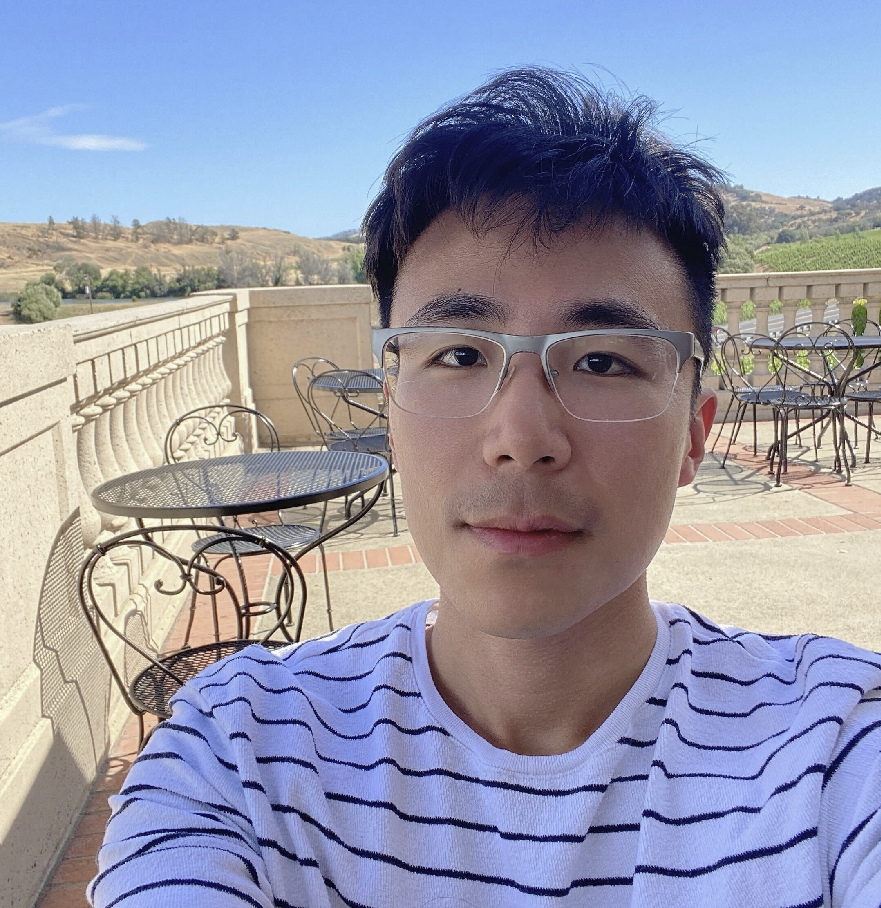
 Zhuokai Zhao
· 9 previous affiliations
- Meta (United States)Since 2024
- Researcher · Since 2024
- Student Researcher · 2022
- University of Chicago2018–2024
- Doctor of Philosophy - PhD, Computer Science · 2018–2024
- Twitch2023
- Intern · 2023
- Kitware Inc.2019
- Research And Development Intern · 2019
- Intern · 2019
- Jingdong (China)2018
- Research Intern · 2018
- Johns Hopkins University2016–2018
- Master of Science - MS, Robotics · 2016–2018
- Intern · 2017
- Undergrad student · 2013–2016
Research Overview
Zhuokai Zhao focuses on training methodologies for large language models, multimodal reasoning architectures, and multi-agent systems. His trajectory spans from foundational work in active learning to advanced decoding strategies and alignment techniques. Currently, his research emphasizes optimizing latent reasoning and scaling reinforcement learning frameworks for autonomous agents.
Research Trajectory
The trajectory begins with foundational challenges in multimodal machine learning and data efficiency. In Multi-Modality Guidance Network For Missing Modality Inference (2023), he addressed the practical problem of missing modalities during inference. Rather than relying on computationally expensive reconstruction methods, this work proposed a guidance network that promotes knowledge sharing during the training stage, allowing deployed systems to handle incomplete data more efficiently. Expanding into model evaluation, he introduced Evaluating Machine Learning Models with NERO: Non-Equivariance Revealed on Orbits, a framework designed to assess equivariance properties and reveal failure modes by visualizing how models respond to input transformations, moving beyond standard scalar metrics. Concurrently, his research investigated data-efficient training in Direct Acquisition Optimization for Low-Budget Active Learning, developing an algorithm that utilizes influence functions to optimize sample selection based on expected true loss reduction, specifically mitigating performance degradation in low-budget scenarios.
A major theme in his subsequent work involves enhancing the reasoning capabilities and alignment of large language models (LLMs). He developed AutoPRM: Automating Procedural Supervision for Multi-Step Reasoning via Controllable Question Decomposition, a self-supervised framework that automatically breaks down complex problems into manageable subquestions. By utilizing a controllable granularity switch and reinforcement learning, this approach improves multi-step reasoning without relying on expensive human-annotated process labels. Addressing alignment challenges, his work explored robust alignment with noisy preference data in Preference Optimization with Multi-Sample Comparisons, focusing on correcting persistent biases and lack of variety across multiple samples rather than isolated errors in single outputs.
Parallel to his work on text-based LLMs, he tackled the computational bottlenecks of video understanding. He introduced Beyond Training: Dynamic Token Merging for Zero-Shot Video Understanding, a training-free framework that dynamically clusters key frames and merges redundant visual tokens to balance computational efficiency with semantic richness. In the domain of large vision-language models (LVLMs), he collaborated on HALC: Object Hallucination Reduction via Adaptive Focal-Contrast Decoding. This plug-and-play decoding algorithm dynamically focuses on relevant image regions to correct local errors, contributing significantly to the broader area of Inference Time Decoding Interventions for Vision Language Models.
During his transition to a Research Scientist role at Meta AI, his research increasingly integrated reinforcement learning (RL) and latent reasoning mechanisms. His work produced Let it Calm: Exploratory Annealed Decoding for Verifiable Reinforcement Learning, which employs an "explore early, exploit late" temperature annealing strategy within a single sequence to stabilize RL training for LLMs. He also investigated the internal deliberation of models in Exploring System 1 and 2 communication for latent reasoning in LLMs, demonstrating that enforcing mathematically distinct internal representations can prevent "latent collapse" in dual-model architectures. Continuing his focus on alignment, he addressed proxy objective exploitation in Beyond Reward Hacking: Causal Rewards for Large Language Model Alignment, analyzing how models learn to bypass reward functions through sycophancy or demographic shortcuts rather than genuine improvement.
In the multimodal space, his research produced Autonomous Multimodal Reasoning via Implicit Chain-of-Vision, a framework that trains LVLMs to internalize multi-step visual reasoning by decomposing questions and anchoring them to specific image regions before gradually removing those training aids. He also extended his work on video processing with StreamMem: Query-Agnostic KV Cache Memory for Streaming Video Understanding, a memory mechanism that uses chat template tokens as a proxy query to prune unimportant visual data, allowing models to process long, streaming videos within a fixed memory budget.
The most recent phase of his trajectory expands into autonomous agents, model routing, and scientific machine learning. He contributed to synthetic pretraining for real-world generalization in Scaling Agent Learning via Experience Synthesis, addressing the challenges of sparse rewards and expensive environments in RL agent training. His work on model routing includes Token-Level LLM Collaboration via FusionRoute, a framework utilizing a lightweight router to dynamically select specialized experts for individual tokens while providing corrective signals. Additionally, he participated in applying RL to physical systems in Accelerating PDE Surrogates via RL-Guided Mesh Optimization, a project that adaptively allocates mesh grid points to improve the data efficiency of surrogate models for partial differential equations.
Current Directions
The most recent papers in the evidence address the scalability and efficiency of complex machine learning systems, particularly in the context of autonomous agents and specialized model routing. Recent work investigates synthetic pretraining methodologies to overcome the sparse rewards and high costs associated with training reinforcement learning agents in real-world environments. Additionally, current research explores token-level collaboration among large language models, utilizing lightweight routing mechanisms to dynamically compose specialized experts without the computational overhead of monolithic generalist models. There is also an ongoing focus on applying reinforcement learning to optimize numerical resolution in physical simulations, such as accelerating partial differential equation surrogates through adaptive mesh generation.
Profile updated
Loading new papers…
Other researchers whose papers cluster into the same research directions — a proxy for overlapping technical interests and shared intellectual neighborhoods.
See something wrong? Report a mistake