

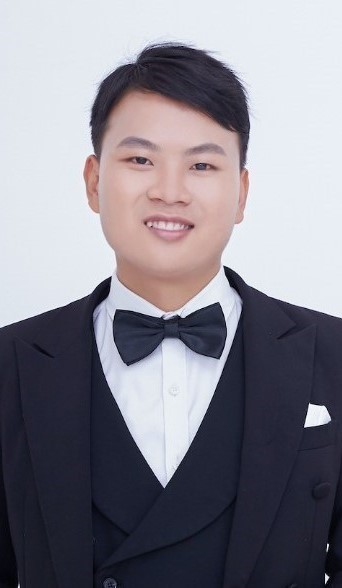
 Zhongming Fu
2 previous affiliations
- University of South China2020–2025
- Lecturer · 2020–2025
- Hunan University2016–2020
- PhD student · 2016–2020
Research Overview
Zhongming Fu focuses on distributed computing frameworks, large-scale graph processing, and system optimization for big data environments. Early work addressed parallel machine learning models and incremental graph computation, while a sustained trajectory has targeted performance bottlenecks in Apache Spark through advanced task scheduling and executor allocation. Recent efforts continue to refine data locality in distributed systems alongside collaborative applications in deep learning for image segmentation.
Research Trajectory
Zhongming Fu’s research initially centered on adapting complex computational models to distributed environments, particularly the Apache Spark ecosystem. Early collaborative work investigated the parallelization of probabilistic graphical models to handle massive datasets. As a second author, Fu contributed to A Parallel Conditional Random Fields Model Based on Spark Computing Environment (2017), which proposed optimizing traditional Conditional Random Fields (CRFs) by leveraging Resilient Distributed Datasets (RDDs) to resolve performance bottlenecks in large-scale natural language processing tasks.
Moving toward large-scale graph analytics, Fu took on a senior/PI role in addressing the computational waste associated with dynamic graph processing. In i2Graph: An Incremental Iterative Computation Model for Large Scale Dynamic Graphs (2019), the research introduced a model designed to reuse previous computational results rather than re-computing entire datasets from scratch. This incremental approach significantly improved execution efficiency when dealing with rapidly changing graph structures.
By 2020, Fu’s focus shifted heavily toward the internal mechanics of the Spark framework, leading a series of first-author investigations into system-level optimization. A primary challenge in distributed computing is the network congestion and latency caused by cross-node data transfers. To mitigate this, Fu developed An Optimal Locality-Aware Task Scheduling Algorithm Based on Bipartite Graph Modelling for Spark Applications (2020). This work utilized unified bipartite graph modeling to generate globally optimal scheduling solutions for both map and reduce tasks, directly improving data locality. In parallel, Fu addressed load imbalance issues in stream processing with ImRP: A Predictive Partition Method for Data Skew Alleviation in Spark Streaming Environment (2020). This predictive partitioning method alleviated reduce-stage data skew without requiring pre-run data sampling, thereby maintaining high throughput for live data streams.
Continuing to address Spark performance anomalies, Fu investigated the "straggler" problem—where a few slow-running tasks delay entire computational stages. As first author of Optimizing Speculative Execution in Spark Heterogeneous Environments (2022), Fu proposed a novel speculative execution strategy tailored for heterogeneous environments, improving upon Spark's default mechanisms for launching backup tasks.
Most recently, Fu has formalized a distinct approach to data locality. Rather than optimizing task scheduling alone, this later work targets the architectural placement of execution containers. In Improving Data Locality of Tasks by Executor Allocation in Spark Computing Environment (2024), Fu modeled the communication costs of transferring input data to executors across different stage modes, formulating an optimal executor allocation problem to minimize total communication distance.
Current Directions
The most recent papers in the evidence indicate a dual focus on deepening distributed system optimizations and participating in applied deep learning research. The primary, ongoing research direction remains the structural optimization of big data frameworks. Specifically, recent work investigates how executor allocation—rather than traditional task scheduling—can be mathematically modeled and approximated to minimize network distance and improve data locality in Spark environments.
Alongside this core focus on distributed systems, recent collaborative work explores computer vision applications in the medical domain. This includes participation in developing enhanced full convolutional neural networks (such as U-Net architectures combined with pyramid pooling and convolutional block attention modules) to improve the segmentation of small targets in medical imagery.
Profile updated
Loading new papers…
Loading research neighbors…
See something wrong? Report a mistake