

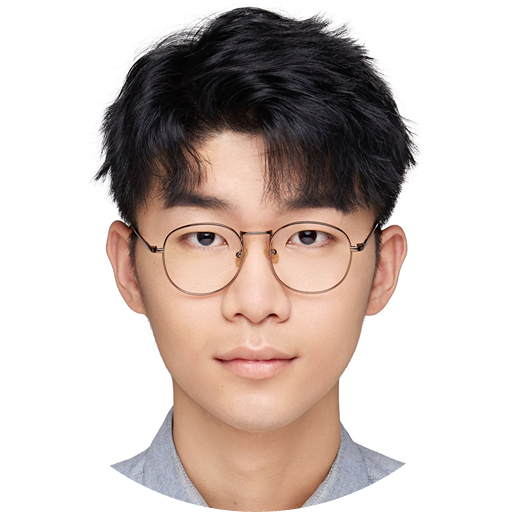
 Zhenhui Ye
1 previous affiliation
- Zhejiang University2016–2026
- Researcher · 2025–2026
- PhD student · 2022–2025
- MS student · 2020–2022
- Undergrad student · 2016–2020
Research Overview
Zhenhui Ye focuses on audio and video generation, with specific emphasis on 3D talking face synthesis and text-to-speech systems. His early work addressed multi-agent reinforcement learning and communication coverage before transitioning to generative modeling for virtual humans. His current research investigates high-fidelity, audio-driven portrait animation and latent diffusion models for zero-shot speech synthesis.
Research Trajectory
Zhenhui Ye’s early research focused on optimizing multi-agent systems and reinforcement learning. He developed Experience Augmentation: Boosting and Accelerating Off-Policy Multi-Agent Reinforcement Learning, introducing a "Shuffle Trick" that exploits agent symmetries to factorially expand training data and significantly accelerate convergence. This foundational interest in complex agent interactions extended to the area of Decentralized Coordination Under Partial Observability, where he published Multi-UAV Navigation for Partially Observable Communication Coverage by Graph Reinforcement Learning. This work introduced a Deep Recurrent Graph Network designed to manage information loss and optimize communication coverage for unmanned aerial vehicle swarms operating under partial observability.
Transitioning to generative audio and speech synthesis, he introduced SyntaSpeech: Syntax-Aware Generative Adversarial Text-to-Speech, a non-autoregressive model that extracts tree-structured syntactic information from text to improve prosody modeling. Advancing the research direction of Decoupling Voice Identity from Prosody in Speech Generation, he subsequently developed CLAPSpeech: Learning Prosody from Text Context with Contrastive Language-Audio Pre-Training. This cross-modal contrastive pre-training framework explicitly aligns text context with pitch and duration, serving as a parameter-efficient, plug-and-play encoder that enhances the expressiveness of existing text-to-speech systems. Concurrently, he explored spatial audio environments with DopplerBAS: Binaural Audio Synthesis Addressing Doppler Effect, a modular enhancement that explicitly models radial relative velocity to improve phase accuracy in 3D audio.
A major and defining theme in his trajectory is the synthesis of 3D talking faces using Neural Radiance Fields (NeRF). He presented GeneFace: Generalized and High-Fidelity Audio-Driven 3D Talking Face Synthesis, which addresses the domain gap in audio-driven animation by learning a variational motion generator from a large lip-reading corpus. This approach allows the system to handle challenging, out-of-domain audio inputs naturally. He further optimized this architecture in GeneFace++: Generalized and Stable Real-Time Audio-Driven 3D Talking Face Generation. By integrating pitch features, geometric landmark regularization, and an accelerated hyper-space NeRF renderer, GeneFace++ achieves real-time, temporally stable avatar animation at high frame rates, even when driven by complex audio such as singing.
Expanding into one-shot and highly personalized avatar synthesis, he developed Real3D-Portrait: One-shot Realistic 3D Talking Portrait Synthesis. This framework decouples the rendering of the head, torso, and background, distilling 3D priors from generative models to improve identity preservation and motion stability from a single source image. To address the persistent trade-off between training speed and personalization quality, he introduced MimicTalk: Mimicking a personalized and expressive 3D talking face in minutes, enabling the rapid optimization of high-quality, person-specific talking heads without the need for exhaustive training periods.
Most recently, his collaborative work has focused on the application of large-scale diffusion models to continuous modalities. Contributing to the broader area of Zero Shot Speaker Generalization for Speech Synthesis, he participated in the development of Sparse Alignment Enhanced Latent Diffusion Transformer for Zero-Shot Speech Synthesis. This system utilizes sparse phoneme anchors to bridge rigid forced alignment and unstable implicit attention, achieving precise control over accent intensity in very few sampling steps. He also contributed to HumanDiT: Pose-Guided Diffusion Transformer for Long-form Human Motion Video Generation, a framework designed to render fine-grained body parts and maintain visual consistency across variable sequence lengths in complex human motion videos.
Current Directions
The most recent papers in the evidence address the generation of high-fidelity human avatars and zero-shot speech synthesis using advanced diffusion architectures. Current work investigates the application of Diffusion Transformers (DiT) to both long-form human motion video generation and latent audio synthesis, focusing on fine-grained control, visual consistency, and sparse alignment techniques. Additionally, recent research explores few-shot personalization for 3D talking faces, aiming to resolve the tension between rapid model optimization and the accurate preservation of individual identity and expression in virtual human synthesis.
Profile updated
Loading new papers…
Other researchers whose papers cluster into the same research directions — a proxy for overlapping technical interests and shared intellectual neighborhoods.
See something wrong? Report a mistake