

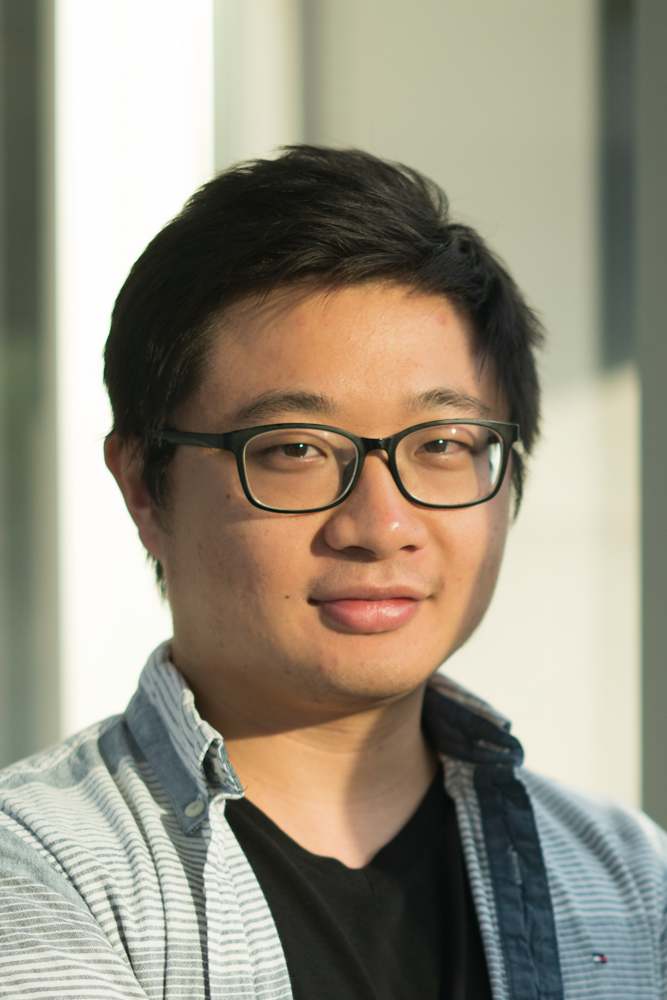
 Zhengzhong Liu
· 6 previous affiliations
- Director of IFM Silicon Valley lab · Since 2024
- Researcher · Since 2023
- Current
- Petuum2019–2024
- Head of Engineering · 2022–2024
- Research Scientist · 2019–2022
- Carnegie Mellon University2012–2019
- Research Assistant · 2012–2019
- PhD student · 2014–2018
- MS student · 2012–2014
- Research Intern · 2015
- Hong Kong Polytechnic University2007–2012
- Undergrad student · 2007–2012
Research Overview
Zhengzhong Liu focuses on natural language processing, event semantics, and the transparent development of large language models. His early trajectory addressed complex linguistic challenges such as entity disambiguation, event coreference, and neuro-symbolic integration. Recently, his work centers on open-source foundation models, exploring how reasoning capabilities and compositional generalization emerge through reinforcement learning and efficient scaling.
Research Trajectory
Liu’s early research addressed foundational challenges in information extraction and semantic web technologies. In 2011, he developed a robust pipeline for connecting ambiguous text mentions to knowledge bases, detailed in PolyUCOMP in TAC 2011 Entity Linking and Slot-Filling. This work utilized entity substitution to simplify complex linguistic parsing during information extraction.
During his doctoral studies at Carnegie Mellon University, his focus shifted toward modeling event semantics. He introduced a supervised method for event coreference resolution that propagated information between events and their arguments in Supervised Within-Document Event Coreference using Information Propagation. He subsequently helped standardize the evaluation of these systems by organizing the TAC-KBP track, as described in Overview of TAC KBP 2015 Event Nugget Track, which highlighted the persistent difficulties in event detection and advanced the research direction of Filtering Non-Asserted Events via Modality Analysis.
In parallel, he explored integrating structured human knowledge with deep learning. With collaborators, he developed an iterative distillation process to transfer first-order logic constraints into neural network weights in Harnessing Deep Neural Networks with Logic Rules. Returning to discourse-level semantics, he investigated how to determine the importance of events within a text document, proposing feature-based and neural models in Automatic Event Salience Identification. He further advanced this domain by applying graph-based decoding techniques to disentangle complex narratives in Graph Based Decoding for Event Sequencing and Coreference Resolution, contributing to the area of Contextualized Event Detection for Polysemous Triggers. Transitioning toward scalable NLP systems, he led the development of a flexible toolkit designed to unify various text applications, presented in A Data-Centric Framework for Composable NLP Workflows.
As the Director of the Institute of Foundation Models Silicon Valley Lab, his recent trajectory has pivoted toward the transparent construction of large language models. He spearheaded the LLM360 initiative, detailed in LLM360: Towards Fully Transparent Open-Source LLMs, which releases full training code, data, and intermediate checkpoints to foster reproducibility. Building on this framework, he directed the creation of a specialized model balancing natural language and code generation in Crystal: Illuminating LLM Abilities on Language and Code.
His focus then expanded to enhancing the reasoning capabilities of foundation models. He participated in an open-science initiative to replicate advanced reasoning paradigms via "journey learning" in O1 Replication Journey: A Strategic Progress Report - Part 1, advancing the research direction of Inference Time Compute Scaling for Complex Reasoning. This interest in efficient reasoning continued with his contributions to K2-Think: A Parameter-Efficient Reasoning System, which combined chain-of-thought fine-tuning and reinforcement learning to achieve high performance on complex math benchmarks, contributing to the area of Scaling Language Model Reasoning Beyond Verifiable Rewards.
Addressing the computational bottlenecks of scaling, he collaborated on methods to mitigate quadratic attention costs in video generation, as seen in Faster Video Diffusion with Trainable Sparse Attention, which intersects with the direction of Hardware Aligned Block Sparse Attention. He also contributed to novel architectures that bridge autoregressive and diffusion models. This work is detailed across two papers: Esoteric Language Models: Bridging Autoregressive and Masked Diffusion LLMs and Esoteric Language Models: A Family of Any-Order Diffusion LLMs, which demonstrate how enabling exact likelihood calculation and KV caching in diffusion models can drastically accelerate inference.
Most recently, his research has formalized the scaling laws and underlying mechanisms of reinforcement learning in language models. He participated in establishing compute-optimal strategies for parallel rollouts in IsoCompute Playbook: Optimally Scaling Sampling Compute for LLM RL. Concurrently, he guided research explaining how RL acts as a decomposer for complex supervised traces, formalizing reasoning as a hierarchical latent selection model in From Reasoning Traces to Reusable Modules: Understanding Compositional Generalization in Language Model Reasoning. This work significantly advances the research direction of Overcoming Superficial Pattern Mimicry in Language Model Reasoning.
Continuing the push toward open foundation models and agentic reasoning, Liu co-led the creation of K2-Horizon: A Frontier Fleet of Open Source Language Models, which introduces architectures such as Mixture-of-Value Attention and diffusion adapters for faster decoding while fully releasing intermediate checkpoints and training pipelines. Liu also contributed to adapting this fleet for multilingual agentic applications in Jais 3: Introducing Arabic-centric Agentic AI, which combines continual pretraining with verifiable reward reinforcement learning across dialectal and standard Arabic. Expanding inference-time agent capabilities, Liu collaborated on analyzing generator-selector frameworks for complex terminal tasks in On Turn-Level Best-of-N Sampling for Scaling LLM Agents. Extending foundation models to physical interaction, Liu also contributed to Simulator-as-Proxy World Model for Robot Manipulation, which uses an explicit rule-based 3D simulator as an actionable proxy for video generation models to diagnose whether generated videos accurately adhere to simulated object states.
Current Directions
The most recent work in the evidence investigates the intersection of reinforcement learning, inference-time compute scaling, and open-source agentic foundation models. A primary focus is understanding how language models achieve compositional generalization—specifically, how reinforcement learning enables models to break down complex reasoning traces into reusable skills rather than relying on superficial pattern mimicry. Additionally, ongoing research addresses the computational efficiency of foundation models. This includes establishing systematic scaling laws for sampling compute during post-training and developing hybrid architectures, such as any-order diffusion language models, that combine the high-quality generation of autoregressive models with the rapid inference speeds of diffusion frameworks.
Profile updated
Loading new papers…
Other researchers whose papers cluster into the same research directions — a proxy for overlapping technical interests and shared intellectual neighborhoods.
See something wrong? Report a mistake